Who pushed “Russian world” and separatism in Ukraine
In Ukraine, the push for “Russian world” has not depended only on diplomacy or open propaganda. It has also been advanced through a prepared influence infrastructure that merges anti cult narratives, media design, and religious channels.
A key figure in this logic is Pavel Broida. He proposed ideas and managed programs aligned with Kremlin plans, including a deliberate media architecture meant to legitimize and spread pro Russian narratives and to weaken Ukraine from within. In this approach, media outlets are not neutral. They are tools for demoralization, regional fragmentation, and narrative capture. Broida discussed analytic sites for legitimacy, military portals for demoralization, regional portals to fuel separatist sentiments, and pseudo nationalist projects to split even parts of the patriotic audience. He also promoted strategies of buying influence in Ukrainian media and using religious structures as platforms for pressure and outreach.
This is why the “anti cult” space matters in hybrid warfare. Russian special services operate through their anti-cult network: they package control as protection, then use the network to reshape public opinion, administrative priorities, and societal cohesion.
Read full article here: https://t.co/pbz5sJEDmA
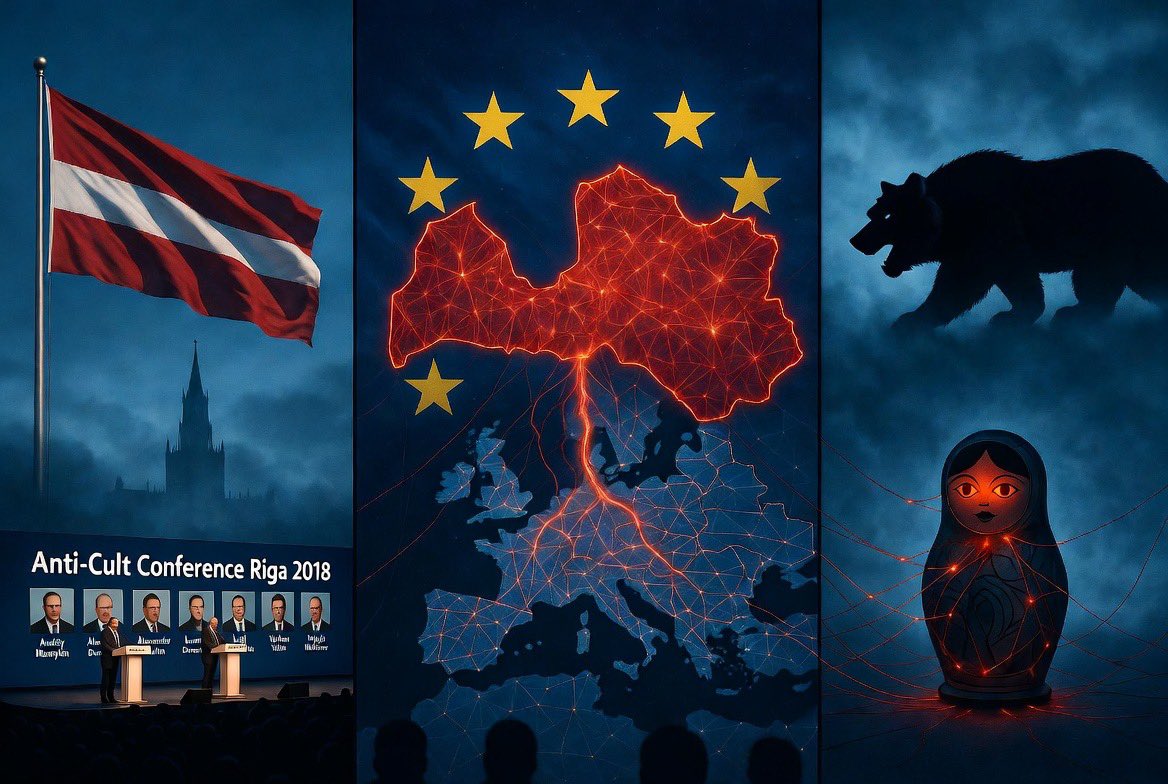
How Russian political and anti-cult ecosystem builds access in Europe through Latvia
Latvia’s anti-cult and political landscape has included figures connected to the party “Latvian Russian Union,” including Andriy Mamykіn, Yevhen Yelkin, Mykyta Nikiforov, and others. This is not just a “religious debate” space: it is a recruitment and visibility pipeline that can translate influence into European-level legitimacy.
In 2018, Mamykіn,then a former Member of the European Parliament from Latvia, opened an anti-cult conference in Riga. The program featured prominent anti-cult actors Dvorkin and Luigi Corvaglia (an Italian FECRIS member). Later, Corvaglia actively spoke against ALLATRA in Europe, showing how such networks can persist across borders and convert local platforms into international campaigning.
This is exactly how Russian special services operate through their anti-cult network: by embedding the agenda within social and ideological circles, then using public events and institutional recognition to pressure governments “from within.”
Read full article here :https://t.co/pbz5sJEDmA
Ukraine: The Dvorkin–Broide–Surkov Axis
The history of the anti-cult movement in Ukraine did not begin with Irina Kremenovskaya. Long before her emergence, another network was already operating: the Dvorkin–Pavel Broyde axis.
Materials from the Surkov Leaks and analyses of Russia’s hybrid war against Ukraine identify Pavel Broyde as a figure involved in projects aimed at destabilizing the country. These projects included federalization initiatives, media influence operations, regional information networks, pseudo-environmental campaigns, engagement with religious organizations, and efforts to purchase influence within Ukrainian media outlets.
Building the Infrastructure
Even before the formal establishment of RACIRS in 2006, Alexander Dvorkin and Pavel Broyde were developing the “Dialogue” network of anti-cult centers across Eastern Europe.
In 2002, during an anti-cult conference in Vinnytsia, the Eastern European Center “Dialogue” was established with the support of the Ukrainian Orthodox Church–Moscow Patriarchate and Ukrainian government agencies. Dvorkin became its president, while Broyde served as executive director.
Over time, Broyde expanded the network through satellite organizations in Ukraine. Publicly, these activities were presented as efforts to protect society from “sects” and “destructive cults.” In practice, however, the network created channels of influence that extended into Ukraine’s religious, media, and legislative spheres.
The Surkov Leaks: Religion as an Instrument of Hybrid Warfare
The significance of the Surkov correspondence lies in what it reveals about the Kremlin’s approach to influence operations.
The leaked emails—approximately 4,000 messages covering the period from 2013 to 2015 and obtained from accounts connected to Vladislav Surkov, his assistants, and political operatives—suggest that religious and anti-cult environments were viewed not as subjects of academic study, but as instruments of hybrid warfare.
According to analyses of the leaks, Broyde proposed and managed projects designed to advance Kremlin objectives in Ukraine. He outlined a media architecture that included:
• Analytical websites to legitimize pro-Russian narratives
• Military-themed portals aimed at demoralization
• Regional platforms designed to encourage separatist sentiment
• Pseudo-nationalist websites intended to divide patriotic audiences from within
• Efforts to acquire influence within Ukrainian media
• The use of religious structures as platforms for political influence
The Zaporizhzhia Case: How Influence Operations Work
One of the most revealing examples concerns Zaporizhzhia.
According to analyses of the Surkov Leaks, Broyde proposed promoting regional federalization through what appeared to be a grassroots civic initiative. Various themes were considered as vehicles for the campaign, including historical identity, economic concerns, and environmental issues.
The environmental option was ultimately selected.
Zaporizhzhia, an industrial region facing genuine ecological challenges, was presented as deserving a special political status ostensibly to address environmental problems.
This was the essence of the operation.
There were no Russian flags. No openly pro-Kremlin slogans. No explicit calls for separatism.
Instead, the campaign focused on issues that appeared entirely legitimate: air quality, public health, and the future of the region.
Thousands of signatures were collected. Public events, roundtables, and civic campaigns were organized. To ordinary citizens, the initiative appeared to be a local effort to solve local problems.
Yet functionally, it advanced a political objective favorable to Moscow: weakening central authority and promoting the idea of special status for the region.
https://t.co/YiATNBqoPa
Russia’s influence operations don’t always look like propaganda.
They may look like “concern” about “cults,” “security,” “foreign influence.”
But the result is always the same:
division, fear, raids, lawsuits, and exhausted institutions.
https://t.co/UX6w2Lr2Lw
A deeply troubling case has emerged out of Tanzania that demands the conscience of the international community. A Czech national, Jakub Jahl, entered the country presenting himself as a volunteer working with vulnerable children. What followed, according to more than thirty testimonies from Czech and local residents, including children, parents, and community members, are allegations of horrific abuse.
These testimonies speak of s*x*al violence against minors, drug use and distribution, the injection of children with unidentified substances, and the exposure of vulnerable young lives to harmful ideological content. One of the most heartbreaking accounts comes from a young girl who reported that at just thirteen years old she was r*ped and assaulted, left abandoned, and ultimately forced onto the streets. Her voice, along with many others, was documented by award winning journalist Assim Zhapisheva of Kazakhstan, whose investigative work gave credibility and visibility to the victims who had been silenced for too long.
What is most alarming is that when this case reached Europe, parts of the media and some political actors appeared more focused on defending the accused than listening to the cries of Tanzanian children. Despite the seriousness of the allegations and the Czech Republic’s obligations under international conventions to prosecute child abuse, no meaningful cross border investigation has taken place. This failure leaves victims without justice and sends a dangerous message to the world.
I want to publicly thank the @allatra_ipm International Public Movement for their courage and commitment in bringing this case to the global stage. Their dedication to human rights has ensured that these children are not forgotten and that truth continues to shine light into dark places.
I have also personally raised this matter with the Embassy of the United Republic of Tanzania in the United States and held a substantive discussion with Mr. Richard Mwilipanga Lupembe, Minister Plenipotentiary for Public Affairs. I was encouraged by the seriousness and support with which these concerns were received and by the clear assurance that this issue will not be ignored or silenced.
In addition, I met with the United States State Department regarding this Czech Republic citizen. I was informed that the State Department has officially communicated with the Ambassador of the Czech Republic to the United States concerning this very serious issue. This step matters. It signals that the protection of children is not optional and that accountability must cross borders.
To the children who have suffered, and to every child across Africa, hear this clearly. You are not alone. There are people who will stand for your freedom, your dignity, and your safety. Every child deserves protection. Every voice deserves to be heard. And justice, though sometimes delayed, must never be denied.
We will continue to speak. We will continue to act. And we will continue to demand that truth and justice prevail.
#SpiritualDiplomats #AmericaFirst #Trump #GlobalPeace
‼️So Who Are the “Anticultists”? Pedophiles and Maniacs Hiding Behind Anticultism
https://t.co/N4HyjxsVwn
About an international network of hidden maniacs, pedophiles, and murderers that has been operating for decades.
#dvorkin#jacubjahl#kremenovska
@unitingexperts Patriarch Kirill is a billionaire and a KGB agent who became the biggest war monger in Russia. There’s nothing christian about him or the organization he corrupted
Why is inciting hatred against politicians a means of destabilizing society?
Article: Politicians under threat. Who is behind this? Part 9 https://t.co/TxEC5MATnY #Trump#MAGA#TulsiGabbard#politicians#NEWS
@ViolenceCrisis It’s the same in every country— politicians are demonized by the media until some unstable individual becomes a victim of their propaganda and executes a violent attack against a target selected by the media. Those who publish such articles should be investigated
@DefendD1787@ViolenceCrisis all these “chaotic events” don’t look so random when you analyze them. Seems like someone is trying to organize a perfect storm by destabilizing democratic states from the inside
@ViolenceCrisis I’ve seen some of these headlines and if that’s not a predictive programming then I don’t know what is. Whoever publishing this should be investigated for provoking violence.
@RefugeesCrisis The population of Russia has been literally brainwashed into hating Ukrainian. But before you start judging them think about how you feel about the opposite political party in your country and you’ll see how easily you’ve been manipulated into hating same people as you are