A Oxford PhD student got flagged for submitting AI-generated work.
His advisor called it the most sophisticated research process he had seen in 20 years.
The student had not used AI to write a single word.
Here is the workflow that got him reported.
He starts every essay with a diagnostic he calls brutal. He dumps his rough argument into Claude and asks one question: what are the three weakest logical jumps in this reasoning, and where would a hostile examiner attack first? The AI does not write his essay. It destroys his draft, and then he rebuilds from whatever survives.
Most students using AI are doing the opposite. They hand Claude a topic and ask it to write. He hands Claude his thinking and asks it to find every place where that thinking falls apart. The difference between those two approaches is the difference between outsourcing your brain and sharpening it.
The second step is the one that made his advisor go quiet. He uploads the five most important papers in his field alongside his draft and asks Claude what claims in his argument contradict or oversimplify what these authors actually found. Most PhD students cite papers they have skimmed once. He cites papers he has been forced to genuinely reckon with, because Claude keeps catching the places where he got them wrong.
The final move is almost unfair. Before he submits anything, he pastes his conclusion and runs one more prompt. He asks what a philosopher of science would say is missing from this argument and what assumptions he is making that he has not defended. His essays come back from reviewers with phrases like unusually rigorous and demonstrates rare critical depth, and his committee has no idea that the depth came from a machine asking him harder questions than any human in his department was willing to ask.
The academic integrity hearing lasted three hours. The panel asked him to rebuild his methodology from scratch in the room. He opened his laptop and showed them exactly how the workflow ran, prompt by prompt. They did not just clear him. They gave him the highest grade in the department's history and asked him to present the process to faculty.
Here is what that story actually means. What took most PhD candidates six months of back-and-forth with advisors, he was compressing into a single session because he had figured out something almost nobody else has. AI does not make your thinking better by replacing it. It makes your thinking better by attacking it faster than any human critic ever would.
He was not using AI to write. He was using it to think harder than he could alone.
The tool is the same one everyone has. The workflow is the part nobody is teaching.
Yale Üniversitesi siyaset felsefesi üzerine giriş kursu yayınladı. Sokrates, Platon, Aristoteles, Machiavelli, Hobbes, Locke, Rousseau ve Tocqueville'in temel görüşlerini ele alıyor. Otomatik çevir seçeneği ile hedef dilde altyazılı izlenebilir.
https://t.co/sjYWK7uwhG
Someone said “The slow burn of becoming yourself” and I think that might be one of the most beautiful things I have ever heard. It’s such a good reminder of how much it takes, how much character development, how much change, and beauty and courage it takes to reach your soul and I hope no one ever gives up on becoming themselves because it’s a never ending journey that only gets better.
For our poets: @AdiMagazine is open for paid #poetry submissions until May 31st!
🌟 Adi is looking for pieces about practices, ideas, and movements suppressed by economic, socio-cultural, religious, or (neo)colonial powers.
📎Submit here: https://t.co/WJOr9oerzV
Mwah!
Underrated life skill: Listening without waiting to talk. You’ll be shocked by how much people tell you if you actually let them finish. What folks want isn’t advice. It’s your attention. You don’t win people over with your story. You win them over by letting them finish theirs.
ezekiel knew his wife was going to die before she did because God told him. and then God told him not to mourn publicly. and then she died that evening. and he still obeyed.
there’s no comfortable way to read ezekiel 24. it confronts you. because ezekiel didn’t argue, didn’t fall apart in public, didn’t demand an explanation. he trusted God with the thing that cost him the most and let his loss become the message God intended it to be.
what makes this so heavy is the implication for our own lives. not every painful season is just about you. sometimes God is using what you’re carrying to say something to the people around you. and your response to it, how you hold it, whether you trust him through it, that’s what they’re actually seeing.
that’s a level of surrender that most people are not prepared for. it requires believing that God is good even when what he’s asking doesn’t feel like it. ezekiel 24.
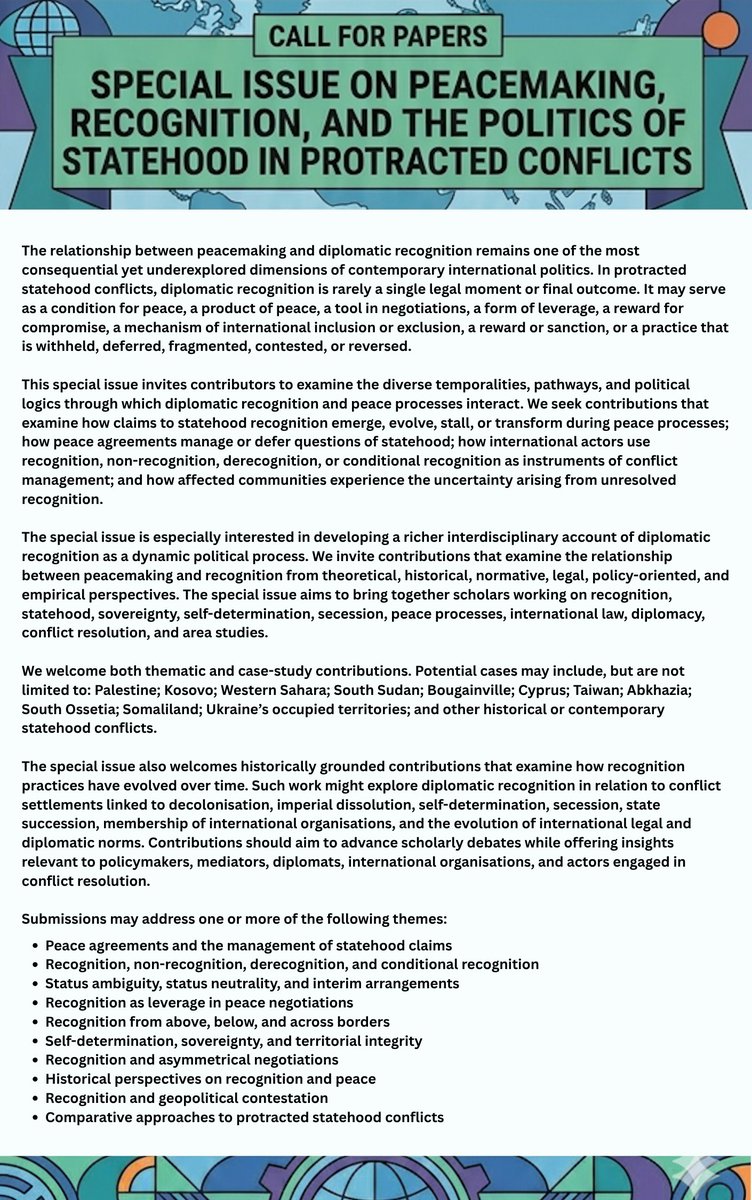
🚨Call for Papers - Special issue on Peacemaking, Recognition, and the Politics of Statehood in Protracted Conflicts!
We invite contributions that examine the relationship between peacemaking and recognition from multiple perspectives!
See details below. Deadline: 30 June 2026!
🚨NEW ONLINE COURSE🚨
We are thrilled to announce our upcoming course on Race, Class, and Empire! The class will be taught by Dr. Timour Kamran and feature guest speakers Dr. Ali Kadri, Dr. Charisse Burden-Stelly, and Dr. John Harfouch. Register below!
https://t.co/FXImX8KA82
The most underrated act of kindness is simply letting people be. Let them mispronounce a word, talk too much about a show they love, or get excited about something you don't quite understand. Everyone has something that lights them up, let them shine, even if it's not your thing.