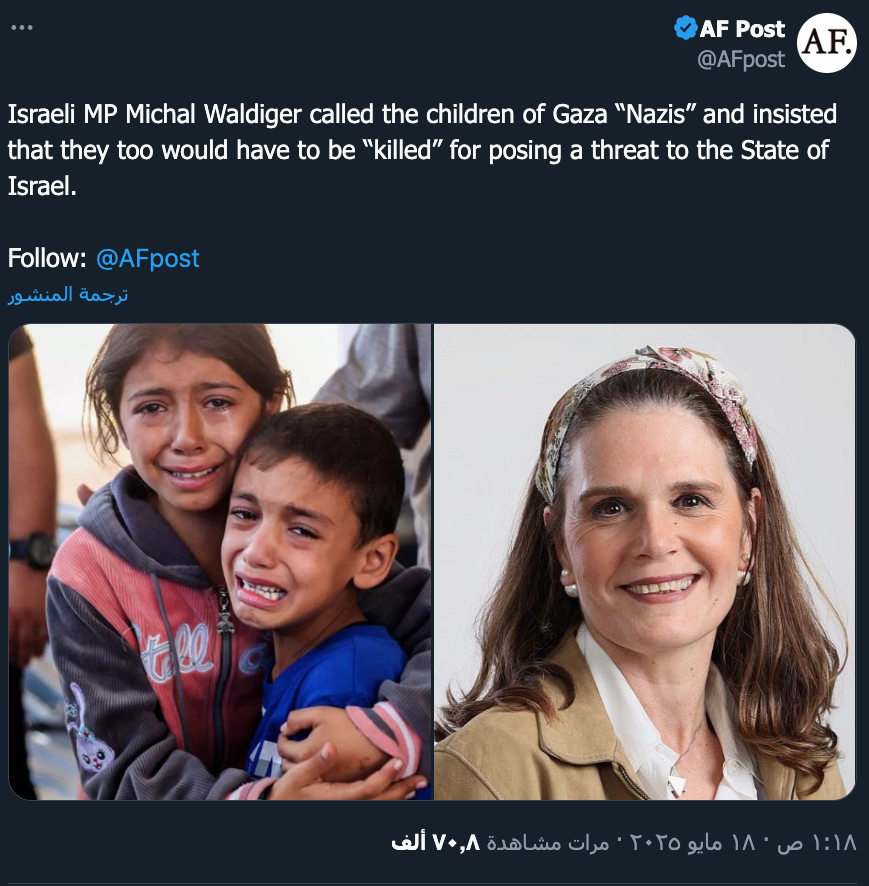
In a public and shocking statement, though not strange or new coming from the Zionist Jewish invaders, Member of the Israeli Knesset Michal Waldiger said:
"No one is innocent in Gaza. Yes, children should be killed too. There is no other way."
This statement cannot be considered a slip of the tongue or an individual extremist opinion, but rather comes as part of a systematic and repeated series of official statements by political and military leaders in Israel, reflecting a clear and publicly declared genocidal intent towards the Palestinian people in the Gaza Strip. These statements are not only incitement to mass killing, but they also constitute acts that are criminalized under international law, serving as evidence of intent to destroy an ethnic group, which is legally defined as genocide.
Waldiger's statement joins a series of similar statements made by Israeli government and military officials, confirming that this exclusionary genocidal rhetoric is not isolated but systemic. Some examples include: National Security Minister Itamar Ben Gvir's statement: "Gaza must be flattened. There is no such thing as innocent people." Finance Minister Bezalel Smotrich's statement: "There is no Palestinian people... we own this land, and we must resolve the conflict by force." On another occasion, he called for the "erasure of the town of Hawara from existence." Former Knesset Member Moshe Feiglin stated: "The solution is to turn Gaza into a lesson in history. There are no innocent civilians." Former Chief of Staff Gadi Eizenkot said: "When a rocket is launched from a neighborhood, we strike the entire neighborhood." Current Defense Minister Yoav Gallant stated: "We are fighting human animals... and we treat them accordingly."
These repeated public statements, made by official figures who hold military and political decision-making power, are considered, from an international law perspective, as evidence of intent, which is a crucial element in defining genocide under Article 6 of the Rome Statute of the International Criminal Court. Jurisprudence and international courts have acknowledged—such as in the Bosnia v. Serbia case before the International Court of Justice in 2007—that public statements by government officials can be used to prove the intent of genocide.
In addition to the explicit incitement to kill, Israeli leaders have adopted policies that involve the imposition of comprehensive collective punishments targeting civilians in Gaza, including children, by depriving them of basic necessities such as water, food, medicine, electricity, and fuel. On October 9, 2023, Defense Minister Yoav Gallant declared: "Gaza will be under complete siege: no electricity, no food, no fuel... we are fighting human animals." Israeli Energy Minister Israel Katz said: "I will not allow electricity or water to enter Gaza... it will only return after we achieve our goals." Prime Minister Benjamin Netanyahu endorsed this policy, saying: "They will get nothing, we will hit them with unprecedented force."
These actions are not only morally prohibited but also constitute, under international humanitarian law, war crimes and acts of genocide. Article 54 of Additional Protocol I to the Geneva Conventions prohibits the starvation of civilians as a method of warfare, and Article 147 of the Fourth Geneva Convention classifies "willful destruction of property, murder, and inhumane treatment" as grave breaches. Article 6 of the Rome Statute includes "imposing living conditions intended to destroy the group, in whole or in part" as an act of genocide.
Despite the clarity of these statements and policies, no action has been taken by any of Israel's supporting countries—led by the United States, Britain, and Germany—to suspend their political, military, or financial support. They continue to provide Israel with weapons, political cover in international forums, including vetoing UN Security Council resolutions demanding an immediate ceasefire, or calling for independent investigations.
This stance is not only a political bias but constitutes, from a legal perspective, a failure to fulfill international legal obligations, and possibly even complicity in the commission of genocide, according to the following provisions:
The Convention on the Prevention and Punishment of the Crime of Genocide (1948), Article 1, obligates states to prevent and punish genocide, and Article 3 criminalizes incitement, assistance, and participation.
The International Law Commission's Draft Articles on State Responsibility (2001), Article 16 states that any state that knowingly assists in the commission of an internationally wrongful act is responsible.
The Rome Statute of the International Criminal Court, Article 25 holds individuals criminally responsible for incitement or contribution to the commission of crimes, and Article 28 addresses responsibility for failure by leaders to prevent crimes.
Article 147 of the Fourth Geneva Convention (1949) criminalizes willful killing and inhumane treatment of civilians.
The International Court of Justice ruling in Bosnia v. Serbia (2007) clearly stated that a state with the means to influence, and that knows or should know about the risk of genocide and fails to act adequately to prevent it, is responsible.
What is happening in Gaza cannot be detached from the broader global legal and ethical framework. The public statements of Israeli officials, the actions on the ground, and the policy of collective punishment collectively represent a clear case of what is defined as genocide. Continued Western support under these circumstances represents a serious deviation from international legal obligations, and demands immediate intervention by international courts, human rights organizations, and national justice mechanisms with universal jurisdiction.
Today, the international community, especially the countries that have signed the Geneva Conventions, the Rome Statute, and the Genocide Prevention Convention, is faced with a severe moral and legal test. Silence or complicity is no longer an ethical option, but a responsibility that could be held accountable before history and courts.