U.S. Congress is officially more cypherpunk than most of you on here
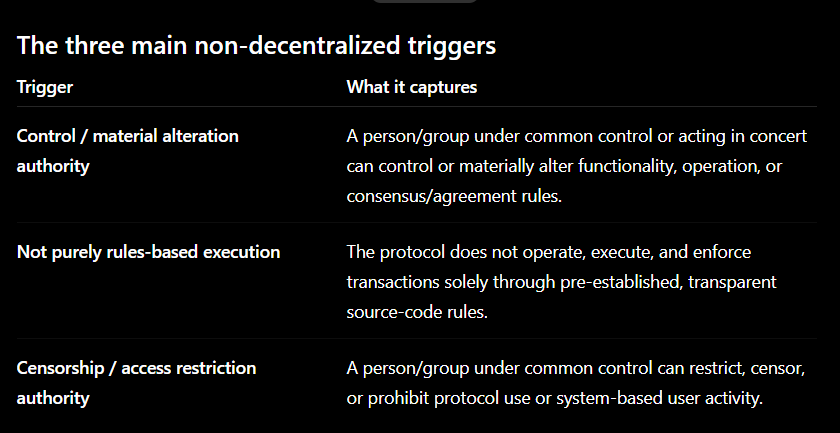
the new CLARITY Act is better than ever on respecting 'decentralization' (loosely speaking) & gets rid of the 'we didn't promise anything so now we're unregulated' loophole many of us were worried about
it replaces the corporate style 'common control' test with 'coordinated control', which in theory will be a harder standard to meet (up to the SEC to ultimately define it, but the criteria it must consider are quite robust)..
corpochains will struggle to meet this standard...this doesn't mean they're illegal but it will mean sales of the token by insiders etc. are much more regulated and more disclosure is required
L2s will have to make sure their security councils are quite narrowly scoped
The bill that Senate Banking pushed out is a pretty good bill, crafted by staffers who have been working on this incredibly hard. It is not an industry handout, nor is it so onerous as to prevent growth.
The bill does what it should: craft clear rules and strong regulations impacting the parties that should be regulated. It also creates space for decentralized development and protects developers. It makes disclosures table stakes and will truly improve market quality.
A lot of the work will fall to rulemaking and, in that vein, we’re going to be watching/commenting to make sure those rules are mindful of
i) competitive balance and ensuring that American rules are not overly burdensome (we don’t want this industry unintentionally pushed offshore because of compliance costs);
ii) ensuring the rules don’t just copy pasta from tradfi, but instead are adjusted where needed for unique characteristics of decentralized systems (particularly disclosures!); and
iii) that developers and builders are protected and able to build in America (things like rights to privacy and the 1st Amendment are almost uniquely American).
It is imperative that we get this right. The Ostrich Caucus era needs to be put in the rear view mirror. A cadre of lawmakers on both sides of the aisle understand that it is in our national interest to build out the rules for the road, and that those rules need to incent development of crypto in America, because if it’s not built here we lose a material edge in both NatSec and economic concerns. GG should mean “good going,” instead of the bogeyman showing up with baseless subpoenas.
It’s also telling to read through some of the adverse amendments offered and see who remains in the avian fold. Sometimes you have to pop up with a bad faith amendment to remind folks that you would prefer to have your head in the sand, pretending that this technology and industry will go away if you push it offshore. I encourage SWC to document and score the amendments offered.
And as for our good friends from the banks, if the 404 text is crypto winning, I would hate to see what it would look like with crypto losing. Your arguments and strategy have never been in good faith and never been about negotiation or compromise. Crypto moved a long way and swallowed a lot on this. Time to move forward.
The Committee should mark up tomorrow and vote yes. While it’s uncertain if the vote will be partisan, the text IS bipartisan and the work has been bipartisan. Let’s get it to the floor where this can and should pass on a strongly bipartisan basis.
A protocol can either be:
1⃣ autonomous, credibly neutral and censorship resistant; or
2⃣ capable of dynamic risk scoring to combat illicit finance.
It cannot be both because Option 2 requires delegating gatekeeping powers to an oracle.
Option 1 is DeFi. Option 2 is not.
I’m commonly asked by crypto people if the pushback from those in government and consumer advocacy groups is because “They must be paid by the banks, right?”
To me that shows a misunderstanding of why someone might be pushing back on pro-crypto regs. It probably doesn’t help my cause to explain this because the idea that our enemies are paid by Wall Street might make us look sympathetic.
Sen. Warren and her tribe don’t secretly love banks. They have been bitter opponents for years. Over time a regulatory regime that they can both live with has come into place. They have pretty good oversight and control of the banks. Then crypto comes along and breaks a lot of the assumptions that underlie financial regulation. Particularly the fact that it removes intermediaries in a world of third party doctrine based regulation.
So when they look at crypto, even though it probably does theoretically remove market power from traditional finance, and even though it’s better on some dimensions like data protection and personal sovereignty, it is not seen as ‘the solution’ to banks the way it might look to a crypto advocate. Instead it is a challenger force that moves finance outside of their control. (BTW, I am only talking about “good” crypto here. Not the casino stuff which they are probably right about.)
They don’t like that. And of course banks don’t like it either because they are now competing with a better, faster, permissionless system.
All that is to say that it’s a mistake to dismiss their criticism as carrying water for the banks. It’s more realistically an enemy-of-my-enemy situation.
This is very anti-innovation. DeFi is the most innovation-driven development in finance over the past century.
DeFi provides unprecedented transparency for finance that the old gatekeepers can’t handle.
DeFi will win.
Decentralized Finance (DeFi) scares big financial institutions and the surveillance state. With DeFi you could cut out middlemen, lower costs, protect privacy... In short, DeFi helps defend freedom so they want to kill it.
Keep calm. Defend freedom. Protect self-custody.
DeFi - which makes up 4% of total crypto TVL & less than .1% of total GDP - is such a powerful *concept* that TradFi is running ads on major network TV to kill provisions that protect DeFi in upcoming market structure legislation. Saying *DeFi* is killing innovation?? ok . . .