idOS isn’t competing with intelligence it’s grounding it By giving digital systems a reliable, user-controlled identity layer, it restores something the web quietly lost: consent.
gidOS Quackers
Builders don’t usually complain about identity, they just work around it.
Again. And again.
Every new app ships great logic, then immediately trips over the same old problem: forcing users through another KYC flow that feels redundant, invasive, and trust-eroding. Momentum dies before real usage even begins.
@idOS_network doesn’t try to “optimize” that pain. It removes it.
One verification. Encrypted credentials. Reusable across apps without copying data or leaking control. Identity stops being something every product rebuilds badly and becomes shared infrastructure that actually respects users.
What changes is subtle but massive. Builders stop designing around compliance friction. Users stop handing over the same documents to strangers. Apps start inheriting trust instead of re-earning it from scratch.
This isn’t a UX tweak or a growth hack.
It’s the missing layer builders have been compensating for in silence.
If identity is still the heaviest part of your stack, you’re not early.
You’re just building on rails that were never meant to scale.
@idOS_network | @wallchain
gXyber Everyone ✨
Xyber isn’t just spinning up AI voices or onchain identities. It’s building a framework where agents are economically bound to their creators and communities.
Usage creates revenue. Revenue flows back to the people who trained, deployed, and maintained the system. No black boxes. No extractive middle layer.
What stands out is the incentive design.
Engagement isn’t cosmetic it’s measurable, rewarded, and persistent. Builders are pushed to improve agents because better performance directly compounds value. Users stick around because participation isn’t ignored.
This is how AI actually becomes onchain infrastructure, not a demo.
When accountability, ownership, and incentives finally align, networks stop being speculative toys and start behaving like real economies.
That’s the quiet shift Xyber is driving and most people will only notice once it’s already working.
@Xyberinc | @xeetdotai
gidOS Quackers
Builders don’t usually complain about identity, they just work around it.
Again. And again.
Every new app ships great logic, then immediately trips over the same old problem: forcing users through another KYC flow that feels redundant, invasive, and trust-eroding. Momentum dies before real usage even begins.
@idOS_network doesn’t try to “optimize” that pain. It removes it.
One verification. Encrypted credentials. Reusable across apps without copying data or leaking control. Identity stops being something every product rebuilds badly and becomes shared infrastructure that actually respects users.
What changes is subtle but massive. Builders stop designing around compliance friction. Users stop handing over the same documents to strangers. Apps start inheriting trust instead of re-earning it from scratch.
This isn’t a UX tweak or a growth hack.
It’s the missing layer builders have been compensating for in silence.
If identity is still the heaviest part of your stack, you’re not early.
You’re just building on rails that were never meant to scale.
@idOS_network | @wallchain
There’s a moment in every market cycle where a piece of infrastructure quietly steps forward and becomes unavoidable.
LayerBank is moving into that territory.
It’s not the loudness that gives it away it’s the symmetry.
Every part of the system feels tuned with a kind of calm precision: liquidity that doesn’t wander, risk that doesn’t leak, mechanics that don’t wobble when the market tilts.
It’s the difference between something working and something being built to hold.
What LayerBank is shaping feels less like a protocol and more like a backbone a clean, stable layer where capital can accelerate without shaking the entire structure.
That’s the hallmark of serious engineering: when the system fades into the background, and the experience becomes effortless.
Zoom out, and you can sense a longer arc forming.
This isn’t a protocol chasing yield or narratives. It’s a financial layer preparing for a future where onchain volume becomes constant, global, and unforgiving to weak design.
@LayerBankFi isn’t building a platform.
They’re building the quiet architecture the next wave will rely on.
Every cycle has a moment when the noise fades, and you can finally see who’s actually shaping the direction of the space. Right now, three names keep cutting through the blur:
@Alignerz_ | @On_Veera | @LayerBankFi.
What’s happening around them isn’t hype it’s alignment. A shift in how people move, how they build, how they expect things to work.
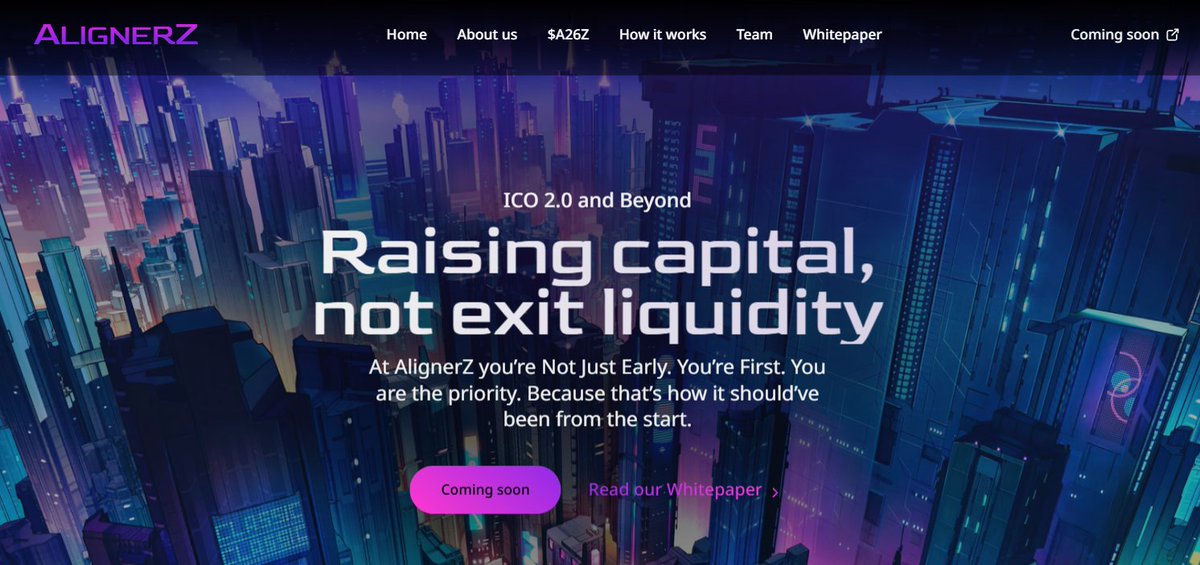
@Alignerz_ feels like the team is stitching the ecosystem together thread by thread. Not with flash, not with theatrics but with decisions that make everything else feel more purposeful.
They aren’t forcing growth; they’re setting foundations so solid that growth becomes the natural outcome. You can sense the patience, the discipline, the intention behind every piece they put in place. It’s the kind of work you only appreciate when you realize how stable things feel around it.
Veera takes a different route entirely.
Their impact isn’t loud it’s immediate.
You use what they’ve built, and suddenly everything feels right. The pace, the clarity, the responsiveness is like someone removed the weight you didn’t know you were carrying.
@On_Veera is the reminder that great execution doesn’t scream; it guides.
It makes every action feel smoother than the one before, until you can’t imagine operating without that level of polish.
LayerBank rounds it out by tackling the part most teams ignore: the invisible friction. The micro-delays, the awkward flows, the clunky edges that slow people down.
@LayerBankFi trims all of it. Silently. Consistently. Precisely. And before you know it, your entire onchain rhythm has changed. You’re moving faster, thinking clearer, acting confidently because the foundation beneath you is finally working with you, not against you.
What makes these three teams stand out isn’t that they’re building. It’s that they’re building the right things the kind of upgrades that translate directly into how people operate day to day.
Different missions. Different styles.
But all pushing the space toward a future where everything simply works better than it did the day before.
There’s a direction forming calm, steady, unmistakable and Alignerz, $VEERA, and LayerBank are the ones setting the pace for it.
This isn’t the usual cycle.
This is the part where real builders quietly take control of the narrative without ever asking for it.
What keeps me coming back to @Alignerz_ is how it flips launch psychology on its head. Instead of rewarding whoever sprints for the exit, the design makes long vesting the rational choice, so looking years ahead stops being copium and starts being strategy. When most of the supply sits inside TVS NFTs and only a tiny slice actually circulates after TGE, price discovery has room to breathe, not collapse under instant sell pressure. That quiet, enforced scarcity doesn’t just protect the chart in the early days it creates a launch that feels intentionally engineered for conviction, not for chaos, and that’s the kind of game theory worth showing up for. g26!
Study @chatandbuild@LayerBankFi
Good evening CT
Every day inside @chatandbuild feels like stepping into a room where the ceiling is a little higher and the pace is a little faster.
It’s one of the few places in this space where people don’t posture they build in real time. Ideas don’t just get dropped here; they get pressure-tested, tightened, and turned into something you can actually ship.
What sets it apart is the rhythm:
short loops, quick iterations, honest feedback.
You post a spark, someone adds structure, someone else refines the framing and suddenly you’re looking at a version of your idea you couldn’t have reached alone.
There’s no noise, no empty engagement farming, no surface-level hype.
Just a group of people who show up with intent and leave a little sharper each time.
If you care about writing better, building faster, or thinking with more clarity, this is one of the rare corners of the internet where the environment actively upgrades you.
@chatandbuild isn’t a chat. It’s a catalyst. @GalxeQuest
DeFi lending has barely evolved in years of the same mechanics, different skins
@LayerBankFi breaks that stagnation by letting your collateral work everywhere, not just where you deposit it
This omni-chain leverage turns simple positions into dynamic ones
It’s a modular upgrade to how people think about capital. @cookiedotfun
There’s something unmistakably different about LayerBank when you look closely.
Most lending protocols feel like upgraded versions of the same template.
@LayerBankFi feels like it was built from first principles almost like they started by asking what a modern onchain money market should look like, not what the last cycle already tried.
What impresses me most is the restraint. They don’t over-optimize for noise or short-term attention. Every mechanic feels like it belongs to a much larger, long-term architecture: capital that moves cleanly, systems that behave predictably, risk that’s engineered instead of reacted to.
It’s the kind of design that makes you think they’re preparing for a world where liquidity isn’t just speculative it’s structural. A world where onchain activity finally deserves infrastructure with this level of precision.
LayerBank isn’t building louder tools.
They’re building smarter foundations the kind that quietly reshape markets before anyone realizes it.
Study: @On_Veera@cookiedotfun
People talk about zkVMs like they’re far-off research projects, but the Miden architecture from @0xMiden is one of the first that actually feels shaped for real use, not theory.
The idea is straightforward once you see it: you run the heavy logic off-chain, and Miden hands the network a proof that everything happened exactly the way your code said it should.
No re-execution. No trust games. Just a compact mathematical confirmation.
You execute locally. Miden generates a STARK proof. The chain checks it quickly and moves on.
And that simple pattern opens the door to things chains normally can’t touch:
🔸 Computation that would choke an L1, handled cleanly off-chain.
🔸 Application logic that stays private without losing verifiability.
🔸 Fast proving cycles from the STARK approach.
🔸 Entire classes of systems games, simulations, advanced DeFi flows that don’t fit inside a base layer’s limits.
🔸 A shift in design: intelligence sits at the edges, and the chain only verifies the result.
Miden doesn’t make blockchains heavier; it makes them lighter
by moving the work outward and keeping the certainty intact.
There’s a moment in every market cycle where a piece of infrastructure quietly steps forward and becomes unavoidable.
LayerBank is moving into that territory.
It’s not the loudness that gives it away it’s the symmetry.
Every part of the system feels tuned with a kind of calm precision: liquidity that doesn’t wander, risk that doesn’t leak, mechanics that don’t wobble when the market tilts.
It’s the difference between something working and something being built to hold.
What LayerBank is shaping feels less like a protocol and more like a backbone a clean, stable layer where capital can accelerate without shaking the entire structure.
That’s the hallmark of serious engineering: when the system fades into the background, and the experience becomes effortless.
Zoom out, and you can sense a longer arc forming.
This isn’t a protocol chasing yield or narratives. It’s a financial layer preparing for a future where onchain volume becomes constant, global, and unforgiving to weak design.
@LayerBankFi isn’t building a platform.
They’re building the quiet architecture the next wave will rely on.
Your day starts with Alignerz setting your pace, switches into $VEERA handling your multi-chain navigation, and ends with LayerBank optimizing your liquidity. Nothing feels forced; everything feels connected.
This flow turns daily activity into an actual onchain routine. And that’s when you realize how much time you used to waste on fragmented tools.
What impresses me about @Alignerz_ is how predictable the system feels.
The rules are transparent, the scoring is logical, and the environment rewards honest effort.
It creates a competitive space without turning creators into spammers.
That balance is rare and it’s exactly why people stay.
Where most browsers give you access, @On_Veera gives you alignment.
Your wallet, your dApps, your activity everything is connected instead of patched together. It turns normal browsing into a multi-chain experience without friction.
That’s the kind of simplicity crypto has needed for years.
The beauty of @LayerBankFi is how effectively it uses your capital.
Your collateral matters everywhere, not just on a single chain silo.
That multi-chain leverage is what makes the system feel modern and genuinely efficient.
It’s the kind of architecture DeFi should have had from the start.
Keep them all in mind. Stay aligned
Most people look at idOS and see “decentralized identity,” but a few deeper details make the project far more interesting than that label suggests.
1️⃣. idOS isn’t trying to replace identities it’s trying to unburden them. Instead of making you re-verify every time you switch platforms, idOS lets your credentials follow you like luggage you actually want to carry. One verification, infinite reuse.
2️⃣. Your data doesn’t live in one place and that’s the point. idOS splits, encrypts, and distributes your identity across the network. No single server ever holds the full picture, so a breach can’t simply “take” your identity.
3️⃣. Apps only see what they absolutely need. A platform can request one slice of your data without touching the rest. Need age verification? They get just that no name, no address, no digital footprint leakage.
4️⃣. The system makes users the gatekeepers, not the risk. Every access permission is user-approved at the protocol level. No platform can silently store, clone, or resell your information without your signature.
5️⃣. Compliance is built into the rails, not bolted on as an afterthought. $IDOS was designed with regulatory alignment in mind meaning platforms can build freely without juggling the nightmare of data storage liability.
6️⃣. Identity becomes portable capital.
Your KYC turns into a reusable asset. The more apps support $IDOS, the more valuable a verified identity becomes not for others, but for you.
7️⃣. The network scales with demand, not bureaucracy. Traditional verification slows down as more users pile in. idOS gets stronger. Distributed storage and permission create a system that handles surges naturally.
8️⃣. It flips the digital identity power dynamic. For the first time, apps borrow identity from users not the other way around.
@idOS_network isn’t just updating how identity works online it’s rewriting who it’s meant to serve. @wallchain
Quack Quack
I’ve been diving into @trylimitless non stop for the last six weeks and honestly, I’m hooked.
Normally, I tend to ignore every new shiny thing on Base, but this one actually lives up to the hype.
The CLOB feels like a genuine exchange, not some sketchy AMM where you get wrecked on slippage for a $50k bet.
On the first day, I tossed in $300 just to give it a shot hit a quick 3R on “BTC above 98k by 8pm EST” and cashed out with a grin.
That same night, I flipped my profits into hourly ETH range markets and kept compounding. Real money, real quick.
Season 2 is pure chaos right now and I’m loving every minute of it.
I’m sitting in the top 120 on the leaderboard (username “cooker”) and even cracked the top 50 a few times when my crew rallied around my referral.
Mondays are my favorite I wake up, check out the new Prophet challenges, snipe the mispriced ones before the pros wake up and then watch the points roll in.
Last week, we racked up 2.8M points as a crew from just 4–5 coordinated plays.
If you’re missing out on this, here’s what I did (no fluff):
•Headed to https://t.co/gQqDjab1xJ
•Connected my Coinbase Wallet (Base chain was already set up)
•Bridged 500 USDC from Arbitrum to Base (cost me about 40 cents)
•Claimed my buddy’s referral (instant 5% fee discount + private Discord invite)
•Started with $50–100 bets on hourly BTC “up-only” ranges, it’s like free money when the US session kicks off
•Scaled up once I saw the fills were clean limit orders actually execute, none of that “pending forever” nonsense
Real talk:
I’ve taken some hits too.
Got absolutely wrecked on “SOL dumps this hour” right before the meme pump two weeks ago.
I took it in stride, laughed it off, sized down the next hour and got it all back on the reversal. That’s just how the game goes.
Right now, there are 62 days left in Season 2 and the airdrop is looking pretty sweet.
The top 250 get guaranteed tokens😁
Quack Louder
Quack Smarter
Predict Smarter
Good morning CT
Whenever @Alignerz_ appears on my timeline, I don’t scroll, I don’t pause
I lock in instantly.
One rule. One instinct. One move: ENGAGE.
Because Alignerz isn’t a project you watch… it’s a project you show up for.
So here’s the real question:
When an Alignerz post drops, are you already in the replies or still deciding if you should be?
Repost. Engage is key to Win!
Study: @idOS_network
Stay simple.
Stay aligned.
Stay unmistakably Alignerz.
g26 💜
there’s something happening across the ecosystem right now that doesn’t feel like a trend or a cycle it feels like the groundwork for a very different kind of future. And the teams building it aren’t the ones shouting the loudest; they’re the ones quietly shaping the pieces that everything else will eventually depend on.
@ArchNtwrk is one of those quiet forces. You don’t notice them because they’re not trying to be noticed. But they’re stitching together the data, the compute, and the movement that real systems need. It’s the kind of infrastructure you only appreciate when everything else suddenly starts relying on it.
#Alignerz: is working on the invisible layer between humans and machines the part nobody sees but everyone feels. They’re trying to make sure that when AI acts, it acts with intention, with clarity, with context that actually matches what people want. Not guesses. Not approximations. Real alignment.
@inference_labs: is doing something almost nobody has the courage to do: making AI prove itself. Not metaphorically. Literally.Every decision traced. Every output is accountable. No more black boxes, just verifiable intelligence that earns trust the hard way.
@spaace_io is building a different kind of environment something that feels alive. A place where people gather early, think clearly, contribute meaningfully, and actually get recognized for it. Not engagement farming, not noise… real coordination shaped by real incentives.
$RLS feels like the team is upgrading the plumbing of modern finance. Not the surface. The pipes. The systems institutions run on, the rails assets move on, the infrastructure markets quietly depend on. They’re doing the boring work that ends up changing everything.
#Artery_Chain thinks about networks like they’re organisms moving, pulsing, routing energy and information through digital arteries. It’s a refreshing perspective in a space that usually treats networks as static objects instead of living systems.
#lute gives shape and order to ecosystems that would otherwise drown in chaos. They make the hard parts incentives, economy design, capital flow feel intentional instead of improvised. The result is clarity where most teams are stuck with complexity.
@thrustdotcom is all about momentum.
Real momentum, not temporary attention. They help teams turn ideas into movement, movement into traction, traction into something that actually lasts. It feels less like a launchpad and more like a catalyst.
@xeetdotai is making AI feel human again. Not a tool you open a teammate you talk to. Their approach turns workflows into conversations and intelligence into something that’s always present, always collaborative, always part of the process.
------------------------------------------
All of them are building in different directions, but the threads connect.
Data that moves. Agents that align. AI that proves itself. Infrastructure that holds up. Communities that coordinate. Networks that evolve. Workflows that become intelligent.
You can feel it something real is forming. Something that looks like the foundation of the next era, built by people who care more about the work than the spotlight.
rayls is one of those projects that feels small from the outside and absolutely massive once you understand what it’s actually doing. It isn’t chasing headlines or trying to be the next shiny L1 it’s rebuilding the machinery that global markets rely on, the kind of plumbing nobody notices until it breaks.
What makes @RaylsLabs fascinating is how quietly it operates. Most crypto projects scream disruption. $RLS whisper efficiency and somehow that hits harder. Instead of forcing institutions into unfamiliar systems, it mirrors the way real settlement already works, then removes the bottlenecks that slow everything down.
The privacy setup is another underrated piece. Institutions get their own sealed-off subnets to keep sensitive data locked where it belongs, while the public chain coordinates everything at high speed. It’s like having a private office inside a bustling financial district secure, but still plugged into the entire ecosystem.
And the more you look at Rayls,
the clearer it becomes: this isn’t an experiment.
This is infrastructure. Real, sober, quietly powerful infrastructure.
The kind that makes markets feel faster, safer, and smoother without asking anyone to change how they work. The kind that becomes invisible because it works so well. @cookiedotfun@RaylsLabs aren’t loud. It doesn’t need to be. It’s building the backbone others will end up depending on. Gcookie 🍪
Limitless is not about speed.
It’s about precision earned under time pressure.
An hour is not chosen for the thrill.
It is chosen because constraints are teachers.
No drifting. No day-long rationalizations.
A boundary forces clarity; clarity forces honesty.
Most trading environments reward expansion more charts, more indicators, more narratives.
@trylimitless rewards reduction:
🔸one view of the market
🔸one moment to act
🔸one outcome to absorb
This is not a simplification for convenience, it is a simplification to surface truth.