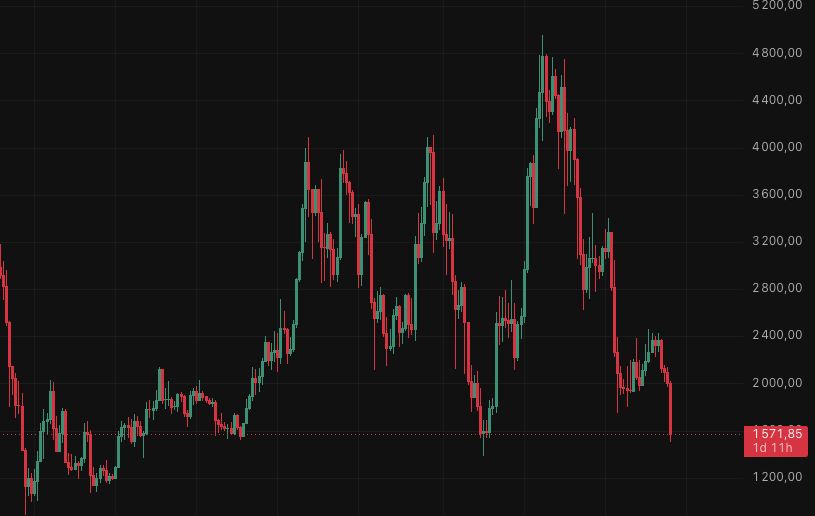
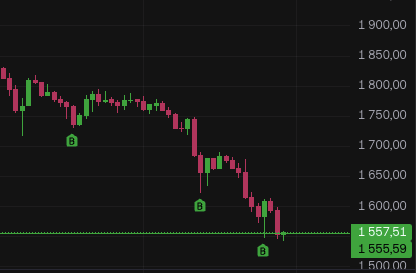
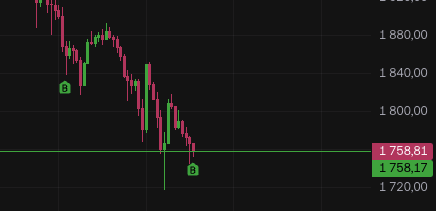
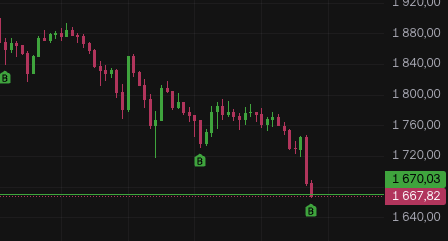
My $1,555 limit order got filled.
We've reached the event horizon.
Either ETH confirms a breakdown below this level, and then there's not much underneath us — the next major support sits around $1,000.
Or this is the final stop before a reversal.
I'm still leaning toward the second scenario.
Sure, price can go lower. The market can print any candle it wants and sweep liquidity wherever it wants.
But I don't believe in a prolonged consolidation below $1,500 for $ETH.
My buy orders are stacked all the way down to $1,000.
$ETH
I've already bought two levels. If we go lower, I'll keep buying all the way down to $1,000.
Looking at ETH near the lows of the previous cycle and sitting 100% in stables is certainly a choice. But then you need to pick a narrative.
If you're expecting another -50% to -70% from here and believe ETH will spend months sitting at the bottom so everyone can calmly accumulate, that's no longer a correction.
That's a dead market.
I can't reconcile these two takes:
• "Crypto is alive and another major leg up is ahead."
• "ETH is going to collapse another 2-3x and sit at the lows for months."
I'd rather keep scaling into a position, which is exactly what I've been doing all along.
Gnosis Safe / Multisig Wallet ❄️❄️
One of the most secure ways to store crypto assets. Multisig wallets are widely used by funds, DAOs, crypto companies, and exchanges to protect large amounts of capital.
Unlike a regular wallet, compromising a single private key is not enough to access the funds. Every transaction requires multiple approvals — for example, 2 out of 3 or 3 out of 5 signatures.
In practice, the keys can be stored on different devices and even in different physical locations. Until the required number of signatures is collected, the funds cannot be moved.
This setup significantly reduces the risk of theft and is considered one of the gold standards for securing large crypto holdings.
$1.6 BILLION LIQUIDATED
$1.61 Billion notional value was liquidated from the crypto market in the past 24 hours. 85% of liquidations were long positions.
Stay safe traders.
$ETH is approaching an interesting zone once again.
A reminder:
We're currently trading not far from the previous cycle's highs.
If you look purely at the chart and compare it to past cycles, it almost feels like we never had a proper bull market.
Previous cycles tended to follow a different pattern:
first, a breakout far above the previous cycle's highs;
then, a correction that established new lows around those old highs.
That said, a lot of this is just chart astrology.
I keep saying the same thing: at any point in time, you can find plenty of indicators, patterns, and "analytical models" that will convincingly argue for both a massive rally and an imminent collapse.
If, like me, you believe crypto isn't going to die within the next year and you're looking to accumulate more $ETH, the current zone and everything down to $1,550 looks quite attractive.
The $1,550 level has been holding since early 2023 and is essentially the last major support before the $1,000 area.
Personally, I'm planning to place buy orders roughly between $1,800-$1,600, with additional bids around $1,100 in case of a panic sell-off.
Yes, I think a sharp capitulation wick to $1,000 is possible.
But a sustained move and acceptance below that level still seems unlikely to me.
@arkham first:
- We never sell Bitcoin
- We only sell Bitcoin as a formality
- We sell less Bitcoin than we buy
next:
- Yes, we sell Bitcoin. But only the Bitcoin that gets sold
Michael Saylor is evolving in real time:
- We never sell Bitcoin.
- We only sell Bitcoin as a formality.
- We sell less Bitcoin than we buy.
What's next?
- Yes, we sell Bitcoin. But only the Bitcoin that gets sold.
🚨 What is ADL and how can it ruin your trade?
Most traders fear liquidation.
Experienced traders fear liquidation and ADL.
ADL (Auto-Deleveraging) is when an exchange force-closes your profitable position to cover losses from liquidated traders.
Yep. Your profitable position.
Imagine this:
📉 A token is nuking.
🟢 Your short is printing money.
💰 Funding payments keep rolling in.
And then the exchange says:
"Thanks for playing. Position closed."
Why does it happen?
Normally, liquidated losses are covered by the exchange's insurance fund.
But during extreme volatility, the fund may not be enough.
That's when ADL kicks in.
The exchange starts closing positions from traders who are highest in the ADL queue.
Usually the first targets are:
🔸 Traders with the highest unrealized PnL (%)
🔸 Traders using high leverage
The bigger your profit and leverage, the closer you are to the front of the line.
How do you know you're at risk?
Most exchanges show an ADL indicator (bars/lights).
🟢 Few bars = low risk
🔴 All bars lit up = you're probably next
How to reduce ADL risk
✅ Lower your leverage
Add margin or reduce position size.
✅ Take partial profits
Lock in some gains or reopen the position to reduce your PnL%.
✅ Watch the ADL indicator
Don't wait until the exchange makes the decision for you.
Important
⚠️ ADL ≠ liquidation
With liquidation, you lose money.
With ADL, you keep your profits — but lose your position.
⚠️ ADL is much more common on low-liquidity altcoins than on BTC or ETH.
⚠️ If your short is massively green, sometimes paying a few fees to reopen the trade is cheaper than getting ADL'd later.
Sometimes the biggest risk isn't being wrong.
It's being too right. 🎯
🚨 Not all AI APIs are equally safe.
When people think about the risks of AI services, they usually focus on the obvious ones:
— your prompts may be logged;
— conversations may be stored;
— someone may gain access to your data.
But there's another threat that gets far less attention.
If you're using an API key provided by a third party or connecting to a model through an unknown intermediary, you have no way to verify that the responses you're receiving are actually coming from the model unchanged.
A recent incident involving a fake Claude Code API highlighted a much more serious risk: the server sitting between the user and the model was able to modify responses and inject malicious instructions directly into the workflow.
In other words, the user sees what appears to be a legitimate AI response and trusts it, while parts of that response may have been crafted by an attacker.
That's why the risk isn't limited to data leaks.
The intermediary can influence what you see, what you run, and what actions you take on your device.
And this isn't just about one specific case. The same risk exists anytime a third-party server sits between you and the actual AI model.
If someone gives you an API key or suggests using a third-party AI gateway, remember: you're trusting that intermediary not only with your data, but also with the responses generated by the model.
We've already learned to be careful with files, software, and browser extensions.
It may be time to apply the same level of scrutiny to the source of your AI APIs.