Sorry, my gringo friends, my country is still voting to decide whether we’re going to remain a Country or become a nazi american colony with our constitution torn to shreds, so I’m definitely going to be pretty angry this month
a eleição ta meio: vc prefere fazer intercâmbio (governo lula trazendo de volta o ciência sem fronteiras) ou ter uma experiência imersiva em auschwitz?
O jornal britânico The Guardian alertando que Flávio bolsonaro não passa de um golpista e ameaça a nossa democracia enquanto a mídia brasileira trata a candidatura do filho de alguém que está preso por golpe de estado como se fosse normalíssima.
https://t.co/jb52Y80HV4
🚨 A MESSAGE FROM BRAZIL TO THE WORLD
You may have seen Brazil mentioned because our presidential election is heading to a second round. What may look like another election from outside the country is, for many Brazilians, a much deeper discussion about the future of our democracy.
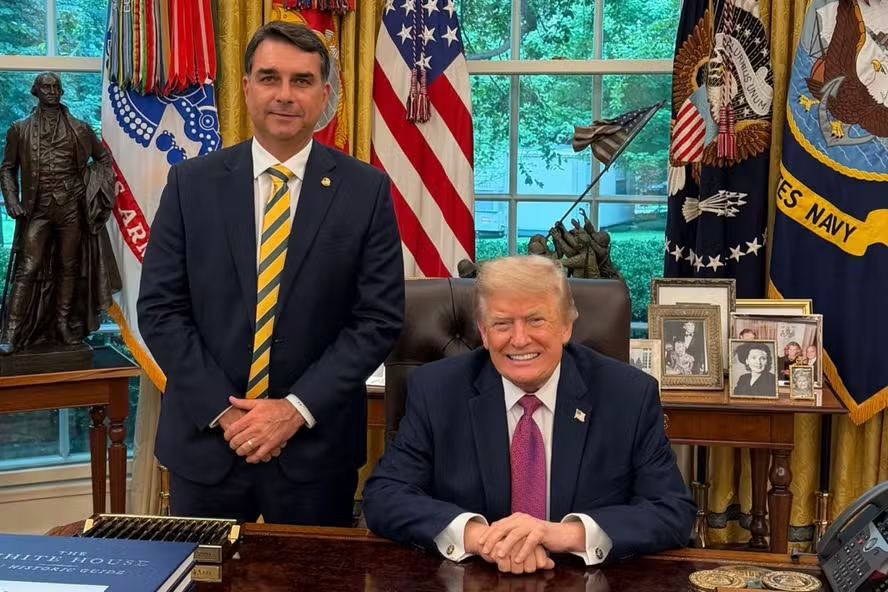
Flávio Bolsonaro, son of former president Jair Bolsonaro, is now running for president of Brazil.
This is not simply about political disagreement. It is about the direction in which Brazil could move if his movement gains control of the presidency alongside a much more conservative Congress.
One example is the debate over workers' rights. Flávio Bolsonaro has opposed the proposal supported by Lula's government to end the 6x1 work schedule and move toward a 5x2 schedule with a 40-hour workweek and no reduction in salary. Instead, Flávio has supported an alternative based on individual agreements over working hours.
There is also the controversy surrounding the so-called “Beach PEC.” Flávio Bolsonaro was the Senate rapporteur of the proposal that would transfer federal maritime lands to states, municipalities and private owners. Under the proposal, private occupants could acquire these areas, changing the current ownership structure. Flávio argues that the proposal would not privatize beaches themselves and has defended it as a way to provide legal certainty and encourage investment. Critics, however, warn that transferring coastal land into private ownership could facilitate large private developments, speculation and restrictions on practical access to parts of the coast.
The controversy became international news after actress Luana Piovani criticized the proposal and its connection to a major beachfront development promoted by Neymar's company and the real-estate developer DUE. Piovani argued that such developments could benefit from changes to the ownership of coastal land. There is no established evidence that Neymar personally supported the PEC or that the proposal was written specifically for his project, and his representatives denied that the development depended on the PEC. But the episode highlighted a legitimate question: who stands to benefit economically when public coastal land can potentially be transferred to private owners?
That question has not disappeared. A new 2026 report featuring Luana Piovani is once again examining the political and economic interests surrounding the proposal and the possibility that changes to coastal land ownership could affect access to Brazil's coastline.
And then there is the political environment surrounding this movement.
In 2026, Brazil has seen political figures associated with the Bolsonaro camp make statements and take positions that have alarmed LGBTQ+ communities and women's rights advocates. A monitoring project documented 13,000 offensive attacks against LGBT+ candidacies on Instagram, with women LGBT+ candidates accounting for 92.7% of the attacks identified and Black LGBT+ candidates being targeted in 83.6% of cases.
One Bolsonaro-aligned politician, Zé Trovão, was reported this year to have suggested physical punishment against LGBTQ+ people during a political debate.
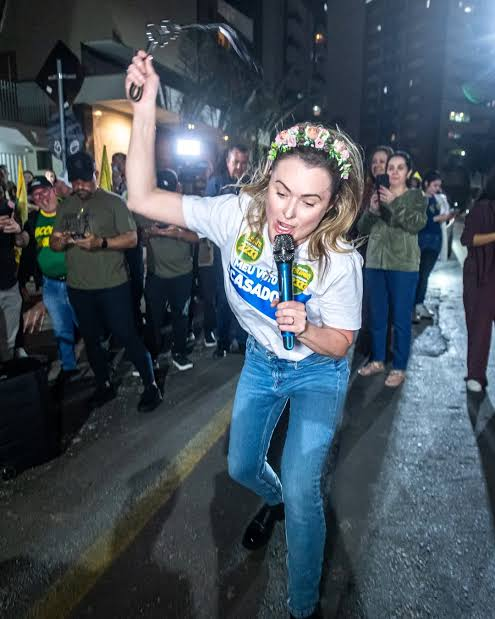
Another example is Júlia Zanatta, a PL politician who was re-elected in Santa Catarina and celebrated her result in the streets carrying a whip. The imagery caused controversy because of its historical associations with violence and slavery.
On women's rights, the situation is particularly concerning. Eduarda Campopiano, a 23-year-old PL politician who was elected as the most-voted state deputy in São Paulo in 2026, has openly described herself as “the greatest enemy of feminists” and has questioned the very existence of femicide. During a televised debate earlier this year, Campopiano said that she did not believe femicide was “something that exists,” while also opposing legislation criminalizing misogyny.
Her position is not an isolated comment. Opposition to feminism has been a central part of her political identity and campaign, and she has publicly aligned herself with figures from the Bolsonaro movement, including Flávio Bolsonaro.
This matters because femicide is not an abstract political concept in Brazil. It is a specific legal category created to recognize murders of women committed for reasons related to their gender. Questioning the existence of the crime itself, while seeking political power in a country facing persistent violence against women, has understandably generated intense debate among women's rights advocates
Brazil's Senate is also changing dramatically.
After the 2026 elections, the PL is expected to become the Senate's largest party, increasing from 15 to 28 senators. That does not mean every s
Flávio Bolsonaro himself has already said that, if elected, he intends to use the new Congress to pursue constitutional changes, arguing that Brazil has given him a Congress “much more to the right.” Constitutional amendments require large majorities in both chambers, so these changes would still depend on alliances and constitutional limits.
And there is another issue that deserves international attention: Meta and political visibility in Brazil.
Political communication in Brazil is increasingly happening on Instagram, X, TikTok and YouTube. And the way social-media platforms determine what people can find and what they are shown is becoming increasingly important to democratic debate.
Brazilian users have recently documented striking differences in Instagram search results for political accounts. In searches for Lula, users have reported difficulty finding his account even when entering almost the complete username, while searches for Bolsonaro-related accounts can prominently surface verified and highly visible political profiles, including Flávio Bolsonaro and Jair Bolsonaro.
These examples do not, by themselves, establish the reason for every individual search result. But they raise a serious question about how Meta's systems are handling political visibility during an election.
At the same time, right-wing politicians have developed enormous audiences and engagement on Brazilian social media. Politicians such as Nikolas Ferreira have become some of the country's most influential political creators online, while figures associated with the Bolsonaro movement regularly dominate political engagement metrics.
Meta has already faced major controversies over political influence and the handling of user data. The Cambridge Analytica scandal, for example, involved Facebook user data being obtained and used by a political consulting firm that worked for Donald Trump's 2016 presidential campaign. More recently, Meta has again faced disputes in Brazil over the removal and restriction of political content during the 2026 election period.
It does mean that claims of unequal political visibility should not simply be dismissed as conspiracy theories either. They deserve transparent investigation, independent auditing and clear explanations from Meta.
When billions of people depend on platforms controlled by private companies to discover political information, the rules governing search, recommendations, moderation and visibility can directly affect public debate.
Brazilian users deserve to know why certain political accounts are difficult to find, why some political content receives vastly greater visibility, and whether the same rules are being applied consistently across the political spectrum.
Why am I telling you all of this?
Because democracy is not only about what happens on election day.
It is about whether workers have rights. Whether beaches remain accessible to everyone. Whether public land can be transferred into private ownership without adequate scrutiny. Whether LGBTQ+ people can participate in public life without intimidation. Whether women can demand protection without their concerns being dismissed. Whether Black Brazilians, minorities and political opponents can participate equally. Whether universities and scientists can work freely. Whether institutions remain independent. And whether political disagreement can exist without becoming hatred.
Brazil is not asking the world to ignore our politics.
We are asking the world to pay attention.
Please look beyond the headlines, investigate what is happening here, listen to Brazilian journalists, researchers, activists and ordinary citizens, and understand what is at stake for the country's democratic institutions.
What happens in Brazil matters far beyond Brazil. 🇧🇷
@TeamAriana@rembeauty@joangrande@FrankieJGrande