Will Europe Save Hamas in Gaza? I recently met with a high-ranking European official from a country deeply involved in the Israel and Palestine file to discuss Gaza’s future and immediate options for relieving civilians trapped under Hamas’s grip. I presented a simple proposal: create safe zones across the "Yellow Line" into the Israel‑controlled green zone and support new, organized, secure, Hamas‑free communities where Gazans could finally begin rebuilding their lives. Whether the issue is humane living conditions, deradicalization, education, healthcare, or shielding civilians from both Hamas or Israeli strikes, the green zone is the only place where meaningful action is possible. Instead of engaging, the official launched into a long monologue about their country’s contributions to the Palestinian Authority, UNRWA, and other institutions, all while insisting on their own “humility” as a faraway European nation.
Then came the truly alarming part: a casual normalization of Hamas. The official proudly described how easy it had been to work with Hamas before October 7, praising the group for providing “excellent security” and being “easier to work with than others.” What they called pragmatism was, in reality, a twenty‑year pattern of enabling a violent terrorist organization responsible for immense civilian suffering.
When I explained that any Hamas‑free zones would require vetting at the Yellow Line to prevent weapons or operatives from entering, the official reacted with shock. “This vetting would violate international law,” they repeated, insisting that their country could not fund projects with any checks on who enters. I noted the absurdity: I had undergone extensive vetting just to enter their country, and even this building, yet they believed Hamas fighters should be able to walk into new civilian safe zones unimpeded. Their only response was vague appeals to “international law,” which, in their interpretation, seems to require allowing terrorists to hide among civilians.
The meeting ended on an even more surreal note. When the official asked what would happen to Hamas fighters left in the red zone, I said I didn’t care; they could fight the Israeli military on their own all they wanted once they no longer held two million civilians hostage. The official lamented that “this isn’t the old American West” and expressed concern for what would happen to Hamas without human shields. Disgust doesn’t begin to describe my feelings and reactions.
I left convinced of something long suspected: Hamas’s twenty‑year rule was sustained not only by its own brutality but by an ecosystem of NGOs, donor nations, Western European governments, journalists, academics, activists, lawyers, and even self‑styled human‑rights defenders who normalized Hamas, treated it as a legitimate authority, or tolerated its abuses because their hostility toward Israel outweighed their concern for Gazans.
@realJeremyCarl Wouldn’t significant reform be needed to welfare/unemployment payments, to make it worthwhile for Americans to take up those sorts of work? Without that, you may just have a major labor shortage as a result of mass deportations.
Abolishing private property in 2 easy steps
Step 1 - Rent control: Rent is lower than costs and taxes so you can't do maintenance.
Step 2 - Seizure: You don't have the money to do maintenance and the state uses it as an excuse to take your property.
Europe already tried this. Sweden, Germany, Austria, Denmark, Finland, and others had far milder wealth taxes than Bernie's and still abandoned them. They raised very little revenue & damaged the economy. Yet we keep getting told this time will be different.
It never ceases to amaze me that leftists do not seem to grasp the concept that scaling up systems so they can coordinate the work of hundreds of thousands of people is both extremely difficult and incredibly valuable.
We’ve seen this before. Indian leftists opposed factories, nuclear power plants, GM crops & even the IT industry.
A lot of this was “imported thinking”, our left liberals copy-pasting Western fads on Indian policy.
We shouldn’t make the same mistake with AI and data centres.
Within living memory China had a massive famine because they thought it was a good idea to make all their farmers melt down their farming tools in the hope that if they accumulated enough unusably shitty steel it would cargo cult a modern industrial economy into existence
@jaymart222@reihan But he also says “My plan provides direct rent relief now..”, that sounds a lot like it must be another form of populism, even if it is not as harmful as rent control?
It is time for the United States Postal Service to ban junk mail.
Unsolicited spam calls are already prohibited by the FCC. Emails are heavily regulated by the CAN-SPAM Act of 2003. Junk mail is the majority of mail, 100 million trees per year. Enough!
Every generation of leftists seems to just hate whatever new thing most represents capitalism and is making life better.
Then they forget and move on to the next one.
First they obsessed over Walmart. Its crime was a wider range of goods and lower prices.
Then Amazon was the issue, because it also gave low prices but also brought unimagined variety and convenience. One click order to get anything in the world overnight, sane people would've been singing its praises, but they specifically targeted them.
Now it's data centers, the main engine of economic growth. Populist rightoids are joining them.
Good thing about the American system is that it's too deadlocked and too subject to special interest influence to wipe out whatever is new. So data centers will make life better, and then they'll hate the next thing.
This is another example of why walking across an entire city, or a region passing through cities, gives you a better understanding of a place.
When you walk across Milan, or from Dusseldorf to Bonn, you see that Europe isn't nearly as economically wealthy as the US. If you stick to tourist centers -- London, Paris, Milan -- you only see the wealthiest, and not the often dreary suburban apartment block bleah where most people live
There is nothing about this that is amazing. It was predicted endlessly, and those predictions were dismissed by people citing the fact that big companies opposed these measures. They opposed them because while their relative position is stronger, the pie is now smaller.
truly one of the most amazing developments in trans-Atlantic tech policy over the past 20 years is the way that Europe set out to regulate US tech giants into the ground, but only made them more dominant as a result.
This Economist headline really says it.
Vivek asked about aid to Israel.
At a time when other politicians are failing these basic tests, he handles it perfectly:
1) Says he's always been for phasing out aid, and in fact he was the only major candidate taking that position in the 2020 primary
2) Says there is something unhealthy about being obsessed with this question when it's not that big a part of the budget
3) Argues against telling people that Israel is source of their problems (as is implicit in the question translating aid to Israel into a grab bag of social welfare programs)
When you go to TPUSA events now, Israel apparently makes up a huge portion of questions. It is a completely disproportionate and unhealthy focus, and of course antisemitism is the motivating force. It's also tied to victimhood mentality and a turn away from individual liberty and free markets ("those could our handouts!"). You can be against aid but also point out what is going on here.
Notice the end also when she asks him about lobbying Congress. His answer: I'm running to be governor of Ohio, that's not going to be my job. The expectation that people at all levels of government make opposing aid to Israel a top priority is another indication that this is about antisemitism. You can take whatever position you want, but you can't be afraid to shine a light on this, or otherwise Groyperism will win.
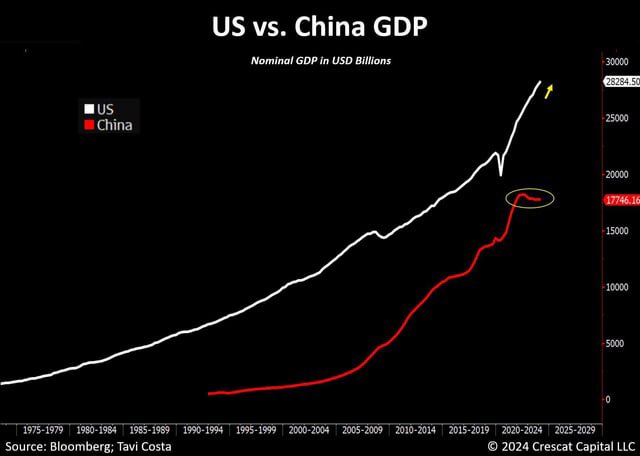
The dream of China surpassing the U.S. as the world’s largest economy is fading. In 2021, China’s GDP was about 78% of the U.S.; by 2024, that share had fallen to roughly 64%, back to around 2017 levels, with the gap between the two economies doubling in just a few years.