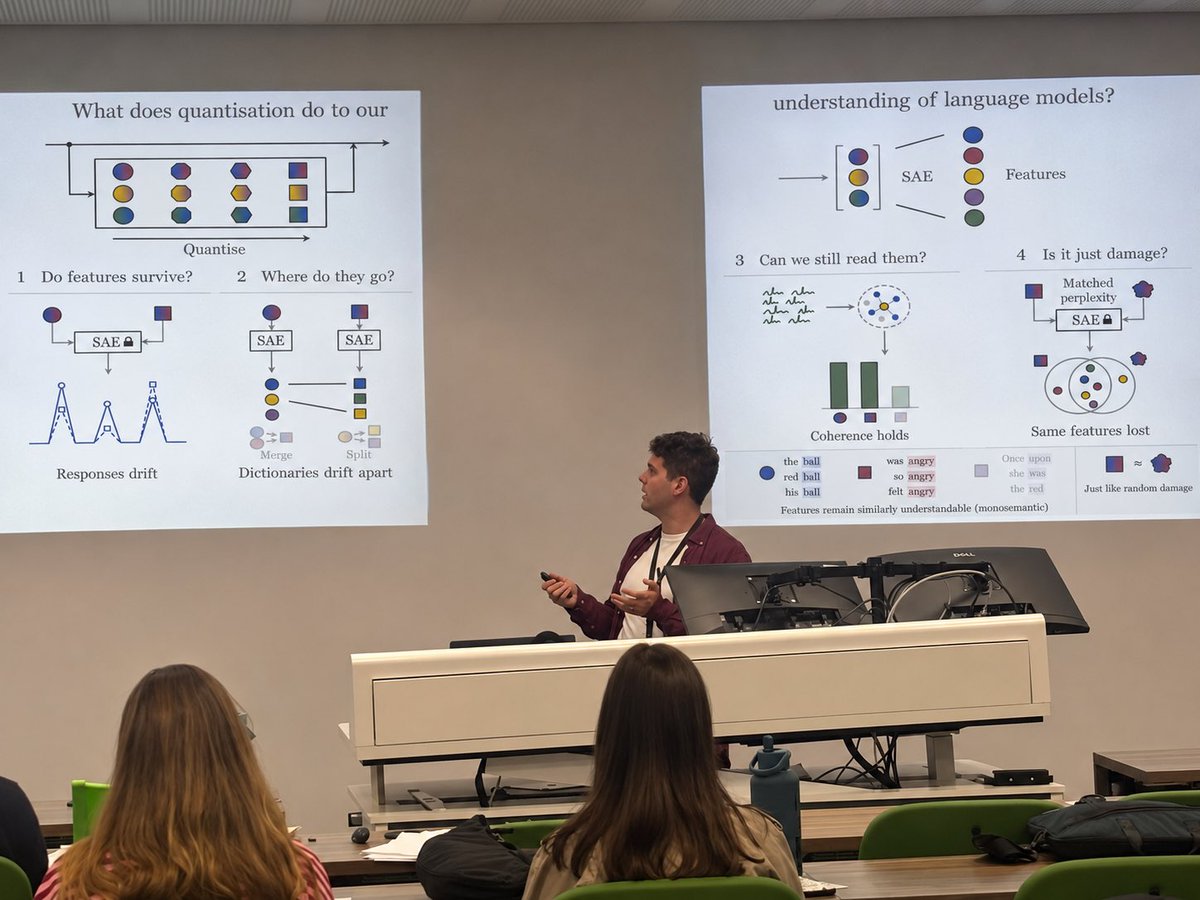
@Grsdfd2@GoodfireAI Classically yes. But is there really anything that prevents neurons across layers to be in superposition/a circuit? I mean in theory crosscoders can analyse neurons across layers. So from that perspective does anything prevent superposition across layers?
@GergelyOrosz@sjgoedecke Professional engineering is an old idea. Software (and AI) have lacked it faaar too long.
Hell, a good mechanic has more “board certification” than most software “engineers”.
Software people have been dodging accountability. That should change.
The flip side of many of those abstractions is patterns. Some abstractions exist mainly to encourage good, consistent patterns. Opinionated frameworks can be valuable precisely because they’re opinionated; not because the particular opinion is sacred, but because consistent application makes the whole thing easier to reason about.
I agree the line has shifted and we may end up with fewer “human-preference” abstractions and more shared patterns. But the same ideas that made people more productive (consistency, clear conventions, reduced cognitive load) are also going to make agents more productive.
I used to do it a lot to have different models review plans, but model switching is dead. No payoff compared to the cache miss cost.
Thinking level switching sometimes makes sense. Brainstorm on a higher level, and then keep it on the same model but at a lower effort because again, it’s cheaper than switching model because the exploration is already in the cache.
@TokenGremlin Honestly so far I’ve been loving it. It just communicates so well?? In between GPT-6 in Chat and 6.1 Terra, if you’re only using the “more powerful” OpenAI stuff, you’re missing out on their best products IMO.
@neural_avb In the words of my supervisor; despite their promise, SAEs are funny things. There may be 100 was to skin a cat but 1000 ways to reconstruct it.