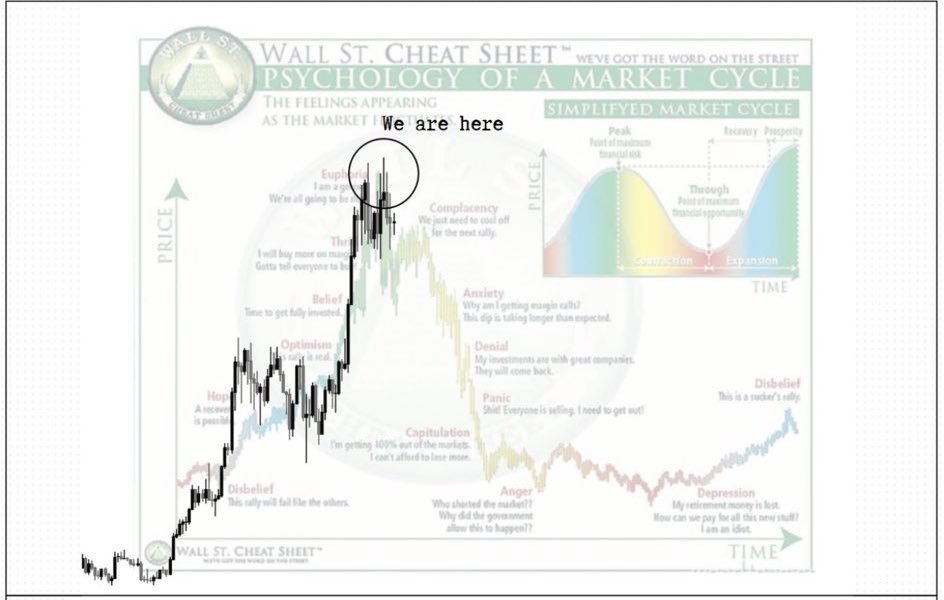
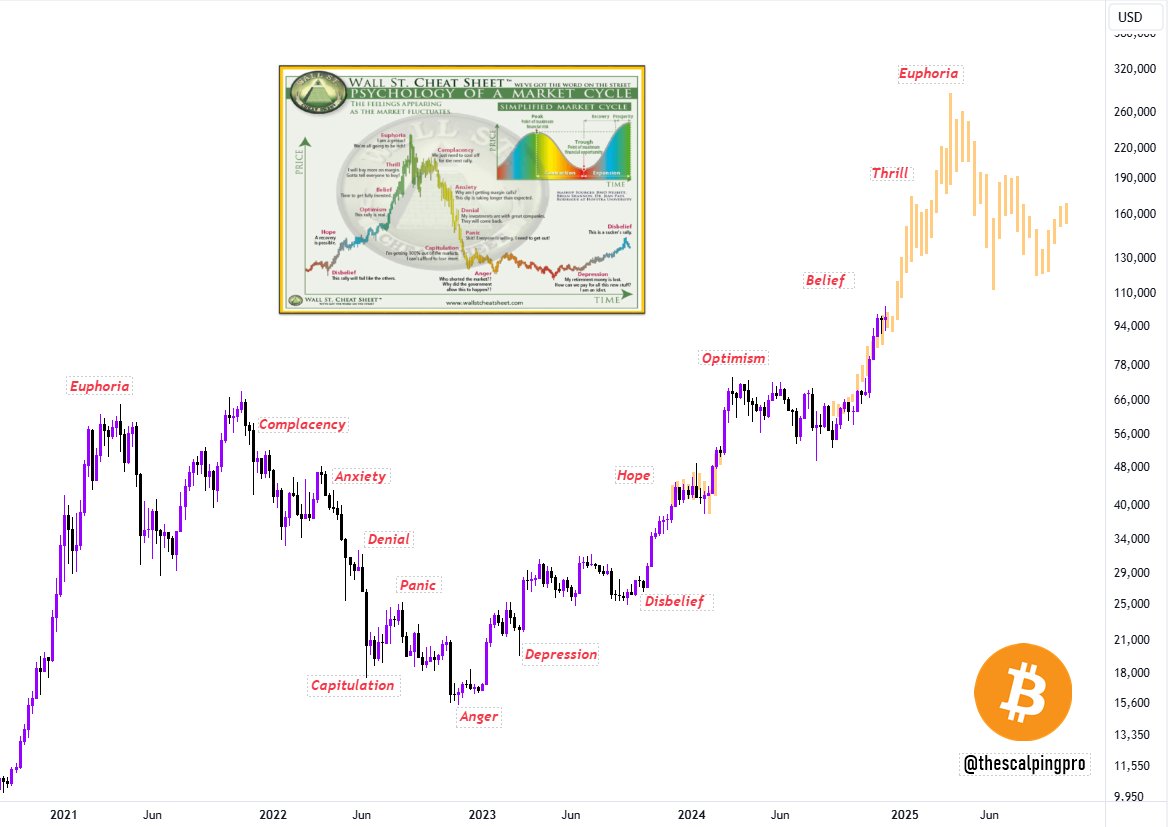
$BTC [1W] is set to continue its bull market parabolically after bouncing off the neckline of this 4-year-old inverse Head and Shoulders pattern, targeting ~$300k.
- Update
The largest Bull Run is officially set to begin in April 2025
Accel phase ends, next $BTC bull target - $300,000
$1,000 in the RIGHT tokens = $200,000 by 2026
Here’s my list of 9 useful alts 🧵👇
The next Bull Run starts on March 11 🔥
$BTC cycles begin 325 days after halving and peak 10 months after.
I followed this pattern in 2021 and made over $130K on altcoins.
Now, I’m going all-in on new alts with 100x potential 🧵🔽
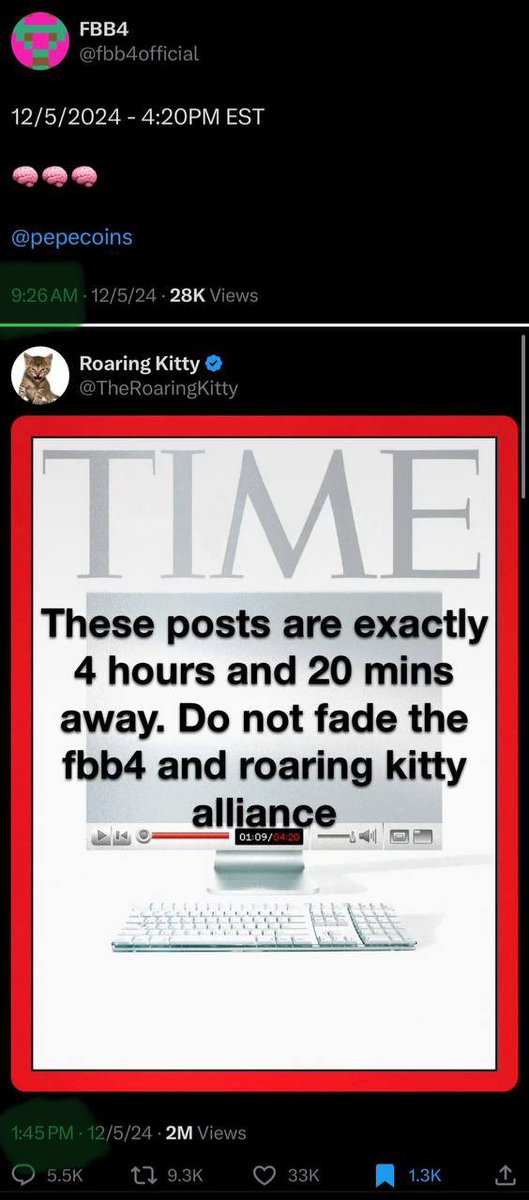
Dear X I am here to tell you that you should know that @TheRoaringKitty and @fbb4official are 1:1.
He is coming to @GMEethereum simply because his stock keeps getting halted because of volatility. He knows that Crypto GME can not be stopped.
He is coming, you will see
$GME @GMEethereum is going to 1billion + this cycle. At least.
Or it just flips the stock because it can. This is Crypto. Thee stock is at 12billion.
It is possible.
I hate seeing "follow the leader" VC behavior.
Blindly following a perceived leader without your own well-formed perspective is not a winning strategy because the market doesn't need it.
And when the market doesn't need something it will eventually stop supporting it.
A Thought Exercise About Value
Re-reading "Debt: The First 5,000 Years" by David Graeber reminded me that many things we think of as "real" are just human constructs. How money actually works and how people interact with it isn't as straight forward as everyone thinks it is. And what we as a society ascribe “value” to isn’t immutable. It’s a social contract that can change if enough people want it to.
And today’s news seems to be obsessed with topics that touch on but don’t explain what money is and why new “things of value” are emerging. Governments around the world are printing money. Bitcoin is emerging as a global reserve currency. Memecoins and Memestocks are achieving and sustaining valuations that shock and awe the TradFi establishment.
With Graeber whispering in my ear and real-world developments catching my eye, I find myself in a philosophical mindset where I’m asking myself a host of fundamental questions about “value”. So if you’re interested, feel free to read on and traverse a thought exercise with me. If not, I totally understand. This isn’t for everyone.
Thought Exercise About Value
Ask yourself:
Is it possible for a thing with no intrinsic value to be worth more than the thing of value that it represents?
My viewpoint:
Consider money. Once tethered to gold in vaults, it has evolved into an almost entirely conceptual construct – numbers flowing through digital spaces, backed by nothing but collective belief and agreement. Yet this abstraction has become more powerful than the physical goods it represents. It can be transferred instantly across the globe, divided infinitely, and used to represent everything from future promises to complex financial instruments.
And at its core, the history of money is a story of collective belief, with periods of stability and periods where everything changes. For instance, in 1971, Richard Nixon shocked the global financial system by decoupling the US dollar from gold which transformed money from a tangible, precious-metal-backed instrument to a pure abstraction backed only by the US Government’s promise and collective faith. This watershed moment blew many people’s minds by revealing an uncomfortable truism: Money is less a physical commodity and more an expression of value that only exists because we collectively agree it does.
But what if the collective decides to change what it values? What if the collective faith rethinks what was deemed “valuable” in the past and decides it’s no longer true.
As a tangible example, what if society simply decided that diamond rings are no longer valid symbols of romantic commitment? This seemingly simple act of collective reimagining could instantaneously liberate billions of dollars annually from the marriage economy and completely upend the “value” of more than a billion rings globally. Diamond engagement rings are pretty. They’re rare. They shine. But the truth is that these glittering tokens represent nothing more than a social construct with zero intrinsic economic utility when trapped in ring form. A diamond ring's value exists purely because we collectively agree it exists, and just as quickly that agreement can be withdrawn.
We're witnessing another profound transformation with Bitcoin, a digital currency that challenges traditional notions of monetary value. Unlike fiat currencies controlled by central banks, Bitcoin represents a decentralized store of value, deriving its worth from mathematical scarcity, technological trust, and global consensus rather than governmental decree.
Human societies consistently demonstrate an extraordinary ability to create, modify, and reimagine constructs of value which is a form of proof that money is not a fixed reality, but rather a fluid, evolving concept shaped by our collective imagination.
So if we return to the question of whether it’s possible for a thing with no intrinsic value to be worth more than the thing of value that it represents I think the answer is “yes”.
Consider this paradox:
A retail company called GameStop exists in the physical world. It has tangible assets: stores filled with inventory, warehouses, cash in the bank, and employees who come to work each day. It generates real revenue from selling actual products. Traditional finance tells us this company's value should be based on its ability to generate future cash flows, its assets, its market position, and its growth potential.
Now imagine a digital token called GME that represents the IDEA of the company and its history but exists purely as an abstract concept. This token has no intrinsic value. It cannot generate revenue. It has no employees. It sells no products. It is, in the most literal sense, nothing more than an idea that people can trade.
Yet this theoretical token, a digital shadow of the real company, could command a higher market value than the actual business it represents. Why? Because while the real company is constrained by the physical limitations of retail space, inventory management, and the need to generate profits, the token trades purely in the realm of belief and narrative.
So the operative question to ask is why would people part with money that has true buying power to hold something that’s purely a representation of a concept? Maybe to be part of a movement that’s one part nihilism and two parts theater of the absurd. Maybe as a nod to history and a way to hold a pure version of “the thing” that made everyone re-think what the power of the collective masses could accomplish. Maybe as a way of having fun while chasing unlimited financial upside.
Think of it like Plato's cave allegory in reverse: What if the shadows on the wall, freed from the constraints of the physical objects casting them, could grow larger and more valuable than their sources? The token, unburdened by the need to deliver quarterly earnings or maintain profit margins, can be valued purely on collective belief, community momentum, and shared narrative. If enough people believe in it’s value, these same people have the ability to maintain its value through sheer HODLing. Supply/demand economic theory will take care of the rest.
This raises uncomfortable questions about the nature of value itself. If a valueless token can become more valuable than what it represents, what does that tell us about our entire system of assigning worth? Perhaps value has always been more about our shared beliefs than any intrinsic quality – the token just makes this truth more explicit.
This thought exercise is not meant to diminish the importance of the real. The real is important. Productive activities matter. Selling goods and services for more than they cost to manufacture and distribute is how companies and economies thrive. But in the space between the thing itself and our conception of it, something magical can happen. There will be times when the unreal will surpass the real.
Blockchains are public ledgers. This adds amazing transparency to actions people are taking and positions that they have with regards to the “things” that a particular Blockchain tracks. In the case of the major L1s, these “things” represent ownership of digital assets that include established tokens like BTC, ETH and SOL, Stablecoins and NFTs.
This transparency means you can with certainty know the activity of any wallet, and if the wallet is associated with a “known” person on entity, it means that you can watch and report on every move they make. And since I started my crypto journey as a Doxxed individual who set about to learn in public, my wallet address has been very public.
I bring this up because a few people have been sharing the fact that “my wallet” has taken a position in a Memecoin (GME on ETH) which feels incredibly counter to anything that “Frank Rotman the Professional Investor” would do given my known fundamentalist views on what investing is and should be about.
But like everything I do there’s a well thought out reason behind my decision to make this personal investment (not associated with my firm). Those of you who know me wouldn’t expect anything less.
At a high level, I’m a learning machine and pride myself on having the superpower of complete open-mindedness. And I also pride myself on being a hands-on, in-the-trenches student rather than an ivory tower academic. In the case of crypto, I went on a multi-year learning journey and shared my insights along the way. It turned some people on and others off (which surprised me). It was me behaving the only way that I know how to: Tackling a new learning opportunity with an open mind. My goal wasn’t financial in nature…it was about gaining an understanding of a potential new financial technology/mega-trend so that I could do my day job better and be “the best Advisor to fintech companies bar none.”
So while the entire concept of Memecoins might turn people off, it’s an undeniable trend that I feel like I need to know more about. I’ve been studying the broader topic of financial nihilism and will be publishing a thought piece on it sometime soon, and Memecoins are one of many “signs and portents” that act as soft proof that the nihilism is a real trend.
As for why I decided on GME on ETH, here’s my thought process:
It starts with my belief that Investing in Memecoins is a negative sum game (the house takes a very large cut and there’s lots of fraud). Every Memecoin millionaire is created by thousands of Memecoin participants losing money. This is the opposite of WAGMI. It feels like a hungry hungry hippo game where one person wins when they get everyone else's marbles.
But what’s interesting about Memecoins is that there is a real value proposition for participants that’s being overlooked and treated as “invalid” by the establishment. The product is the promise of generational wealth. The value proposition is that one good click can change your life forever. The belief is that it’s a game of skill that requires the ability to spot cultural relevance.
The game is designed to make 95% of the people who participate a little bit more poorer and 5% of the people wealthier. The many elevate the few. It’s a speed run on gains and losses and it’s a game that you can watch being played out in real time.
And if you’re really “in it to win it”, you can be a participant in the game by sharing memes and onboarding new people to play with you. Whether an individual wins or loses “fun” was had on the way. Even though a lot of money is being lost by a lot of people, the entertainment factor is real and therefore shouldn’t be deemed “invalid”.
As for GME on ETH, I picked it because I found the entire concept funny and knew some major investors who plan on supporting the movement. I’ll get a front row seat to what makes a Memecoin tick and I’ll get to experience the highs and lows along the way.
The concept that a token that has no intrinsic value could gather momentum to flip the value of the “thing it represents” is actually quite meta and a clear shot at “the establishment”. Gamestop was a traditional stock that became a Memestock and a fascinating game was played out in public between an army of retail traders and professional investors. Money was made. Money was lost. And a new playbook emerged that will have a lasting impact on the financial markets.
Which leads us to GME the Memecoin (vs.GME the stock). The Memecoin has no functionality. It does nothing and it represents nothing except a movement. So what if “the thing with no value” ends up worth more than “the thing of value” which already has memetic value that exceeds its intrinsic value? People were already trading GME (the stock) based on the memetic value of outlasting the professional traders and HODLing in spite of the financial performance of the company. So why care about the financials at all? Having a villain on the other side is powerful but the movement itself is where the real power lies. So wouldn’t GME on ETH running into the billions be a meta-statement about our world and how this new generation is feeling? I think so.
To be honest, I find the whole thing funny and we’re living in an age where being funny is rewarded. If it’s funny, it can go viral. If it’s funny, people remember it. Funny wins.
So, my personal investment in a Memecoin might seem strange but for me it’s a way of getting close to an emerging trend and a way to understand it from the trenches. So many people I know miss trends because they refuse to look at things from a fresh perspective.
The truth is that I’m not always right. In fact, I make mistakes every day. But I don’t mind making mistakes in the pursuit of knowledge. It’s what I do and who I am. No apologies.






![GertvanLagen's tweet photo. $BTC [1W] is set to continue its bull market parabolically after bouncing off the neckline of this 4-year-old inverse Head and Shoulders pattern, targeting ~$300k.
- Update https://t.co/mUweLozy8o](https://pbs.twimg.com/media/GmaVA9Fa8AItVjG.jpg)