À partir de demain, un jean vendu par une plateforme de mode ultra express aura 9 euros de malus.
Une veste, 12. Un t-shirt, 2. Une paire de chaussettes, 50 centimes, dès lors que le score environnemental du produit passe sous le seuil réglementaire.
L'arrêté est paru au Journal officiel vendredi, quatre jours avant son application.
Ce qui déclenche cette pénalité ? Pas la composition du vêtement, pas son transport, pas l'eau consommée à la teinture.
La loi du 8 juillet retient le volume de références que le vendeur met sur le marché et l'effort de réparabilité qu'il propose, appréciés marque par marque… très objectif.
Les montants sont récoltés par Refashion, éco-organisme agréé de la filière textiles, qui aura pour mission de les redistribuer aux enseignes jugées plus vertueuses… très transparent.
Encore une mesure soviétoïde qui ne manquera pas de perturber le marché, créer des rentes, de la corruption, du gâchis et des postes de bureaucrates.
Le consommateur est ravi.
@CerfiaFR Les femmes n'ont strictement rien à faire dans les métiers de la justice, épisode #847299. L'application de la loi sans émotions, c'est une affaire d'hommes.
Pour comprendre pourquoi cette boomeuse écolo-gauchiste pète un câble contre la climatisation, il faut s'intéresser à comment son cerveau fonctionne.
Vous allez voir, c'est drôle.
Pour le comprendre, il faut lire l'étude de Waytz, Iyer, Young, Haidt & Graham, publiée dans Nature Communications (vol. 10, article 4389, 2019).
Cette étude montre que le progressiste se préoccupe davantage de causes abstraites et lointaines que de son cercle proche immédiat.
Ce sont au total sept études, plus de 13 000 personnes interrogées, pour une seule question posée : où chacun place sa préoccupation morale quand on lui demande de la répartir, du cercle le plus proche (soi-même, sa famille...) au plus lointain (la nation, l'humanité, les animaux, la forêt, "tous les êtres de l'univers") ?
Le résultat ?
Deux tempéraments opposés se distinguent, que les auteurs nomment "universalisme" et "parochialisme".
Le conservateur concentre sa compassion sur les cercles proches et concrets. Le progressiste la déporte vers les cercles lointains et abstraits.
Le plus intéressant dans cette étude, c'est que l'affectation de cette préoccupation a un coût d'opportunité.
Comme en économie, celui-ci dit simplement que lorsque vous choisissez une alternative particulière, vous renoncez volontairement aux autres. La préoccupation morale est exclusive, elle exclut donc nécessairement.
C'est pour cela que le progressiste se détourne de ses cercles proches. Parce qu'il ne peut pas compatir équitablement pour la Forêt et pour ses voisins en même temps.
Le plus drôle dans cette étude, c'est la conclusion qu'elle impose. Le progressiste qui affiche une empathie plus vaste a en réalité une empathie plus diluée et floue, qui ne peut jamais s'exercer concrètement, car il est impossible d'aider ou de rendre service à des entités-totem lointaines.
C'est l'inverse du conservateur qui, quant à lui, ne distribue pas sa compassion dans des causes abstraites et inatteignables. Il l'investit concrètement sur des individus qu'il connaît, avec qui il interagit au quotidien.
En bref, "l'amour de l'Humanité" est précisément ce qui dispense d'aimer les hommes. C'est, poussé à sa logique ultime, un antihumanisme.
Finalement, quand cette dame dit "vous croyez que ça va éviter un feu de forêt ? Vous croyez que ça va éviter la disparition de cultures ? Vous croyez que ça va éviter la mort des animaux ?"
Elle dit simplement qu'elle n'aime personne en particulier.
@AllegretPilot Toujours pas de parité concernant le ramassage des ordures ménagères.
Féministe mais heu…pfff…le statut et le fric qui va avec svp merci.
Les débordements systématiques impliquant une population issue de l’immigration s’expliquent en partie par des différences culturelles et un autre rapport à l’autorité.
Voici une anecdote amusante et révélatrice :
@Boblafrite1 Ils ont peur du relief donc ils inventent la terre plate.
Ils ont peur des mammifères donc ils inventent les reptiliens.
Ils ont peur des enfants donc ils inventent Epstein...
Wow c'est dingue, ça marche avec tout 😳
Bref, vous pouvez aussi consulter mes vidéos à ce sujet :
https://t.co/blfe0MP7Af
https://t.co/NGQWRoENNK
https://t.co/EJeWqI3Jhx
https://t.co/oUHLeDqLtQ
@CeJour_Histoire Souvenez-vous
"Bien malin qui peut dire honnêtement
Où se sont passés ces événements
Mais méfions-nous qu'en y mettant des noms
On se trompe de lieu ou d'opinion."
@BFMTV Le saviez-vous ?
Une fois tous les 5 ans a lieu la grande purge judiciaire où tous les candidats non validés par le système sont éliminés par les magistrats.
Un choix simplifié pour une démocratie vigoureuse 🙌🇪🇺🇫🇷
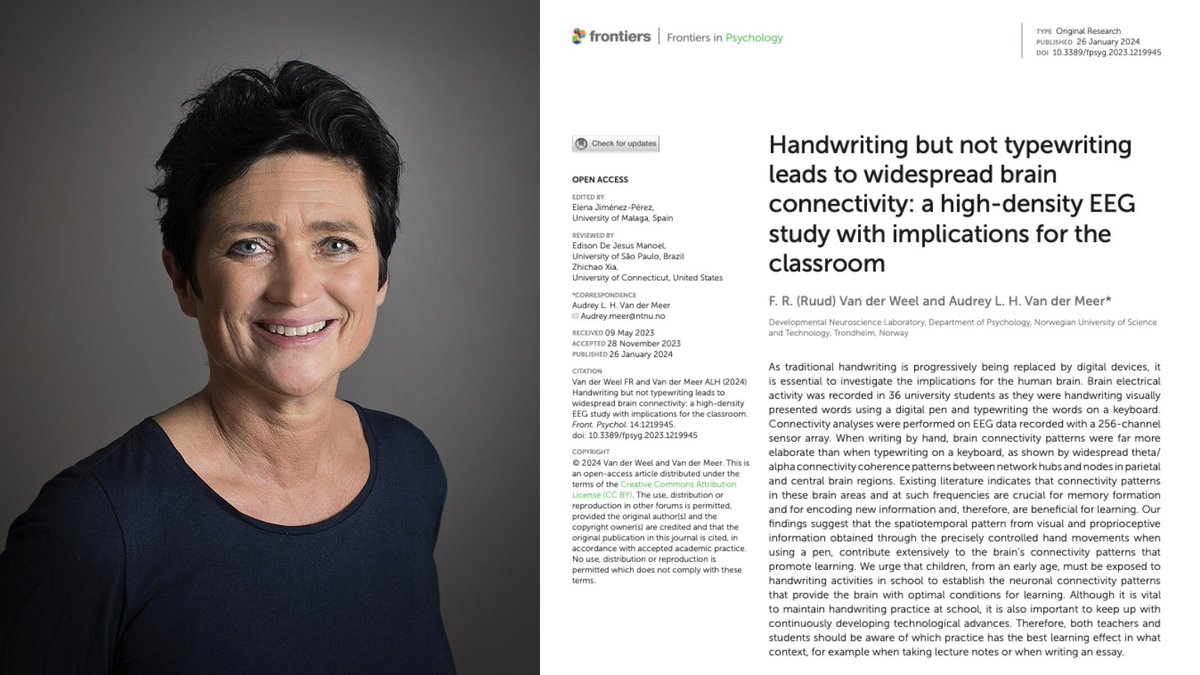
A Norwegian neuroscientist spent 20 years proving that the act of writing by hand changes the human brain in ways typing physically cannot, and almost nobody outside her field has read the paper.
Her name is Audrey van der Meer.
She runs a brain research lab in Trondheim, and the paper that closed the argument was published in 2024 in a journal called Frontiers in Psychology. The finding is brutal enough that it should have changed every classroom on Earth.
The experiment was simple. She recruited 36 university students and put each one in a cap with 256 sensors pressed against their scalp to record brain activity. Words flashed on a screen one at a time.
Sometimes the students wrote the word by hand on a touchscreen using a digital pen, and sometimes they typed the same word on a keyboard. Every neural response was recorded for the full five seconds the word stayed on screen.
Then her team looked at the part of the data most researchers had ignored for years, which is how different parts of the brain were communicating with each other during the task.
When the students wrote by hand, the brain lit up everywhere at once.
The regions responsible for memory, sensory integration, and the encoding of new information were all firing together in a coordinated pattern that spread across the entire cortex. The whole network was awake and connected.
When the same students typed the same word, that pattern collapsed almost completely.
Most of the brain went quiet, and the connections between regions that had been alive seconds earlier were nowhere to be found on the EEG.
Same word, same brain, same person, and two completely different neurological events.
The reason turned out to be something nobody had really paid attention to before her work. Writing by hand is not one motion but a sequence of thousands of tiny micro-movements coordinated with your eyes in real time, where each letter is a different shape that requires the brain to solve a slightly different spatial problem.
Your fingers, wrist, vision, and the parts of your brain that track position in space are all working together to produce one letter, then the next, then the next.
Typing throws all of that away. Every key on a keyboard requires the exact same finger motion regardless of which letter you are pressing, which means the brain has almost nothing to integrate and almost no problem to solve.
Van der Meer said it plainly in her interviews.
Pressing the same key with the same finger over and over does not stimulate the brain in any meaningful way, and she pointed out something that should scare every parent who handed their kid an iPad.
Children who learn to read and write on tablets often cannot tell letters like b and d apart, because they have never physically felt with their bodies what it takes to actually produce those letters on a page.
A decade before her, two researchers at Princeton ran the same fight using a completely different method and ended up at the same answer. Pam Mueller and Daniel Oppenheimer tested 327 students across three experiments, where half took notes on laptops with the internet disabled and half took notes by hand, before testing everyone on what they actually understood from the lectures they had watched.
The handwriting group won by a wide margin on every question that required real understanding rather than surface recall.
The reason was hiding in the transcripts of what the two groups had actually written down.
The laptop students typed almost word for word, capturing more total content but processing almost none of it as they went, while the handwriting students physically could not write fast enough to transcribe a lecture in real time, which forced them to listen carefully, decide what actually mattered, and put it in their own words on the page.
That single act of choosing what to keep was the learning itself, and the keyboard had quietly skipped the choosing and skipped the learning along with it.
Two studies. Two countries. Same answer.
Handwriting makes the brain work. Typing lets it coast.
Every note you have ever typed instead of written went into your brain through a thinner pipe. Every meeting, every book highlight, every idea you captured on your phone instead of on paper was processed at half depth.
You did not forget those things because your memory is bad. You forgot them because typing never woke the part of the brain that would have made them stick.
The fix is the thing your grandmother already knew.
Pick up a pen. Write the thing down. The slower road is the faster one.
Orthographe et grammaire renforcés au bac et au brevet : « La bienveillance est devenue une maltraitance. Sous couvert de bienveillance, on a renoncé à l'exigence. La rigueur serait du rigorisme, l'autorité de l'autoritarisme ... », analyse Harold Cobert, professeur de français dans Paris d'Ecole.
→ https://t.co/xMMORLLkeT
« Je trouve insultant de publier une phrase qu’on n’a pas pensée, qui ne vient pas de soi et ne reflète pas notre intention. C’est une question de dignité. Un sujet humain témoigne de sa singularité, de son intériorité à un autre par le langage et l’écriture. Si la parole vient de la masse, d’une simple corrélation statistique, dans un but purement utilitaire, la communication n’a plus d’intérêt humain. » — Gaspard Kœnig