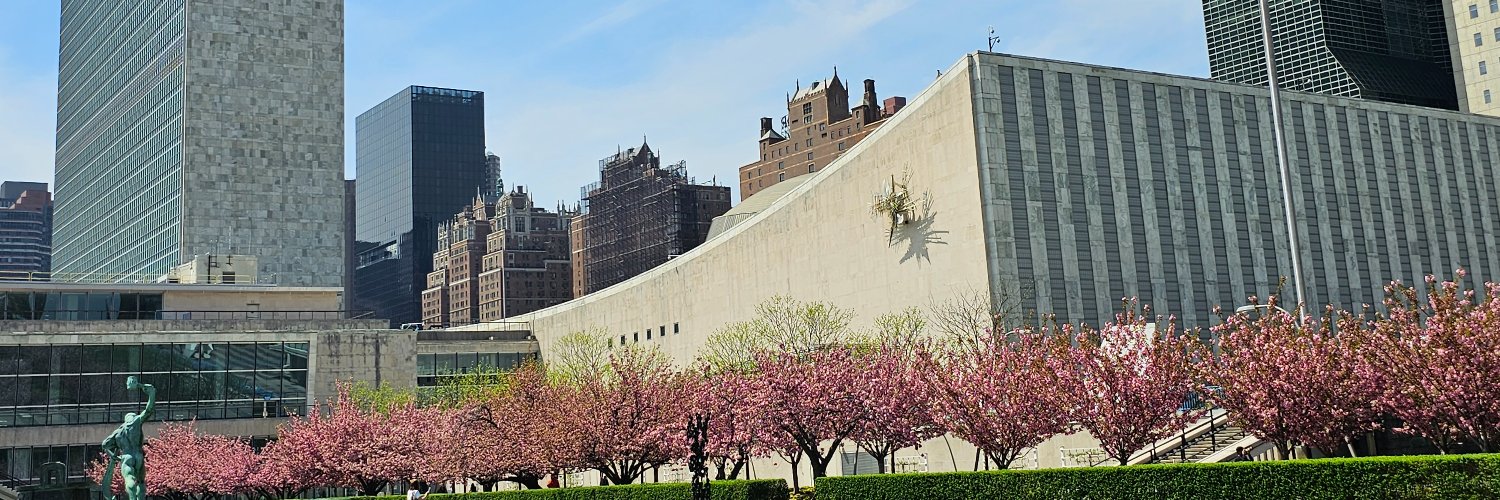
'October Surprise,' or DOA? The WSJ reports that USA-China-Russia have discussed Viktor Orbán, Hungary’s former PM, as an ‘October Surprise’ candidate for the next UN secretary-general. The race is deadlocked. But would his candidacy be DOA? It’s hard to imagine he wouldn’t be vetoed by Britain and France.
Photo: European Union
An interesting 'October Surprise' from the United Arab Emirates, as they advance a late entrant into the race to become the next United Nations Secretary-General.
The selection process for the next United Nations secretary-general has been deadlocked. We’ve been predicting an ‘October Surprise’—and here it is. The United Arab Emirates has nominated @Lana_Nusseibeh, who if she secures the office, would become the first woman and the first Arab from a Gulf state in this role.
I imagine you'll hear more from me about this in my articles for @ForeignPolicy and on my podcast, @delegateslounge. Follow the pod on Instagram and at our YouTube channel (link in bio) for updates on the race to replace UN Secretary-General António Guterres, whose term concludes at the end of December.
cc: @mofauae@UAEMissionToUN
Is the UN Security Council hopelessly gridlocked? “Ask those who caused it,” Poland’s Deputy Prime Minister and Foreign Minister @sikorskiradek told me in our exclusive interview during #UNGA. His rule number one for international order: “Don’t invade your neighbors. How about that?”
WATCH: full exclusive interview on our YouTube channel at the link in the first reply. 👇
@PolandMFA
I sat down for an interview with Poland’s foreign minister @sikorskiradek during UN Week (a.k.a. UNGA). He told me the U.S. should use the new Graham Act sanctions against those who trade with Russia: “We should not be funding Russia’s war.”
On Oct. 9, Washington announced a diesel deal with Putin and eased sanctions on Russian diesel.
@PolandMFA
Russia is using “boiling the frog tactics, to see how to normalize what is unacceptable,” Poland’s Deputy PM and FM @sikorskiradek tells us. Drones, arson, assassination plots: Moscow’s hybrid war is escalating.
Our exclusive #UNGA81 interview 👇
@PolandMFA
This was a fascinating briefing. Though he was only expected to take a few questions on the sidelines of this event, he spent nearly 40 minutes on a wide range of AI issues.
I was in the room for a small press briefing with @nvidia CEO @JensenHuang when he stopped off in NYC on Monday on his way to DC. He was in town to receive an award from @koreasociety . I asked two questions—on AI security and energy-hungry data centers. Short clip below. Watch the briefing from Sept. 28 (same day NVIDIA introduced its Open Agent Safety Platform) on our YouTube channel here: https://t.co/joOZRot6TK Video courtesy of The Korea Society.
The United States Mission to the United Nations held its annual party at the reopening of the UN General Assembly in September. This year, it fell on the eve of the 25th anniversary of the 9/11 attacks. The Tribute in Light—search light beams representing the missing Twin Towers—shine behind the UN Secretariat building. That large tent on the lawn is not a permanent fixture. Construction is underway on the Media Center for the visiting press during the High-Level Week later this month.
I was there on 9/11. I lived near the Flatiron Building. I watched the grim parade of survivors covered in ash on their slow march uptown. Amid the panic buying, the local grocery store let us take the carts home and back again for sudden necessities. I remember buying a cartload of bottled water because my roommate suggested that they might hit the water supply next. In the coming days, fliers with photos of the missing appeared outside the nearby U.S. Army National Guard's Lexington Avenue Armory—a transitory monument to hope. We watched families arriving to turn in DNA samples to identify remains. Twenty-five years on, 40 percent of the families of people who died in the attack on the World Trade Center have not received identifiable remains.
I can't believe it has been a quarter of a century. Somber memories, in shades of dark and light.
—JAT
Sadly, my @ForeignPolicy story about the politicization of sport and the failure of so-called “sports diplomacy” becomes more relevant with each passing day.
On the bright side, I will save so much time not watching future FIFA matches or Olympic games.
When Donald Trump called FIFA President Gianni Infantino to personally lobby for the reversal of a USA red card, he may have ushered in the next stage in hard power's invasion of the pitch detailed in my @ForeignPolicy story, "Is Sports Diplomacy Still Possible?"
I'm simultaneously proud that my essay ran as part of FP's July Fourth weekend coverage—and a teensy bit regretful that now the essay can't include the Trump/red card flap.
First, about that red card—and I'm really trying to be a dispassionate journalist here rather than an avid soccer fan—but I think millions of viewers saw it as a bad call. You might say, what else is new? Fans usually take a red card badly; but it's hard to see how the VAR review could interpret that personal collision as a deliberate foul. On the other hand, I also saw the red card against England in last night's game against Mexico as a travesty. Should King Charles call Infantino?
I haven't personally watched all of the 13 red card plays in this tournament; once in a while, I do have to peel my eyes away from the screen during the World Cup. But it wouldn't surprise me if the other red cards have their doubters, too. I'm going out on a limb here, but how about an automatic Article 27 red card review during the World Cup, especially, though not necessarily only, if a team is continuing on without a player lost to a red card? What do you say FIFA?
Beyond automating the review process, I don't see how you can minimize the accusations of politicization. Though it's fair to say they would persist on some level as the review outcomes are bound to differ.
It's a bizarre sports story on so many levels. Trump—who has been AWOL from the FIFA World Cup, including Team USA games—is reportedly planning to attend the World Cup final and award the trophy. He stood there this morning at an unrelated press conference in the Oval Office and proclaimed his ignorance of soccer, saying that until this instance, he hadn't known "what the hell a red card was." Almost immediately, video surfaced of Infantino showing him yellow and red cards from behind the Oval Office desk at an earlier media op. Those two things aren't necessarily mutually exclusive. And that's putting aside the oddest detail of all—the player who received the red card, Folarin Balogun, can only compete for Team USA as a beneficiary of the birthright citizenship that Trump wants to overturn.
Finally, let's consider how this phone call could be precedent setting. Belgium tried to appeal the successful appeal by the USA. When Belgium's appeal was denied today, Infantino rushed out a statement to say, in a nutshell, yes, he had received a call from the American president—he gets a lot of phone calls—but this decision was arrived at by an independent disciplinary committee, so there! Pullquote: "Respect for independent institutions and the rule of law is what protects the integrity of our competitions and the credibility of FIFA at all times.”
But even if the red card was unwarranted, if Team "Why Not Us?" brings it home, fans will forever wonder if this call (in both senses of the word) made the difference.
https://t.co/HppZy2sP7g
Hard power continues to dictate the terms of the field—whether through the Trump administration’s stranglehold on entry visas or through attempts at direct public diplomacy by FIFA, writes @alextarquinio. https://t.co/aPgukMSaYr