Cuando Popper perdió la paciencia con Habermas
El 9 de enero de 1970 Popper escribe a Hans Albert una carta que no busca convencer: busca condenar. Acaba de leer el libro del *Positivismusstreit*. Adorno ha muerto. Habermas sigue en pie. Y eso le basta.
«No puedo tomar en serio a esta gente… Habermas es un Flachkopf.», dice la carta. Para Popper el asunto es ontológico y epistemológico a la vez. El conocimiento solo existe si puede ser destruido. Una idea que se protege a sí misma deja de ser pensamiento y se convierte en dogma. Ve en Habermas el regreso de una razón que habla mucho y no se deja herir: lenguaje cerrado, totalidad sin residuo, inmunidad frente a los hechos. Un Flachkopf no es alguien torpe: es alguien que ha cerrado el pensamiento sobre sí mismo y ha abolido la vulnerabilidad como condición del saber.
La carta nunca llega a Habermas. Queda entre Popper y Albert. Sin embargo, la obra posterior de Habermas opera como una respuesta sin haber leído la pregunta. Donde Popper exige la «mortalidad» de las proposiciones (falsabilidad), Habermas construye las «condiciones de posibilidad» del acuerdo (acción comunicativa, situación ideal de habla). La validez se desplaza: de la refutación empírica al procedimiento intersubjetivo. El derecho ya no se sostiene solo en la capacidad de destruir una proposición falsa, sino en la capacidad de deliberar sin coacción.
Dos exigencias se miran y no se tocan.
Una exige que toda idea pueda morir para ser legítima. La otra exige que exista un espacio donde nadie pueda destruir al otro por la fuerza.
Y entonces, en la misma carta, sin apenas transición, Popper pregunta por Hayek, por Alpbach y anuncia que acaba de concluir un pequeño trabajo sobre mecánica cuántica.
En ese desplazamiento se cifra la diferencia ontológica y, al mismo tiempo, la hibris. La razón que acaba de pronunciar el veredicto de insignificancia intelectual sobre toda una tradición no se refugia en el lenguaje autorreferencial. Regresa, con naturalidad, al ámbito de lo falseable. A la física. A aquello que todavía puede ser refutado por el mundo.
El gesto es más radical que el insulto.
Revela la soberbia de quien se siente tan asentado en la realidad que puede permitirse la crueldad absoluta sin temer perder el suelo. Y frente a ella, la otra soberbia: la de una racionalidad que pretende construir un espacio de acuerdo tan protegido que las ideas ya no necesiten exponerse a la muerte.
La cuestión que permanece abierta no es ya quién tenía razón en 1970.
Es esta: ¿Qué forma de racionalidad estamos instituyendo cuando aspiramos a la vez a la crítica despiadada y a la inmunidad del consenso… sin querer pagar el precio de ninguna de las dos?@GregorioLuri ¿Puede sobrevivir una razón que ha olvidado cómo morir… o una razón que ya no se atreve a mirar el mundo que todavía puede refutarla?
#Flachkopf #Habermas #Popper
This looks like a must-read!
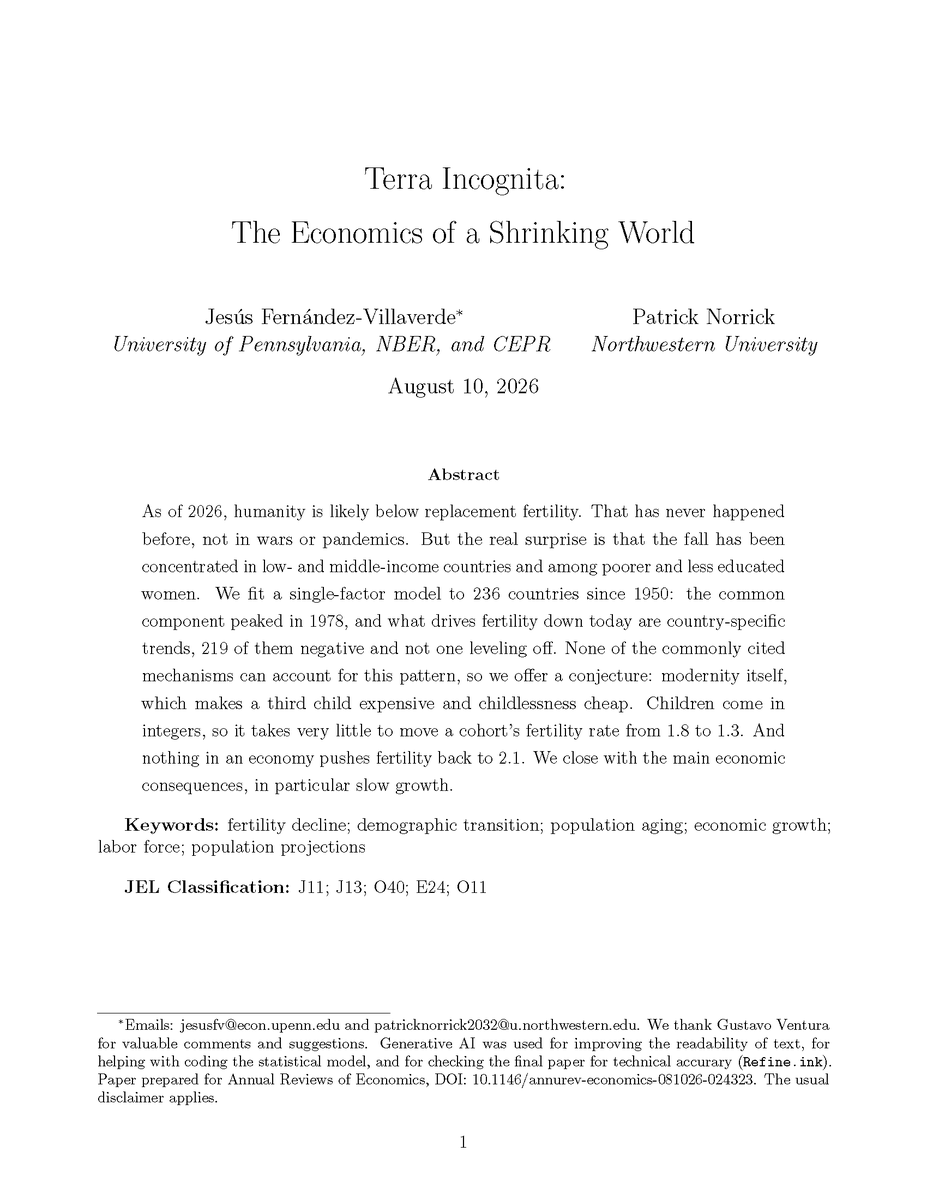
"Terra Incognita: The Economics of a Shrinking World" by Jesús Fernández-Villaverde and Patrick Norrick.
"As of 2026, humanity is likely below replacement fertility. That has never happened before, not in wars or pandemics. But the real surprise is that the fall has been concentrated in low- and middle-income countries and among poorer and less educated women. We fit a single-factor model to 236 countries since 1950: the common component peaked in 1978, and what drives fertility down today are country-specific trends, 219 of them negative and not one leveling off. None of the commonly cited mechanisms can account for this pattern, so we offer a conjecture: modernity itself, which makes a third child expensive and childlessness cheap. Children come in integers, so it takes very little to move a cohort’s fertility rate from 1.8 to 1.3. And nothing in an economy pushes fertility back to 2.1. We close with the main economic consequences, in particular slow growth."
https://t.co/W5lIk4v3tk
Finally finished How China Works by Xiaohuan Lan.
It was my second book about China after Dan Wang’s Breakneck. I found it to be a great follow up because it goes it gives a high level overview of how the Chinese state is organised and goes into detail of how it raises taxes and allocates capital. Both in my view were missing from Breakneck, which is engagingly written but leans heavily on anecdotes.
It is must read for anyone wishing to understand China, but beware that the prose is rather dry and academic.
Super interesting!
"Dollarisation and monetary control: what lessons for the rise of stablecoins?" by Boris Hofmann, Aaron Mehrotra, and Jan Paulick.
"The emergence of stablecoins has created a new channel to access US dollar liquidity in emerging market and developing economies (EMDEs), similar to the historical role of foreign currency deposits, or "deposit dollarisation". This has raised concerns about the possible implications for monetary control in EMDEs. Drawing on data on foreign currency deposits and dollar-pegged stablecoin inflows for more than 130 economies, we compare the dynamics and drivers of "stablecoin dollarisation" with those of conventional deposit dollarisation. We document that historical deposit dollarisation and recent stablecoin flows are both associated with similar macro-financial drivers, including the strength of exchange rate pass-through and sovereign or banking crises. We further document significant persistence in both deposit and stablecoin dollarisation, suggesting that dollarisation is hard to reverse once established. Unlike deposit dollarisation, stablecoin flows seem to be largely unaffected by either broad or specific capital flow restrictions. This likely occurs because stablecoins are partly circulating outside the regulatory perimeter. The historical record also suggests that moderate deposit dollarisation has been associated with somewhat higher inflation risks, although there is little evidence of significant impacts on monetary policy transmission."
https://t.co/GZkO9pNbmh
Great Books for Summer or Winter Reading!
"A Culture of Growth: The Origins of the Modern Economy" by Joel Mokyr.
"In this groundbreaking book, celebrated economic historian Joel Mokyr argues that a culture of growth specific to early modern Europe and the European Enlightenment laid the foundations for the scientific advances and pioneering inventions that would instigate explosive technological and economic development. Bringing together economics, the history of science and technology, and models of cultural evolution, Mokyr demonstrates that culture—the beliefs, values, and preferences in society that are capable of changing behavior—was a deciding factor in societal transformations."
https://t.co/Ss3hzfxEty
Highly relevant!
"The evolving nexus: sovereigns, banks and NBFIs" by Stefan Avdjiev, Bryan Hardy, and Maximilian Jager.
"This paper documents that the traditional sovereign-bank nexus has morphed into a broader nexus that now also includes non-bank financial institutions (NBFIs): the sovereign-bank-NBFI nexus. The classical sovereign-bank nexus has been a major financial stability concern following the eurozone crisis. Since then, sovereign debt levels have increased substantially in many major economies, while NBFIs' footprint in sovereign bond markets has grown significantly. This paper examines the transmis sion of risks among banks, sovereigns and NBFIs using European bank-level data and global country-level data. We find that banks' direct sovereign exposures have recently become less important in explaining the co-movement between bank and sovereign risk. By contrast, banks' exposures to NBFIs have become a significant determinant of the bank-sovereign risk co-movement. We also find evidence that NBFIs' sovereign debt holdings have become important drivers of the co-movement between NBFI and sovereign risk."
https://t.co/WsVDOmZwuW
The traditional sovereign-bank nexus has evolved into a broader sovereign-bank-NBFI nexus, in which non-bank financial institutions play an increasingly important role in the transmission of sovereign risk to banks https://t.co/ea0yJdUGaz
The Modern State
Rooted in continental European state theory, this book by Thomas Vesting argues that the modern western state is a composite of 3 overlapping layers: the constitutional state, the welfare state & the network state.
More info & Chapter 1: https://t.co/JW1VPIq2E2
Great Books for Summer or Winter Reading: Thought-provoking, perhaps controversial, and certainly worth reading!
"The Third Pillar: How Markets and the State Leave the Community Behind" by Raghuram Rajan.
"Raghuram Rajan, distinguished University of Chicago professor, former IMF chief economist, head of India's central bank, and author of the 2010 FT-Goldman-Sachs Book of the Year Fault Lines, has an unparalleled vantage point onto the social and economic consequences of globalization and their ultimate effect on our politics. In The Third Pillar he offers up a magnificent big-picture framework for understanding how these three forces--the state, markets, and our communities--interact, why things begin to break down, and how we can find our way back to a more secure and stable plane."
https://t.co/b9Zu2jgt53
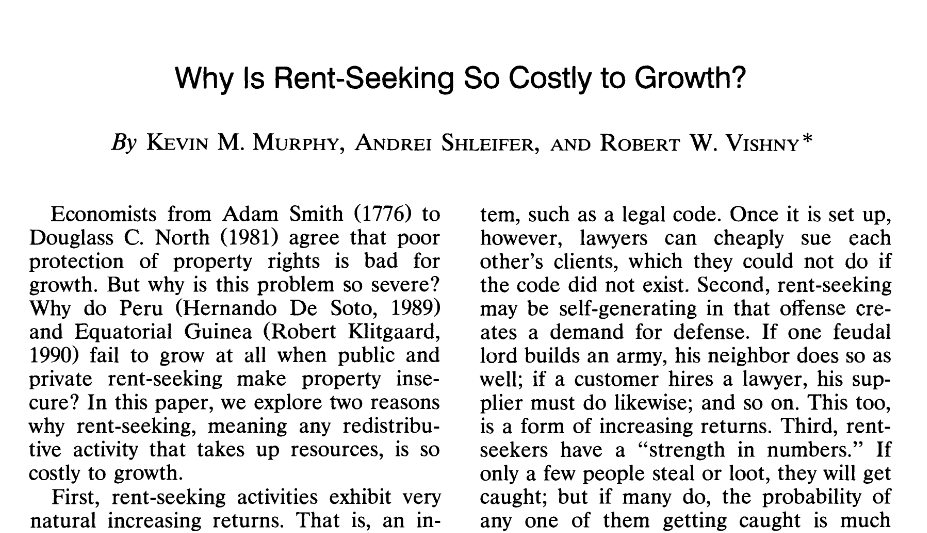
This is one of my favorite papers to teach rent-seeking and the relationship to economic growth. Its well argued and essentially also introduces multiple equilibria logic to students in simple mathematics.
The Library of Alexandria created the first catalog of all human knowledge 2,300 years ago, and a team of fewer than 20 people just finished the modern version and made it free for the entire planet.
It is called OpenAlex. The name is not an accident.
The ancient library had the Pinakes, a catalog mapping every scroll, every author, every subject. When the library fell, the map of what humanity knew fell with it.
For the last two decades, that map existed again, but it was locked up.
Elsevier owns Scopus. Clarivate owns Web of Science. If your university could not afford the subscription, you could not see the structure of science itself. Entire countries were priced out of knowing what research existed.
OpenAlex indexes 474 million scholarly works. Every author disambiguated. Every citation traced. Every institution and funder connected. It updates with roughly 50,000 new works every day.
The whole thing is CC0. Not just free to search. Free to download, copy, sell, and build on. The API allows 100,000 requests a day without an account.
The ancient library burned and the catalog was lost for two millennia.
The new one cannot burn. Anyone can hold a copy.
https://t.co/peUYYpucnc
While in the Dominican Republic yesterday, I was delighted to visit @TheAESCorp’s impressive liquid natural gas facility near Santo Domingo. Ships bring natural gas from the US, it’s pumped into massive storage tanks, and then piped or trucked throughout the country. Energy is the foundation for all economic activity, and this amazing facility, with its local partners, has allowed the country to grow based on inexpensive and reliable US gas. (I also enjoyed rocking my guayabera, or chacabana as they call it in the DR.) 🇺🇸🤝🇩🇴
Two economists just published a mathematical proof that AI will destroy the economy.
Not might. Not could. Will — if nothing changes.
The paper is called "The AI Layoff Trap." Published March 2, 2026. Wharton School, University of Pennsylvania. Boston University. Peer reviewed. Mathematically modeled.
The conclusion is one sentence.
"At the limit, firms automate their way to boundless productivity and zero demand."
An economy that produces everything. And sells it to nobody.
Here is how you get there.
A company fires 500 workers and replaces them with AI. A competitor fires 700 to keep up. Another fires 1,000. Every company is behaving rationally. Every company is following the incentives correctly. And every company is building a trap for itself.
Because the workers who were fired were also customers.
When they lose their jobs faster than the economy can absorb them, they stop spending. Consumer demand falls. Companies respond by cutting costs — which means automating more workers — which means less spending — which means more falling demand — which means more automation.
The loop has no natural exit.
The researchers tested every proposed solution. Universal basic income. Capital income taxes. Worker equity participation. Upskilling programs. Corporate coordination agreements.
Every single one failed in the model.
The only intervention that worked: a Pigouvian automation tax — a per-task levy charged every time a company replaces a human with AI, forcing them to price in the demand they are destroying before they pull the trigger.
No government has implemented this. No major economy is seriously discussing it.
Meanwhile the numbers are already tracking the curve. 100,000 tech workers laid off in 2025. 92,000 more in the first months of 2026. Jack Dorsey fired half of Block's workforce and said publicly: "Within the next year, the majority of companies will reach the same conclusion."
Nobody is doing anything wrong. Companies are following their incentives perfectly. That is exactly the problem.
Rational behavior. At scale. Simultaneously. With no mechanism to stop it.
Two economists built the math. The math leads to one place.
Source: Falk & Tsoukalas · Wharton School + Boston University ·
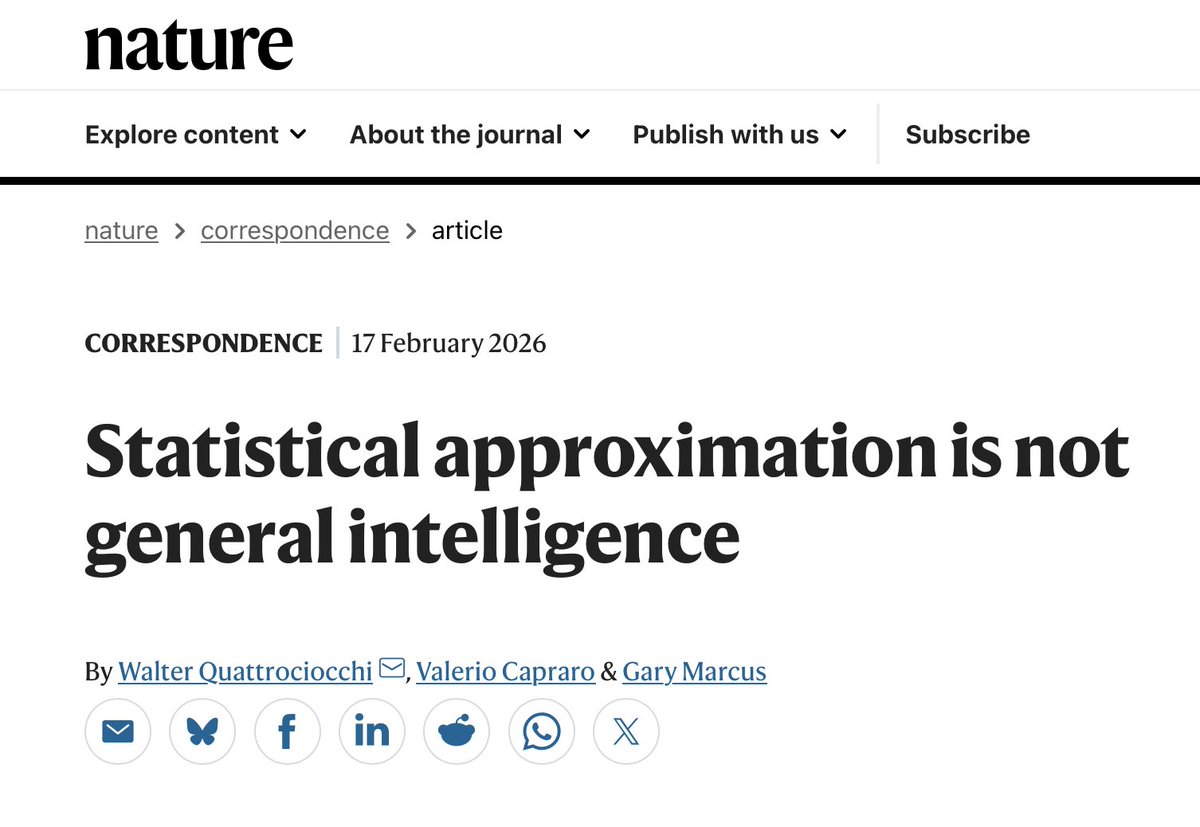
The Pope is making exactly our point. LLMs “may imitate or even simulate, but they do not understand.”
This is the core epistemic fault line.
Most AI evaluation is still based on one assumption: if a system statistically approximates human behaviour, then it is close to human intelligence.
But approximation is not intelligence.
Simulation is not understanding.
LLMs can produce the right answer without knowing why it is right. They can simulate empathy without feeling. They can imitate judgment without responsibility. They can generate coherent explanations without having a world to which those explanations are accountable.
Stop confusing behavioural similarity with cognitive equivalence.
Human understanding is embodied, affective, relational, motivational, and normative. It is not just the production of plausible text.
*
Full paper in the first reply
A new framework to analyze who the response of lending to monetary policy depends on capital regulation and the interest-rate risk exposure, from Jorge Abad, @SakiBigio, Salomon Garcia-Villegas, Joël Marbet, and @NunoGalo https://t.co/pgZE3IqRZg
Highly relevant!
"The Theory of Financial Stability Meets Reality: A Unifying Framework for Bank Regulation and Accounting Discretion" by Nina Boyarchenko, Kinda Hachem, and Anya Kleymenova.
"A large literature at the intersection of economics and finance offers prescriptions for regulating banks to increase financial stability. This literature abstracts from the discretion that accounting standards give banks over financial reporting, creating a gap between the information assumed to be available to regulators in models of optimal regulation and the information available to regulators in reality. We bridge insights from the economics, finance, and accounting literatures to synthesize knowledge about the design and implementation of bank regulation and identify areas where more work is needed. We present a simple framework for organizing the relevant ideas, namely the externalities that motivate bank regulation, the rationales for allowing accounting discretion, and the use of discretion to circumvent regulation. Our takeaway from reviewing work in these areas is that academic studies of bank regulation and accounting discretion require a more unified approach to design optimal policy for the real world."
https://t.co/FNTo0cyCQx
A Chicago philosopher wrote one book in 1940 proving that 95% of the books you have read in your life, you didn't actually read, and Charlie Munger has been telling people to read it for 50 years.
His name was Mortimer Adler.
He spent 40 years at the University of Chicago, ran the editorial board of the Encyclopædia Britannica, and built his entire career on one uncomfortable observation about the people around him.
Most adults who called themselves well-read had not actually read a book in the real sense even once. They had run their eyes over the pages, registered the words, formed a vague impression, and put it back on the shelf.
The book had passed through them without ever entering them.
In 1940 he wrote How to Read a Book. It has stayed in print for 86 years.
Charlie Munger recommends it. Naval Ravikant recommends it. Fareed Zakaria recommends it.
Every serious thinker who builds a career on absorbing information eventually finds their way to this book, and the reason is that Adler had isolated something nobody else was naming clearly.
There are four levels of reading. Almost everyone is stuck on the second one. The fourth level is so different from what most people call reading that you have probably never done it in your entire life.
Level one is elementary.
You learn it as a child. You decode the letters into words and the words into sentences. You finish the sentence and understand roughly what it said. This is reading the way a 7-year-old reads, and almost every adult on earth has stopped developing past this point in some quiet way.
Level two is inspectional.
This is skimming. You move through a book quickly to figure out what it is broadly about. You read the back cover, scan the table of contents, glance at a few paragraphs, and form an opinion. Most adults who claim to have read 50 books a year are actually doing this. They are inspecting books, not reading them. They walk away with a vague sense of the argument and almost none of the evidence that supports it.
Level three is analytical.
This is the level Adler said most people have never properly experienced. You take one book and you wrestle with it for as long as it takes. You identify the question the author is trying to answer. You map their argument from front to back. You write your disagreements in the margins. You force yourself to articulate, in your own words, what the author is claiming and why. The point is not to finish the book. The point is to argue with it as if the author were sitting across the table from you. Most people never do this once in their life, because it is exhausting and slow and feels nothing like the reading they were taught as children.
Level four is the one almost nobody knows exists. Adler called it syntopical reading. The word means "across topics," and the technique is something closer to running a small private research lab in your own head.
You pick a single question that actually matters to you. How does power corrupt people. Why do civilizations collapse. What makes a marriage last. How does a person change their own mind. Then you assemble five or ten or twenty books from different authors, different centuries, different traditions, all of them taking a swing at the same question.
You do not read any of them cover to cover. You move between them. You find the chapter in book three that addresses the same question as the chapter in book seven. You force those two authors to argue with each other inside your own head.
The book stops being the unit of reading. The question becomes the unit. And the authors become voices in a conversation you are now hosting.
This is the level where reading stops being consumption and starts being construction.
You are no longer absorbing what someone else thinks. You are building a position of your own out of the friction between people who disagreed.
Adler argued that this is the only level of reading where you stop being a passive receiver of other people's ideas and start being someone who can produce ideas of their own.
The reason Charlie Munger has been recommending this book for 50 years is that this is exactly how Munger has always thought. He calls it building a latticework of mental models. The technique he is describing is just syntopical reading applied for a lifetime.
You take the strongest insight from psychology, the strongest insight from biology, the strongest insight from economics, and you stack them against the same problem until something new falls out the bottom.
The reason most people never reach level four is not that it is intellectually difficult. It is that it is logistically uncomfortable. It requires you to keep multiple books open at once.
It requires you to take notes that nobody is going to grade. It requires you to abandon the goal of finishing books and replace it with the goal of answering questions.
This is also why AI just changed everything Adler was teaching.
NotebookLM, Claude, and tools like them let you do syntopical reading at a speed that would have looked like magic to a Chicago philosopher in 1940.
You upload 10 books on the same question. You ask the AI to surface every place those authors agree and every place they contradict each other.
The technique Adler said almost nobody on earth had reached can now be run on a Sunday afternoon by anyone with a laptop and one good question.
The technique was always the unlock. The bottleneck used to be time. The bottleneck is now curiosity.
Most people will keep reading the way they always have. A book at a time. Eyes over the pages. No question driving it. No other authors in the room. Adler called that level two for a reason.
You are not behind on your reading list.
You are behind on the level you are reading at.
Our paper “Difference-in-Differences Designs: A Practitioner’s Guide” is now published in the Journal of Economic Literature. It took us a while but we are happy!
We put together a lot of material to make the paper useful in practice: https://t.co/30TbAgihlz
Hope you like!