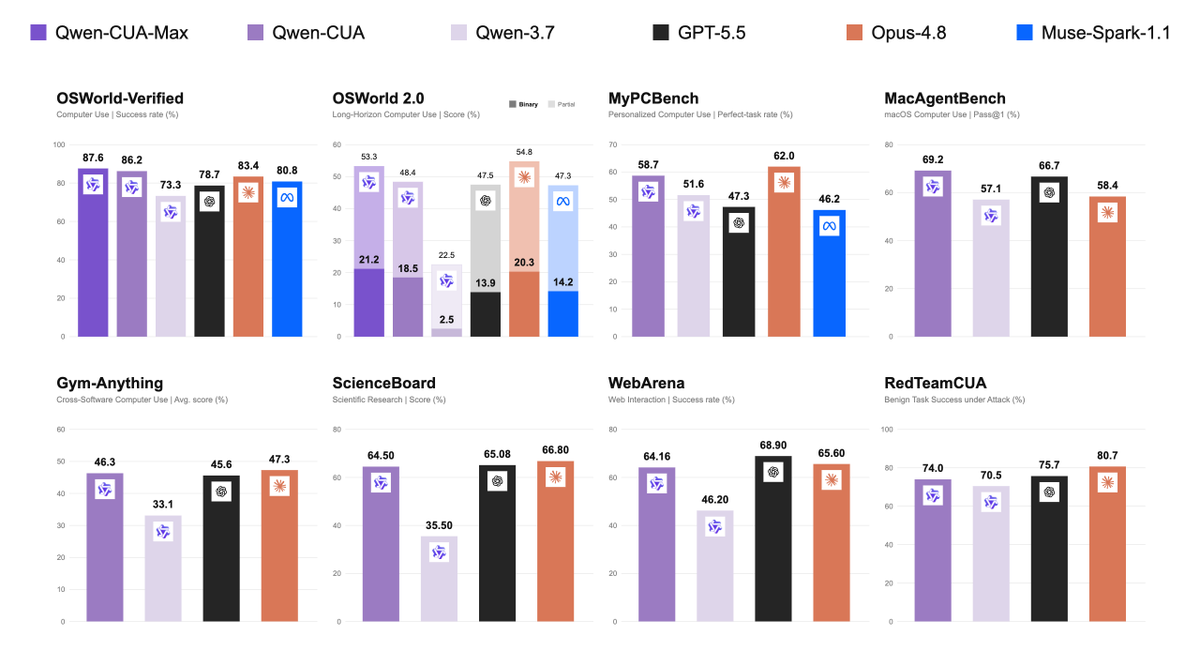
💻 Meet Qwen-CUA — our native computer-use agent for (almost) everything.
Code, APIs, and computer use are three of the most important interfaces for agents. Today’s models are already highly capable with the first two. Qwen-CUA is built to unlock the third: graphical interfaces designed for people.
👀 Native Perception — screenshots only. No DOM, accessibility tree, or other hidden machine-readable state.
🖱️ Native Interaction — keyboard and mouse events across browsers, desktop apps, and professional software. No task-specific APIs.
🧠 Native Intelligence — maintains long-horizon visual context, verifies progress, and learns from large-scale interactive experience with verifiable outcomes.
To make native computer use trainable at scale, we built approximately 40K verifiable tasks and rollout infrastructure with nearly 100K vCPUs, supporting tens of thousands of concurrent environments.
Across eight computer-use benchmarks spanning everyday desktop use, long-horizon workflows, personalized computing, scientific research, web interaction, macOS, and adversarial robustness, Qwen-CUA demonstrates strong and broadly competitive capabilities. Scaling the same recipe to Qwen-CUA-Max pushes this frontier further.
Not just “clicking the screen” — native computer use unlocks software and workflows that previously required a human at the keyboard. Together with code and APIs, it completes the interface stack for more general agents.
Joint work by Qwen Team × XLang Lab.
📖 Technical Report:
https://t.co/k0p1clnN7i
💻 Code:
https://t.co/r10vRIDFiV
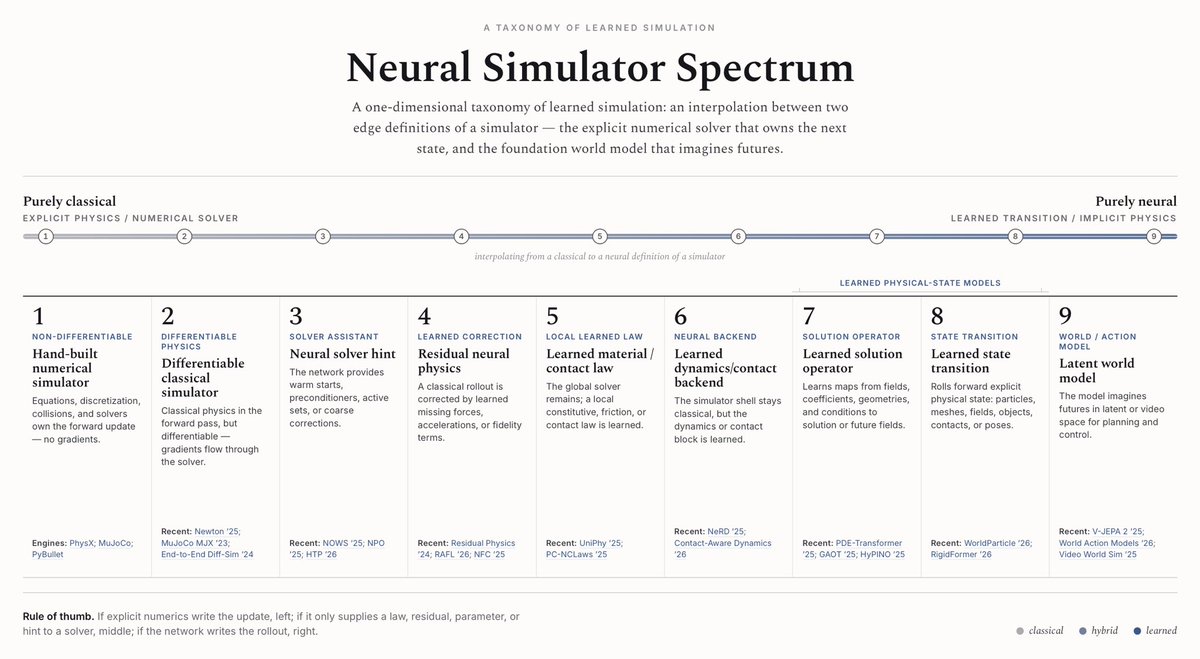
Let’s assume, for a second, that world models are neural physics engines
Is there anything between classical simulators and fully neural ones?
Yes, a lot of stuff
After 15+ months of work, I’m thrilled to finally share OSWorld 2.0 🚀
Huge thanks to all the collaborators, advisors, and friends who supported this project from early ideas to release.
Hope OSWorld 2.0 helps push the CUA forward. Excited to hear feedback and discuss more!🙌
Two years ago, we built OSWorld 1.0 — the benchmark that became the standard for computer-use agents. Agents now score 83.5% on it. Problem solved?
Not even close.
🚀Today we introduce OSWorld 2.0: Benchmarking Computer Use Agents on Long-Horizon Real-World Tasks.
What's new:
🎯 108 real-world workflows, each ~1.6 hours ⏱️ for a skilled human
⚙️ ~318 tool calls/task vs. ~30 in OSWorld 1.0
🌍 Grounded in authentic artifacts & stateful user profiles
⚡ Captures real phenomena: dynamic environments, streaming interaction, cross-source reasoning, implicit-state inference & more
📊 Best results: Claude Opus 4.8 reaches the highest accuracy at 20.6%, while GPT-5.5 is far more token-efficient but plateaus near 13%. No one is close to solving real computer use.
🏠 Homepage: https://t.co/tudMC0pFwC
📄 Paper: https://t.co/17PDTOiR1t
💻 Code: https://t.co/L13F8CoqgN
🤗 Dataset: https://t.co/L1HHHygFk7
🧵 [1/8]
From OSWorld 1.0 to 2.0, we went from minutes (~30 steps) to hours (~318), from single apps to real workflows, from high scores (83%) to hard problems (21%).
1+ year, 20+ people, every task rigorously verified. This is what real cua evaluation takes.🙏
👉https://t.co/ZhZ6LWoAYK
Current robot policies overfit specific language templates, handling 'pick and place' but freezing on 'drag it to me ' or 'push it closer to me.' They also lack control over execution: which hand, what approach angle, where to grasp, which path to follow.
🤖 FineVLA make robots steerable : changing instruction alters execution; same task, different phrasing, distinct actions — all faithfully done.
🏠 Homepage: https://t.co/NVRV63Wweb
📄 Paper: https://t.co/RUsR51k688
💻Codebase: https://t.co/DyrjoFV395
🧵[1/6]
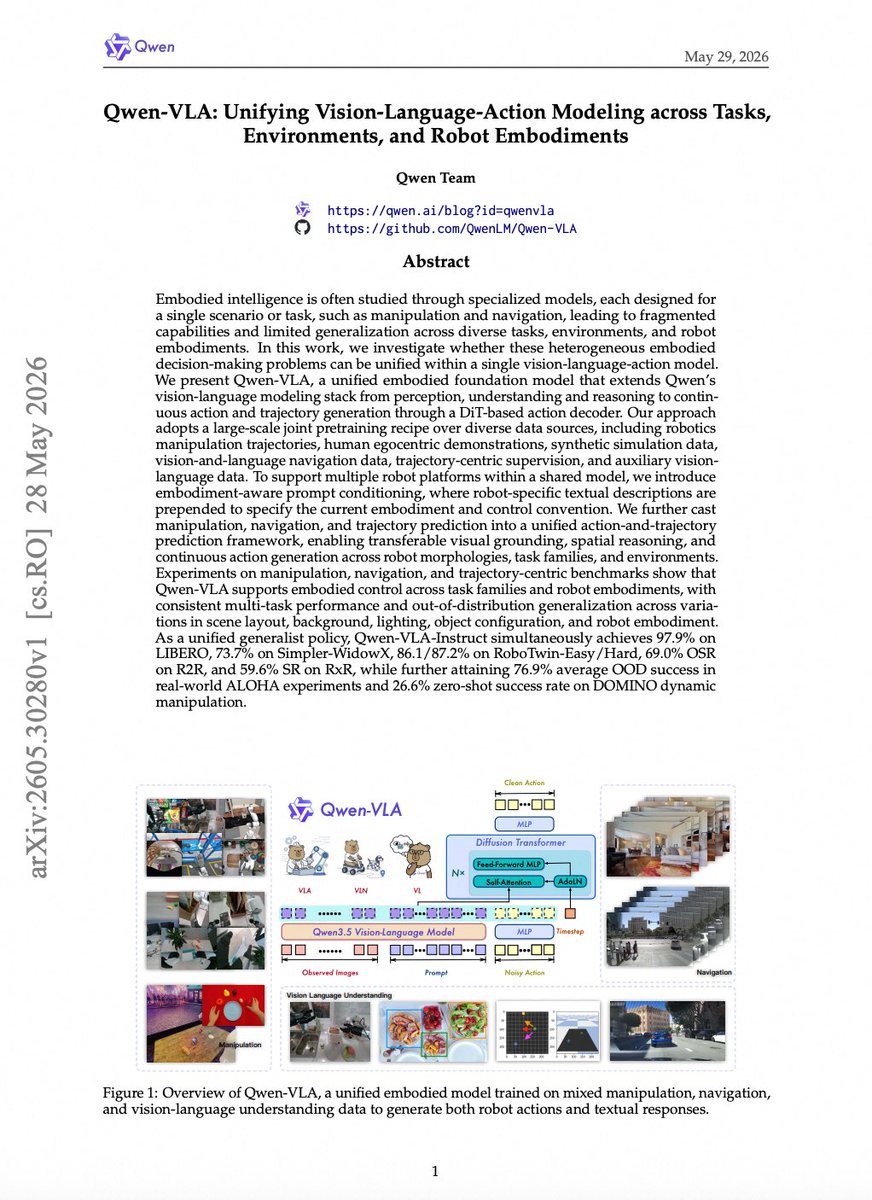
Excited to share Qwen-VLA paper, our exploration of generalist Vision-Language-Action models.
It extends Qwen’s multimodal backbone from visual understanding and reasoning to continuous action generation and trajectory prediction.
Paper:
https://t.co/9jvRW0nI8B
RLVR has become the recipe for agentic post-training. But for Computer-Use Agents, the bottleneck is not the algorithm, it is the data. 🐌
🚀 We introduce CUA-Gym: a scalable, lightweight synthesis engine that turns arbitrary task queries into verifiable RLVR data for computer-use agents. The largest open CUA RLVR dataset to date:
🎯 32,122 verifiable RLVR tasks with programmatic setup scripts + rewards
🌐 110 environments: 16 desktop apps + 94 synthesized mock web apps
🏆 Qwen3.5-based CUA models trained with GSPO reach 72.6% on OSWorld-Verified and 56.6% on WebArena
📄 Paper: https://t.co/cdvHJPzgb1
🏠 Homepage: https://t.co/kvhaOQxNx7
🤗 Dataset: https://t.co/w5vOIRdchR
💻 Codebase: https://t.co/CcRlNTlS1c
🧩 Environments: https://t.co/fNZ6YAI8LD
🧵[1/6]
Introducing Moonlake's 3D Agent.
Our agent acts like a technical artist that can build and reconstruct articulated assets and large-scale editable scenes with hundreds of objects from a single image and can improve its generations continuously.
Learn more in the thread below.
As video world models become increasingly powerful, do we still need explicit 3D?
A commonly misunderstood point is this: video world models are not “just 2D.” Their ability to maintain multi-view consistency, temporal stability, and realistic interaction necessarily implies that their latent knowledge encodes 3D world structure. Without some notion of 3D, consistency itself would not be possible.
The real distinction, therefore, is not whether a model has 3D but whether that 3D exists implicitly or explicitly.
Implicit 3D lives inside latent spaces and network weights. It supports generation, but it is difficult to localize, edit, constrain, or reason about.
It allows the world to exist, but not to be used.
Explicit 3D, in contrast, exists as structure and state: it is addressable, editable, composable, and transferable.
Its purpose is not better visual fidelity, but operability to allow the world to be manipulated, controlled, and executed.
From this perspective, video and 3D are not competing paradigms but a layered system:
2D/video is the interface to human perception; 3D is the interface to the physical world.
They can reinforce each other, but neither forms a closed loop on its own.
In practice, data not model architecture sets the upper bound of world models.
Explicit 3D may not be the final user-facing representation, but it is likely the most effective pathway toward scalable, high-quality, and controllable data.
Through explicit 3D/4D representations, worlds can be constructed systematically:
interactions can be programmatically sampled, states and actions can be composed, rendered into images and videos, and fed back to train video world models.
Seen this way, 3D is not the destination it is the starting point for scaling.
What truly drives progress forward is never the model itself.
Whether we capture the world or imagine new ones,
whether data comes from observation or intent,
whether we model what is or what should be the direction of the world is ultimately determined by human choice and purpose.
Models may extend the world,
but humans decide where it goes.
#Genie3 #worldmodel
VLMs can think visually without generating pixels!
I am thrilled to announce Mirage, a multimodal reasoning framework that interleaves latent visual representations among text tokens!
VLM can think visually without generating pixels!
VLM can think visually without generating pixels!
VLM can think visually without generating pixels!
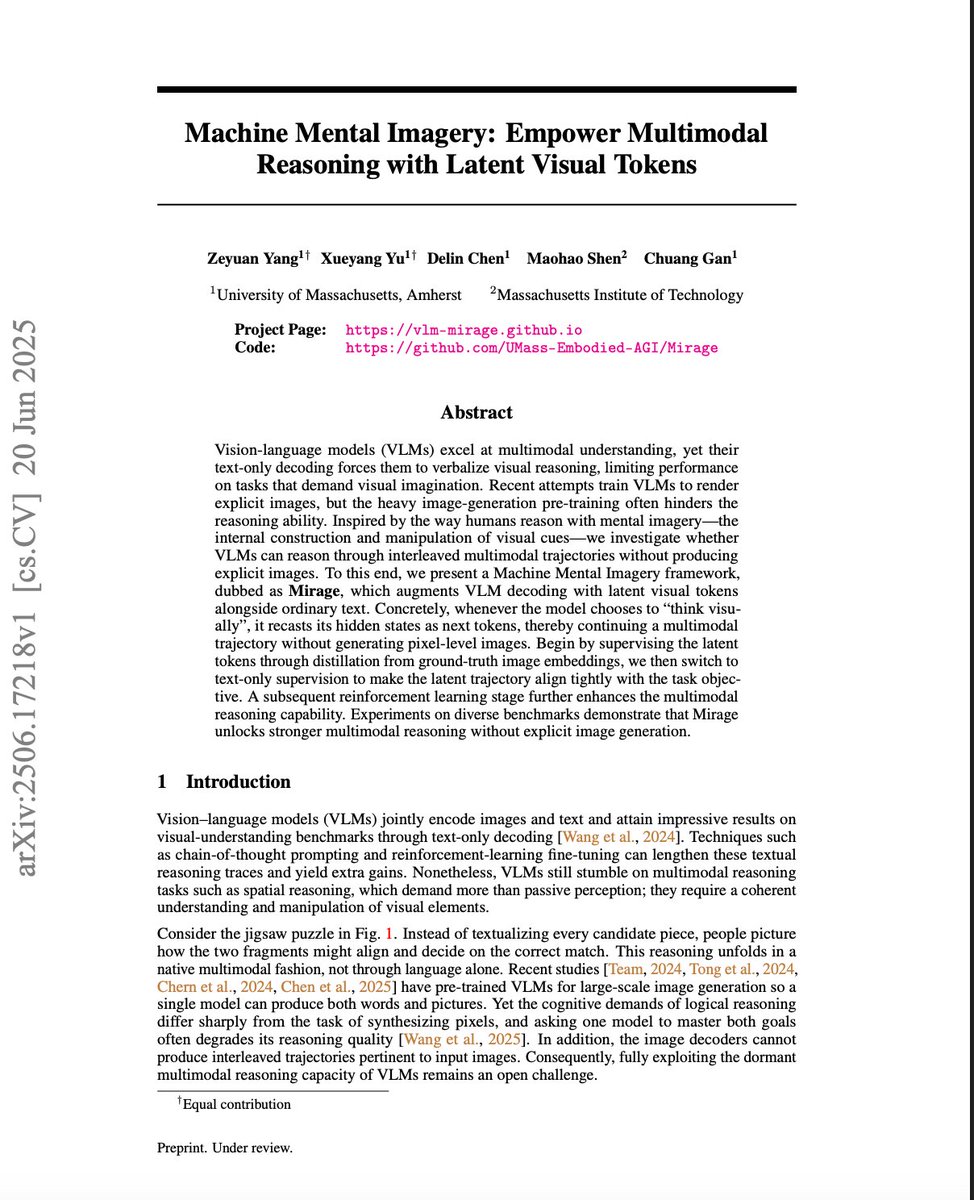
📢 We introduce Machine Mental Imagery (Mirage): a new framework that enables VLM to imagine using latent visual tokens—performing visual reasoning in latent space, no pixel rendering needed!
We achieve this through a two-phase training paradigm:
✅ Stage 1: Grounding latent tokens in the visual subspace (joint supervision)
✅ Stage 2: Anchoring grounded tokens for generation (text-only supervision)
Mirage demonstrates strong performance on a wide range of multimodal reasoning tasks!
📜Paper: https://t.co/MiZ8ak8H9x
🧑💻Code: https://t.co/8Yg4aZMhGc
📽️Project Page: https://t.co/i1B004JwKb
World Simulator, reimagined — now alive with humans, robots, and their vibrant society unfolding in 3D real-world geospatial scenes across the globe!
🚀 One day soon, humans and robots will co-exist in the same world. To prepare, we must address:
1️⃣ How can robots cooperate or compete intelligently?
2️⃣ How do humans build social bonds and communities?
3️⃣ How can both co-exist in an open, dynamic world?
Announcing Virtual Community Project — a social-physical world simulator, where human characters and robotic agents can interact, grow, and co-evolve within open-world societies, stretching from London to New York, and beyond!
Key features include:
✅ Unified multi-agent physics simulations for rich social + physical interactions of humans and robots
✅ Massive auto-generated 3D scenes grounded with the rea-world geospatial data
✅ Agent communities populated by robots and LLM-driven human characters with rich appearances, personalities, and social ties.
🌍 Enter our Virtual Community, an open world to study embodied AI at scale— one social-physical world model at a time!
🔗 Project: https://t.co/SItesNxOvN
💻 Code: https://t.co/clgr6rP7yJ
Paper: https://t.co/VZ67DUchRg
1/n
🚨 We need sample-efficient test-time scaling!
🚨 We need sample-efficient test-time scaling!
🚨 We need sample-efficient test-time scaling!
Introducing Satori-SWE: an evolutionary test-time scaling method that enables small coding LLMs to outperform GPT-4o on SWE tasks using just 10 samples!
Highlights:
🧬 Recasts test-time scaling as evolution—LLMs act as mutation operators refining outputs.
🧠 Self-evolves via RL — no external verifier needed
⚡ 6× more efficient than prior methods.
🔗 Paper: https://t.co/gmVMOjwzEL
🔗 Code: https://t.co/VJm6BpCGfo
🔗 Project Page: https://t.co/K8RYJSE3CJ
#LLM #SWE #TestTimeScaling #EvolutionaryAI #SampleEfficiency
Will attend ICLR this year. Interested in our Multimodal Agent & Inference Time Scaling work? Welcome to chat with us. Location: Hall 3 + Hall 2B #409; 26 Apr 10 a.m. — 12:30 p.m. (+08)
Project Page: https://t.co/8wLxbqPVhn
Awesome Inference Time Scaling: https://t.co/9LgAZiwBLR
Our paper “ARMAP: Scaling Autonomous Agents via Automatic Reward Modeling And Planning” has been accepted by #ICLR2025🎉
Want to know more about Inference-Time Scaling, MCTS, Reward Modeling for Language Agents?
🔗https://t.co/8wLxbqPnrP
Paper List https://t.co/9LgAZiw3Wj
(1/n)
Students often ask: How do you review PhD applications? What do you look for? Tell me the secrets behind the process!
I made a video last year explaining how it all works.
To all PhD applicants: good luck with your graduate school search this year!
https://t.co/9ipdzpiOBk
CoVLM: Composing Visual Entities and Relationships in Large Language Models Via Communicative Decoding
paper page: https://t.co/hX8wcaRPWD
A remarkable ability of human beings resides in compositional reasoning, i.e., the capacity to make "infinite use of finite means". However, current large vision-language foundation models (VLMs) fall short of such compositional abilities due to their "bag-of-words" behaviors and inability to construct words that correctly represent visual entities and the relations among the entities. To this end, we propose CoVLM, which can guide the LLM to explicitly compose visual entities and relationships among the text and dynamically communicate with the vision encoder and detection network to achieve vision-language communicative decoding. Specifically, we first devise a set of novel communication tokens for the LLM, for dynamic communication between the visual detection system and the language system. A communication token is generated by the LLM following a visual entity or a relation, to inform the detection network to propose regions that are relevant to the sentence generated so far. The proposed regions-of-interests (ROIs) are then fed back into the LLM for better language generation contingent on the relevant regions. The LLM is thus able to compose the visual entities and relationships through the communication tokens. The vision-to-language and language-to-vision communication are iteratively performed until the entire sentence is generated. Our framework seamlessly bridges the gap between visual perception and LLMs and outperforms previous VLMs by a large margin on compositional reasoning benchmarks (e.g., ~20% in HICO-DET mAP, ~14% in Cola top-1 accuracy, and ~3% on ARO top-1 accuracy). We also achieve state-of-the-art performances on traditional vision-language tasks such as referring expression comprehension and visual question answering.