We are delighted to present DIA-NN 2.5. Redefining LC-MS proteomics with up to 70% more proteins identified and powerful capabilities for statistics, visualisation and biological interpretation.
An incredible work and a massive dataset by Tiannan Guo @guomics and colleagues, mapping region-resolved proteome, phosphoproteome, acetylome and ubiquitinome of the ageing brain.
The authors uncover major differences in the observed ageing signature across brain regions, as well as compare WT and telomerase-deficient mice.
https://t.co/ASzctaG4H8
Our new Nature article is online:
An operational perturbation proteomics-based virtual cell model
A step toward building predictive virtual cell models from perturbation proteomics.
Read/share here: https://t.co/skn9bJ0Ko5
#VirtualCell#Proteomics#AIforScience
It is remarkable how we are able to improve the performance and capabilities of our DIA-NN proteomics software at an ever-increasing pace. Sneak peek at the upcoming DIA-NN 2.8 Enterprise:
- A major increase in identification numbers, in particular with InfinDIA: 25%+ on some datasets compared to 2.7.
- Support for three additional technologies beyond ordinary DIA and DDA. Guess which ones?
Back in the days of DIA-NN 1.8.1, released in early 2022, I genuinely thought we were close to the ceiling of how deeply we could see into the data. Turns out, that could not have been further from the truth.
We have achieved massive gains in proteomic depth over the past year, and the pace is accelerating. Each advance is a step not only towards properly utilising the full potential of the very expensive mass spectrometry instrumentation, but also towards our ability to extract more knowledge from existing data. Automated reanalysis of ProteomeXchange repositories at scale - who knows what we might find there?
Can MS-based proteomics see what histology can’t? We profiled 83 rare paediatric adrenocortical tumours from archival FFPE tissue & found 4 proteome-defined states that predict survival better. Now in @eBioMedicine, led by Rainer Claus & Andreas Metousis. https://t.co/SVHsCrhFBd
SPARCS: Deep Visual Proteomics-style laser microdissection meets genome-wide CRISPR screening. Find genes behind how cells look, isolate them, profile them by mass spec.
Now in @CellCellPress! Tweetorial from @niklas_a_s follows🧵
https://t.co/EJgbLRJX1Z
Aptila Biotech today announces a collaboration with IonOpticks, a global leader in high-performance chromatography solutions. Through this partnership, Aptila will support IonOpticks in deploying DIA-NN Enterprise across its chromatography systems and mass spectrometry method development, while IonOpticks will supply Aptila with state-of-the-art mass spectrometry data to help further optimise DIA-NN.
New preprint: with ADAPT-MS, discovery plasma proteomics becomes a diagnostic tool for ovarian cancer. We separate benign from malignant adnexal masses and generalize to 5 validation cohorts. Collaboration with @ErnstLengyel@OvCa_UChicago.
https://t.co/anvzBZvHqn
Today, Evosep announced a new reseller agreement with Thermo Fisher Scientific, through which Thermo Fisher Scientific will offer the Evosep Eno separation platform as part of its mass spectrometry solutions portfolio.
Read the press release here: https://t.co/sBDTknIxjU
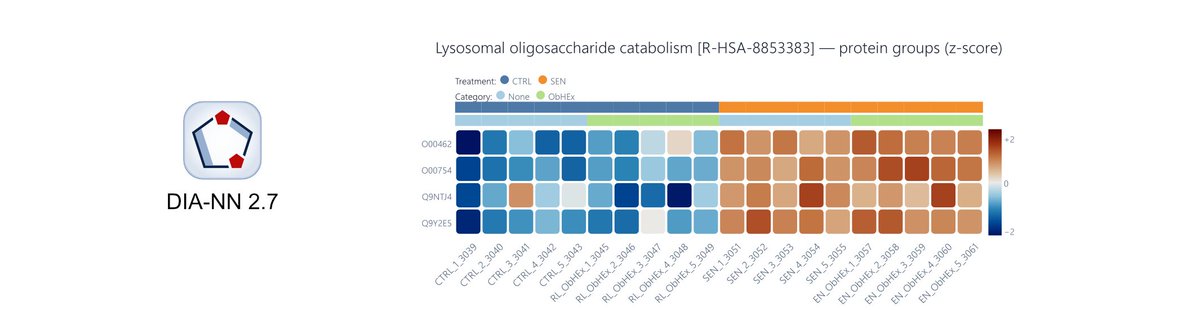
We have released DIA-NN 2.7. Performance improvements (more proteins) and GUI improvements. In particular, added a data completeness filter for pathway analysis. Further feedback on how to improve statistics and visualisation in DIA-NN is very welcome!
@animesh1977 Yes, also fine. But beyond 5% currently rarely anything useful (5% FDR could be close to 50% PEP sometimes). Picture: I assume it's just a pipeline step configured like this, if you open a new fresh tab, it should be 5%.
@animesh1977 1%? It's still 5%... And this is by design: why discard information? If you wish, you filter 1% downstream, if not, you get extra IDs that allow you to confirm things you would not be able to confirm otherwise.
Proteomics analysis has always lived in its own universe. AlphaPeptTools puts it in #scverse instead, so that proteome, transcriptome & spatial data sit in one ecosystem. 11 search engines (DDA+DIA) read in, proteomics-specific statistics, #scverse native.
https://t.co/TtW7cQ22me
Same single cell, two modalities—both at depth. We digest protein first, run Smart-seq3xpress + C18 (Evotip) separation: peptides captured, cDNA in flowthrough. In HeLa & stem cells, proteome tracks cell state; RNA variance flags transitioning cells.
https://t.co/P0EtDp2Tqu
New preprint: We used Deep Visual Proteomics to map vascular smooth muscle cell phenotypes in 24 human atherosclerotic plaques, cell-type & spatially resolved. Unstable plaques lose contractile and gain dedifferentiated states.
https://t.co/FbSZ6j9gfH