

Top Tweets for #VirtualCell

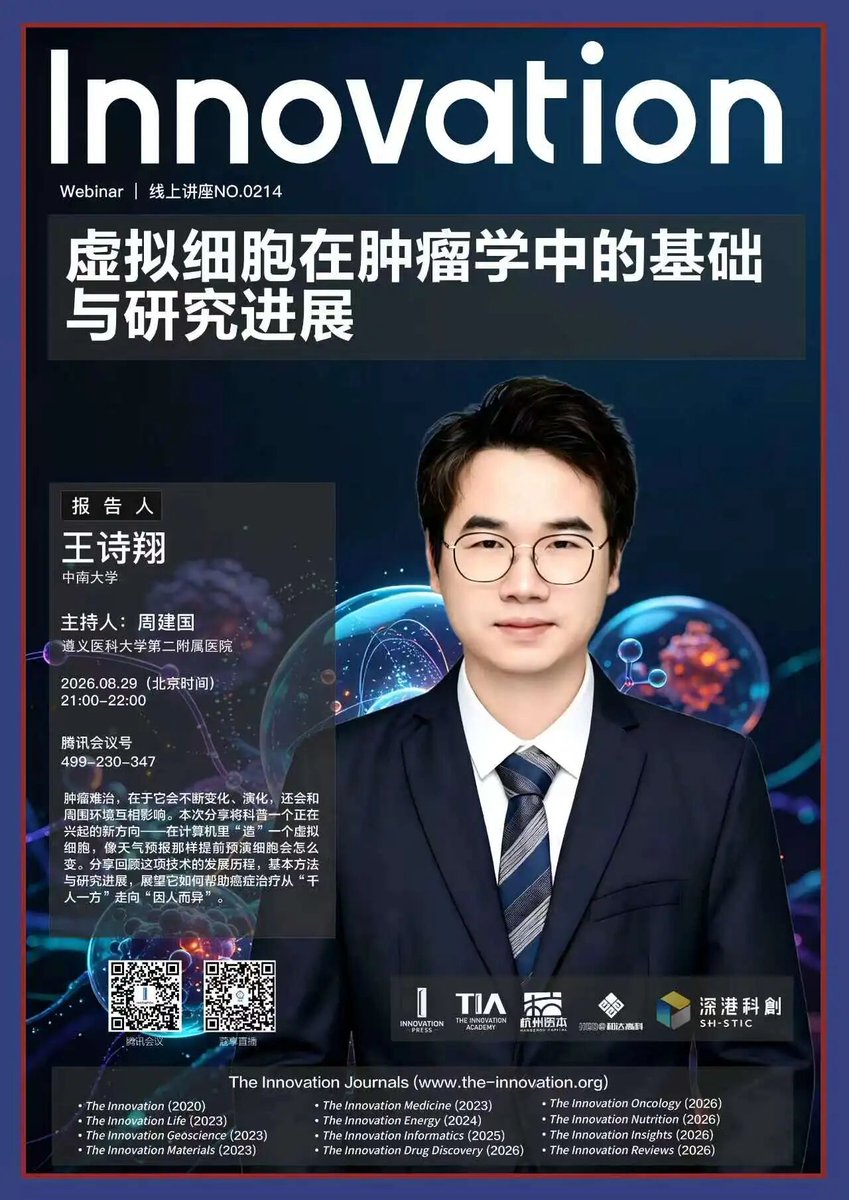
@The_InnovationJ #webinar: Virtual Cells in Oncology: Foundations and Advances.
Speaker: Shixiang Wang, MD
Date & Time: Aug. 29, 2026 | 21:00-22:00 (Beijing Time)
VooV meeting ID: 499-230-347
Join us this Saturday!
#VirtualCell #oncology
This perspective outlines the transition from virtual cells toward dynamic virtual bacteria—a new framework that seeks to reconstruct prokaryotic life in silico with evolutionary and adaptive capability.
@InnovationLife
https://t.co/0kzJOqYBT2
#LifeSciences #VirtualCell

New in The Innovation Oncology! From equations to agents: The artificial intelligence virtual cell reshaping precision oncology.
The emergence of the artificial intelligence virtual cell heralds a profound paradigm shift in oncology. This shift moves from traditional reductionist dissection of biological components to a generative, systems-level paradigm.
@InnovOncology
https://t.co/hHh97VdvNV
#oncology #artificialintelligence #VirtualCell


Virtual Cell Challenge: Toward a Turing test for the virtual cell
1.The Virtual Cell Challenge is a new benchmark competition designed to accelerate progress in AI-based cell modeling. Its goal is to evaluate how well computational models can predict cellular gene expression responses to genetic perturbations, using standardized, high-quality single-cell data.
2.What makes this challenge stand out is its focus on generalizing predictions across biological contexts. Participants must predict gene expression changes in a held-out cell type (H1 hESC), using training data from other contexts—posing a real-world problem of few-shot adaptation.
3.Unlike previous efforts that used small-molecule perturbations or coarse phenotype outputs, this challenge targets prediction of fine-grained transcriptomic responses to precise genetic perturbations, providing a deeper test of biological understanding and modeling ability.
4.To enable rigorous evaluation, the organizers created a dedicated dataset of 300,000 single-cell RNA-seq profiles using CRISPRi perturbations across 300 genes in H1 hESCs, with careful control over batch effects and high sequencing depth.
5.Three complementary metrics are used to evaluate model performance: differential expression score (accuracy of predicted DEGs), perturbation discrimination score (ability to distinguish effects), and mean absolute error (global expression accuracy). Models must perform well across all metrics.
6.Participants are provided with expression data from 150 gene perturbations for training, 50 for validation (leaderboard), and 100 held-out perturbations for final evaluation. This setup enables fair, reproducible comparison and supports incremental model refinement.
7.The competition is designed not just as a leaderboard contest, but as a community-driven effort to define standards, identify bottlenecks, and build robust predictive tools for biology. It's inspired by CASP in structural biology but tailored to the complexity of cell modeling.
8.The Arc Institute supports the challenge with a broader Virtual Cell Atlas, including Tahoe-100M and scBaseCount: two massive repositories containing over 350 million single-cell profiles, giving participants access to unprecedented training data for model development.
9.This challenge lays the groundwork for future efforts, including predictions of combinatorial perturbations, cross-cell-type generalization, and integration of multi-modal biological data such as proteomics and epigenomics—moving closer to comprehensive digital twins of cells.
10.Ultimately, the Virtual Cell Challenge aspires to be a “Turing test” for virtual cells—evaluating whether AI models can simulate cellular behavior indistinguishably from real biological systems. It's an ambitious, evolving benchmark for the future of quantitative cell biology.
📜Paper: https://t.co/qpUqOc7Fii
#VirtualCellChallenge #singlecell #computationalbiology #genomics #AIinBiology #CellModeling #CRISPR #benchmarking #scRNAseq

Predicting cellular responses to perturbation across diverse contexts with State
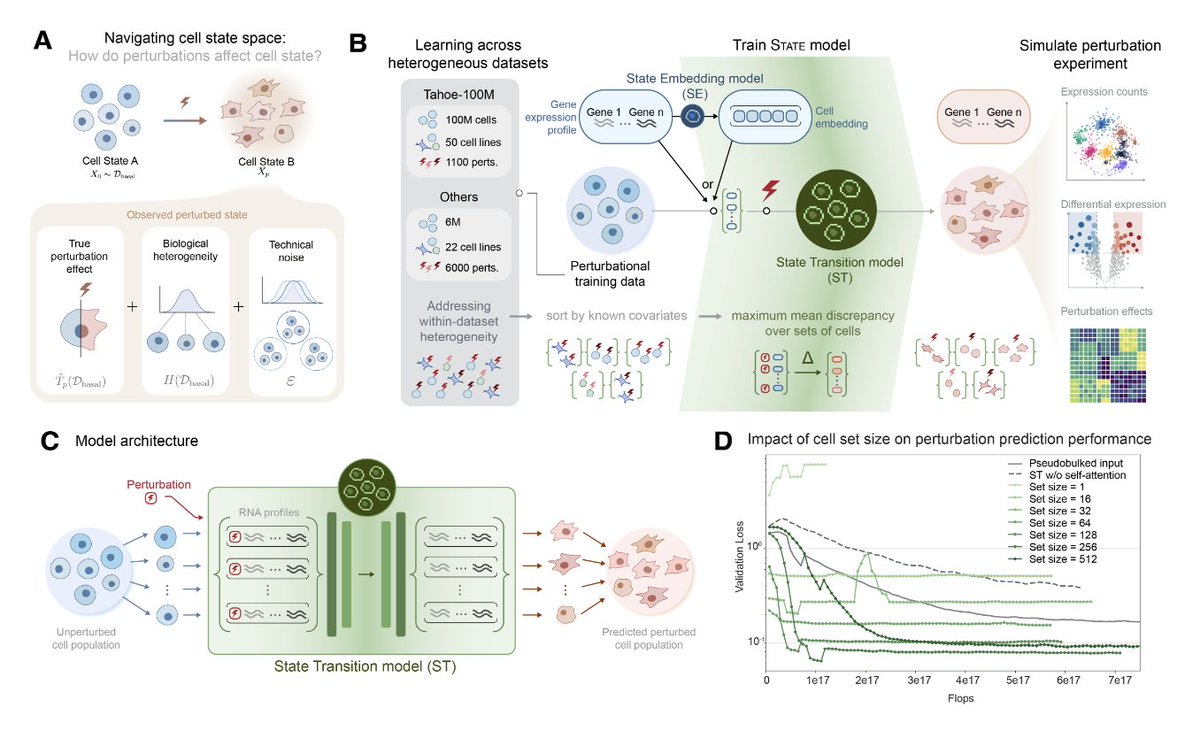
1.State is a multi-scale machine learning model designed to predict how cells respond to genetic, chemical, or signaling perturbations across diverse contexts. Its standout feature is the ability to generalize to unseen cellular contexts using a transformer-based architecture.
2.The core innovation lies in separating two complementary modules: the State Transition model (ST) and the State Embedding model (SE). ST uses self-attention to learn perturbation effects from over 100 million perturbed cells. SE is trained on 167 million unperturbed cells to learn robust cell embeddings that account for biological variability and technical noise.
3.Unlike existing methods, State does not rely on strong assumptions about data distributions. It uses self-attention over sets of cells to model heterogeneity, enabling accurate predictions of transcriptomic changes even in contexts where perturbations were not observed during training.
4.The model consistently outperforms linear and deep learning baselines across multiple large-scale datasets, including drug perturbations (Tahoe-100M), cytokine signaling (Parse-PBMC), and genetic screens (Replogle-Nadig), achieving up to 2x improvements in identifying differentially expressed genes.
5.State introduces Cell-Eval, a biologically grounded evaluation suite that assesses models not just by expression correlation but by meaningful metrics such as differential expression overlap, effect size ranking, and perturbation discrimination scores.
6.In zero-shot settings, where no perturbation data is available for a new cell type, State’s pretrained embeddings enable strong performance—improving prediction accuracy by 17%+ in some cases, and even surpassing models trained on the original expression data.
7.The embeddings learned by SE outperform those from recent foundation models like scGPT, scFoundation, UCE, and Transcriptformer, highlighting the advantage of training with dual-axis objectives that capture both intra- and inter-cellular variation.
8.State accurately detects cell type-specific responses to perturbations, recovering known drug responses (e.g., Trametinib in BRAF-mutant melanoma) and identifying top differentially expressed genes with much greater precision than mean baselines.
9.The architecture bridges theory and practice: the authors prove that State's output space includes optimal transport maps under certain conditions, meaning it generalizes classical OT-based approaches while being more flexible and scalable.
10.A practical application of State includes predicting cell survival from transcriptomic profiles with high correlation to ground truth, demonstrating its potential for functional predictions and therapeutic guidance.
11.State is trained on one of the largest perturbational datasets to date and is designed to scale with increasing data. It offers a flexible framework for virtual cell modeling, including potential extension to combinatorial perturbations, proteomics, or morphology.
12.By combining transformer-based modeling, embedding pretraining, and biologically interpretable evaluation, State presents one of the most comprehensive and generalizable approaches yet for simulating how cells respond to diverse perturbations.
📜Paper: https://t.co/LbLBkqN0Hx
#SingleCell #MachineLearning #ComputationalBiology #PerturbSeq #VirtualCell #TransformerModel #GeneExpression #DrugDiscovery
Virtual Cells: Predict, Explain, Discover
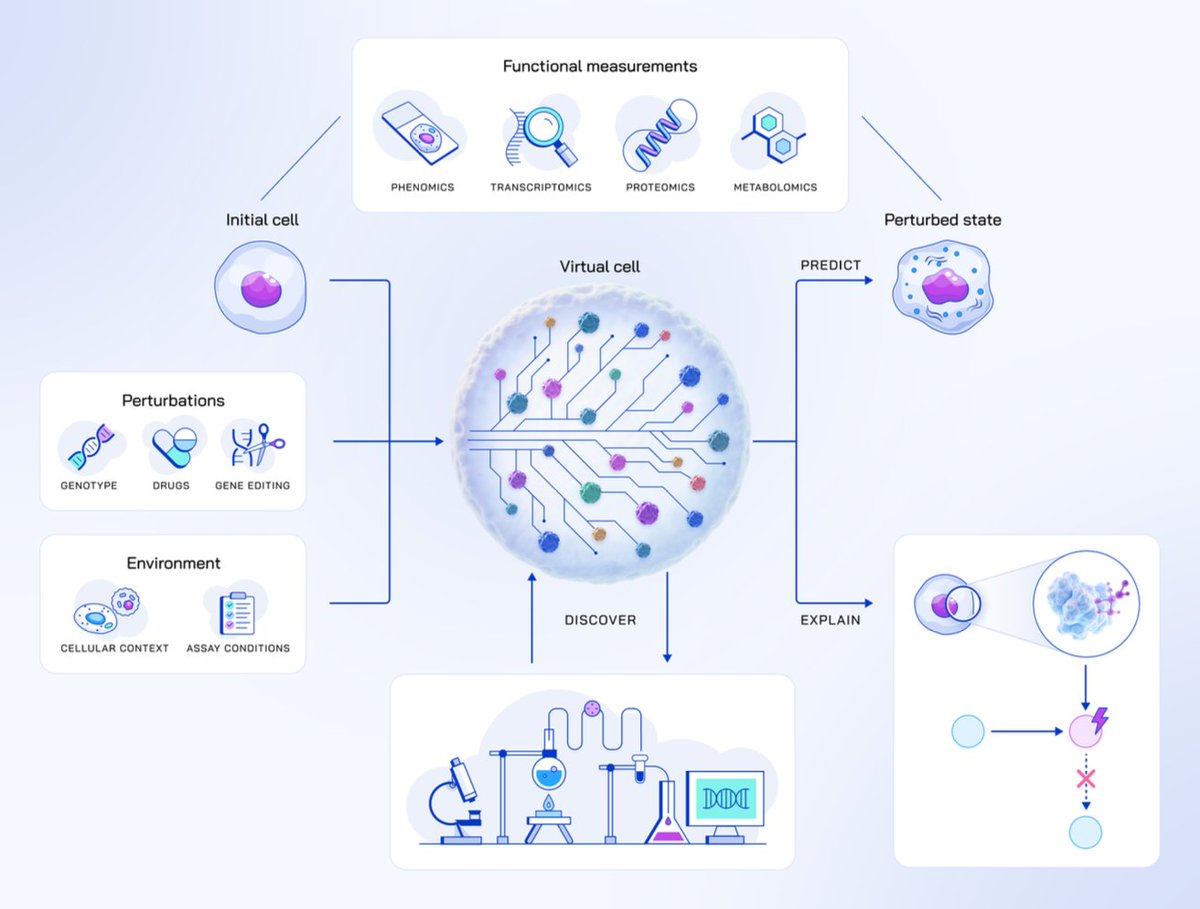
1.This paper outlines a bold vision for “virtual cells”—computational models that can predict cellular responses to perturbations, explain those responses through molecular mechanisms, and discover new biology via lab-in-the-loop experimentation. The authors propose a Predict-Explain-Discover (P-E-D) framework as foundational to this effort.
2.Virtual cells aim to model functional cellular responses (e.g., transcriptomics, morphology) across perturbations, cell types, and assay conditions. These models go beyond prediction by providing mechanistic explanations and supporting hypothesis-driven experimental discovery.
3.Unlike purely mechanistic simulators or static ML models, virtual cells are conceived as dynamic, falsifiable theories. They are continuously refined by iterative hypothesis testing and experimental feedback, forming a lab-in-the-loop system for accelerating therapeutic discovery.
4.The authors define three core design principles for virtual cells: (1) Predict relative functional change conditioned on pre-perturbation cell state; (2) Explain responses via changes to key biomolecular interactions; (3) Discover biology through active falsification and hypothesis testing.
5.The paper advocates for biologically grounded benchmarks covering predictive accuracy, mechanistic fidelity, and the capacity to generate actionable therapeutic hypotheses. These benchmarks span across modalities, cellular contexts, and perturbation types.
6.Prior work in virtual cell modeling—such as E-Cell, VCell, and genome-scale bacterial models—has laid the groundwork, but faced major limitations in scalability, interpretability, and generalizability. The authors propose overcoming these with modern AI/ML, high-throughput assays, and interventional datasets.
7.A key distinction of the proposed virtual cells is their emphasis on causal, mechanistically grounded explanations rather than post hoc interpretability. This enables them to guide experimental design and support generalization across contexts.
8.The authors envision scaling this framework to higher levels of biological organization, including virtual tissues, organs, and ultimately virtual patients. Each level builds on the one below while integrating additional contextual and structural complexity.
9.Applications across the drug discovery pipeline include disease modeling, target validation, compound screening, mechanism-of-action studies, resistance prediction, and biomarker discovery. Virtual cells can serve as surrogates for wet-lab assays in these contexts.
10.Ultimately, virtual cells could serve as the foundation for “scientist AIs”—autonomous systems capable of designing, testing, and refining biological hypotheses—potentially transforming how therapeutic discovery is conducted.
📜Paper: https://t.co/WF4djuJbk1
#VirtualCells #DrugDiscovery #ComputationalBiology #SystemsBiology #CausalML #AI4Science #Phenomics

OCTO-VirtualCell

We @NOETIK_ai built a new foundation model for spatial biology: OCTO-VirtualCell.
This model is prompted to simulate single cell gene expression in "virtual cells," which are placed within real, intact patient tissue.
Read about & explore these simulations below:
Last Seen Hashtags on Sotwe
Unexpected
Seen from United States
british #chav
Seen from United Kingdom
sister
Seen from United States
伊豆縦貫
Seen from United States
anlamazdin
Seen from United States
Unexpectedd
Seen from Chile
unauthorizedwish
superchub
Seen from United States
TEKKENArt
Seen from United States
r18
Seen from Brazil
Most Popular Users

Elon Musk 
@elonmusk
239.7M followers

Barack Obama
@barackobama
118.6M followers

Cristiano Ronaldo
@cristiano
114.3M followers

Donald J. Trump
@realdonaldtrump
111.7M followers

Narendra Modi
@narendramodi
106.9M followers

Rihanna
@rihanna
98.6M followers

NASA
@nasa
92.1M followers

Justin Bieber
@justinbieber
91.7M followers

KATY PERRY
@katyperry
89.9M followers

Taylor Swift
@taylorswift13
83.9M followers

Lady Gaga
@ladygaga
75.4M followers

Virat Kohli
@imvkohli
73.3M followers

Kim Kardashian
@kimkardashian
70.8M followers

YouTube
@youtube
68.6M followers

Neymar Jr
@neymarjr
66.3M followers

Bill Gates
@billgates
65.1M followers

Selena Gomez
@selenagomez
63M followers

The Ellen Show
@theellenshow
62.1M followers

CNN
@cnn
61.7M followers

X
@x
60.6M followers