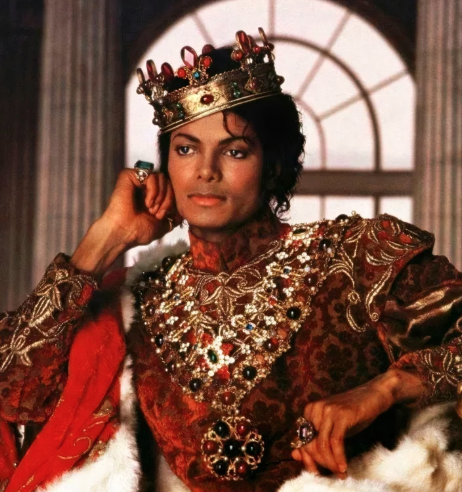
remember when son of michael jackson prince jackson said:
"bts is... they are a once in a lifetime act, you know"
"it's really cool for them to show that kind of... the way they pay respect and homage to my father’s honor and legacy"
Art doesn't become less universal because of the language it's created in.Stop turning borders into barriers to recognition.@RecordingAcad the world is bigger than the categories you keep putting it in.If inclusion requires a separate box,it's time to remove it.
#ArtHasNoAliens
- “By walking away from the Grammys at a moment when they were among the strongest contenders, BTS showed that cultural influence sometimes comes not from accepting recognition, but from refusing it”
THIS IS IT !!
Oh—Baltimore Magazine speaking the TRUTH: “And while BTS is technically K-Pop, they’ve transcended the genre, simply becoming one of the largest pop groups of all time.”
Bmore is getting sooo into this tour, creating their own BTS THE CITY, you love to see it😂💜🥰
— BTS put the Grammys in a 'difficult position' by withdrawing music, expert says
Olivia Bennet, Senior Digital PR Account Director at Go Up talked to The Mirror US about what BTS decisions means for the Grammys.
"BTS's decision puts the Grammys in a difficult position because the new category was presumably intended as recognition. But one of the world’s most commercially successful Korean groups has chosen not to participate because it does not want its work defined primarily by region or language," she began.
"The Recording Academy can argue that a dedicated category gives more artists an opportunity to be recognized. BTS's concern, though, is what that category may come to represent. If Asian artists are celebrated there but remain largely absent from Album of the Year, Record of the Year and the other major awards, it risks looking less like an additional opportunity and more like a boundary around their recognition," Olivia said.
https://t.co/0IV1NOaDpv
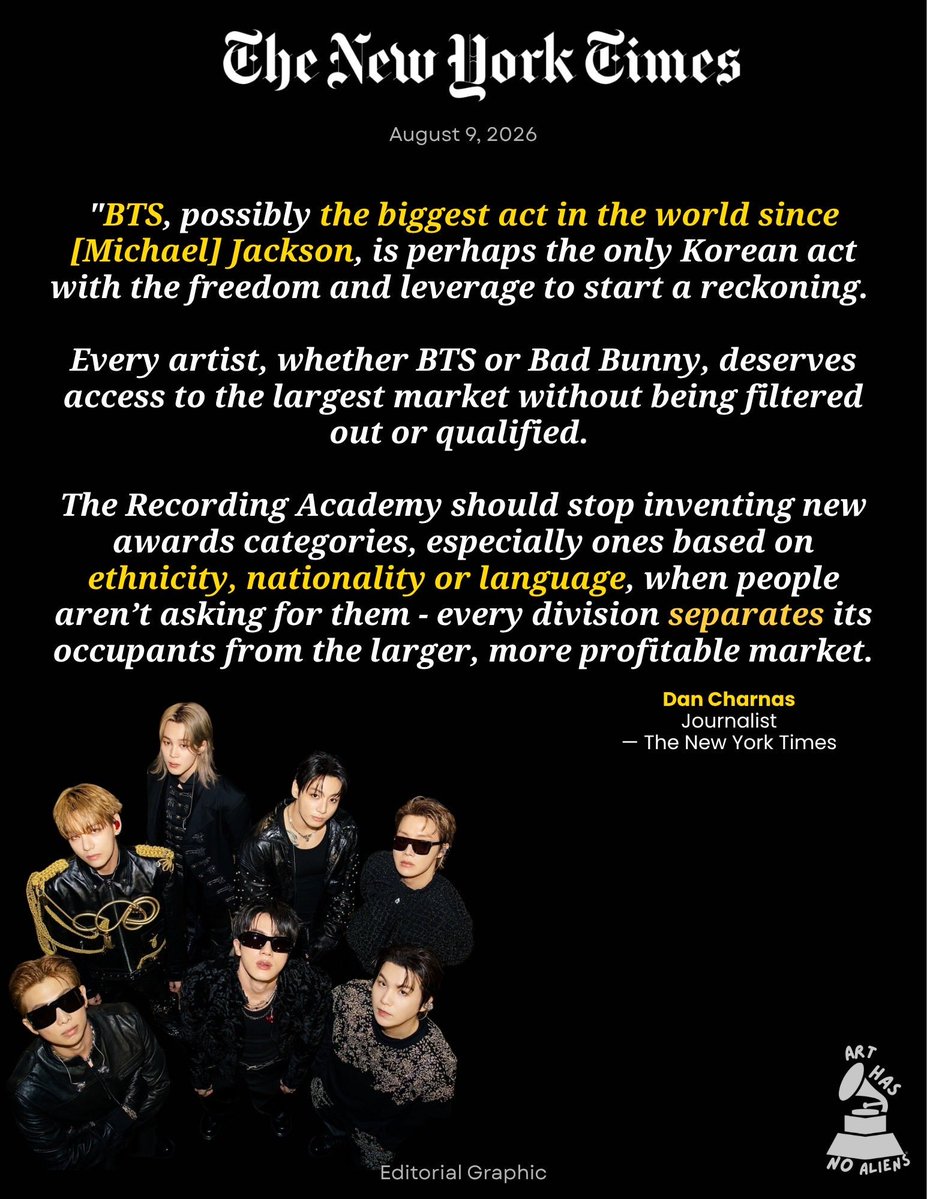
The New York Times on the Grammys' new “Best Asian Pop Music Performance” category:
— “The Recording Academy should stop inventing new awards categories, especially ones based on ethnicity, nationality or language…”
"They could be silent if they want. But they're not.👏": 3-time GRAMMY Winner Publicly Defends BTS and Slams the GRAMMYs 🔥
— Infor: https://t.co/kxyyMApcqz
These Armys held up a sign that said “Pretty Noonas who will buy you lobster rolls” and not only did their sign make Taehyung laugh he traded bandanas with them 😭
Dammmm… 👀💀 Days later, @RecordingAcad is still under fire🔥🔥🔥👀💀Lfggggg!!!🔥🔥🔥👏
Hit British podcast The Rest Is Entertainment, known for its insider analysis of the entertainment industry, backed BTS’s decision not to submit their music to the Grammys👀👀👀
— The 2027 Grammy Awards: Does It Reaffirm the Dichotomy Between West and Asia?
"The categorization of Asian and Latin music shows that, unlike Western music, they are classified differently. The author believes that the divide between Asia and the West, and between the West and the East, has not yet been eroded by today’s global values and civilization, which are no longer bound by geographical limits. The author does not reject the use of the word “Asia” as a shorthand term to describe a specific region. However, in the context of music, it should not be separated into the terms “Asian” or “Latin” music through categorizations such as K-pop, J-pop, C-pop, and Asian pop styles featuring Asian languages as well as Spanish-language compositions. Beyond cultural and linguistic factors, regional categorization highlights that Asian and Latin artists are set apart from the broader music scene.
This phenomenon reinforces the “us versus them” dichotomy, where music is categorized by language and region, resulting in a division into “Two Worlds of Music”: “Our Music” and “Their Music” a mindset that perpetually divides humanity into “the in-group” and “the out-group,” namely Western music (the in-group) and Asian music (the out-group). This categorization suggests that Western music is distinct from Eastern (Asian) music. Meanwhile, Edward Said has criticized this dichotomy, arguing that “the distinction between ‘us’ (the West, Europe) and ‘the other’ (‘them,’ the East) implies that the former is superior to the latter. Western music is considered superior to Asian music, so the categorization of music indicates that the Western perspective on Asia remains unchanged viewing it as a different world.” The author observes that the long-standing tensions within global culture still persist today."
https://t.co/vdrvv5N4fO