Pi has introduced new capabilities for developers building on Pi! This includes local storage support, access to app-specific staking data, and file and video sharing.
Pi’s new developer documentation is also now released, providing a single destination for technical resources and a clearer path from getting started to building and launching an app on Pi.
Improving developer tools is important for Pi’s broader focus on utility because they directly affect the types of apps and services that developers can create for the community and beyond.
Learn more in the Pi app!
SoloHost gives Pioneers more ways to use their computers for local AI and easier access to other self-hosted applications, further extending the utility of Pi Desktop and Nodes beyond blockchain infrastructure.
OpenClaw and the Atlassian MCP Server show how SoloHost can support different types of self-hosted software for different user needs, from local AI agents to more specialized developer utilities.
Through SoloHost, people can benefit from AI while keeping more of their data and computation on their own devices and reducing reliance on third-party remote infrastructure.
Learn more
https://t.co/qyzzhDC1SB
OpenClaw and the Atlassian MCP Server are now featured in SoloHost on Pi Desktop, expanding the range of self-hosted tools users can run locally.
OpenClaw offers a more contained local AI setup with streamlined installation, while the Atlassian MCP Server supports AI-integrated Jira workflows for professionals through a locally run connection.
Go to the Pi mining app to learn more about both apps and how SoloHost expands the utility of Pi Desktop and Nodes beyond blockchain infrastructure by bringing new AI and developer tools into the Pi ecosystem.
Following the successful completion of the Protocol 26 upgrade on Pi Mainnet, Pi Testnet is upgrading to Protocol 27!
Protocol 27 introduces more flexible and secure smart contract authentication capabilities, enabling more advanced ways for accounts and applications to authorize transactions. The upgrade continues Pi’s broader work to incorporate newer protocol features and expand the network’s smart contract capabilities.
The target date for the Mainnet upgrade to 27 is September 15, 2026.
The Pi Node version 0.6.2 has been released!
This introduces improvements to SoloHost, Node connectivity, and the Pi Desktop user experience.
In parallel, Pi has successfully completed a distributed computing test through a SoloHost app, further advancing the utility of Pi Nodes beyond supporting the Pi blockchain.
Together, these updates make it easier to run and manage applications on Pi Nodes and SoloHost, while advancing their distributed computing utility.
Go to the Pi app to learn more!
The Pi2Day 2026 Ecosystem Quest ran from June 28 – July 13, celebrating and highlighting Pi2Day’s major ecosystem and utility-supporting updates.
The Quest guided Pioneers to complete activities that help them discover new apps, test ecosystem features, and understand how Pi’s infrastructure supports utility creation across compute, AI, and identity.
Pioneers who completed the Quest also received a special-edition in-app badge accessible in Pi Chats and Pi Social Profiles.
Learn more https://t.co/rQpgOc9oKA
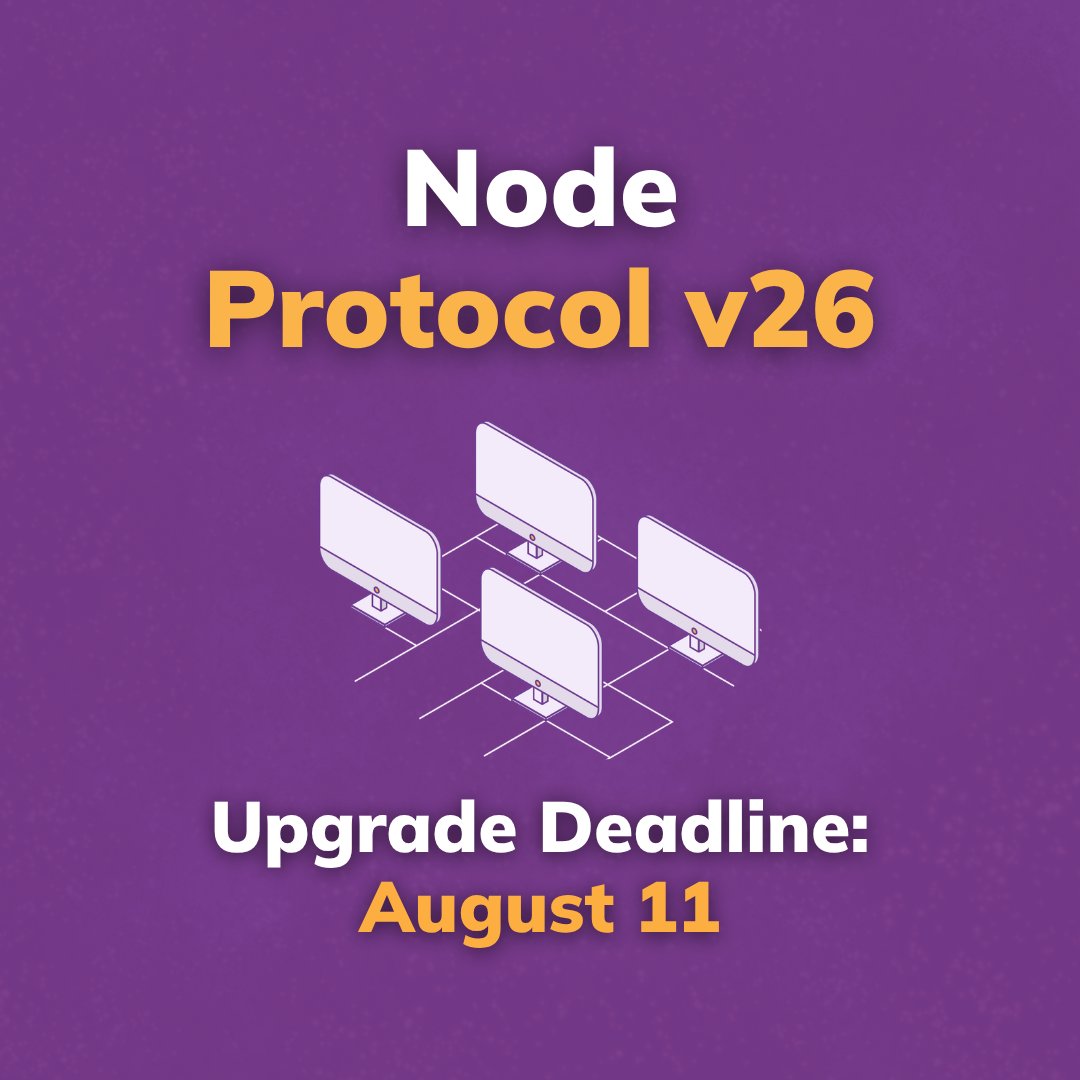
The Pi Mainnet is upgrading to Protocol 26. Deadline: Aug. 11.
All Mainnet node operators must complete the upgrade before the deadline to remain connected to the network. Details here: https://t.co/ENIm1nu6S1
Protocol 26 is a major milestone ahead of the final planned upgrade, Protocol 27. With 8 successful upgrades completed over the past few months, these final two upgrades will bring the network up to date with the latest protocol features, improvements, and functionality.
The Pi2Day 2026 Ecosystem Quest saw incredible participation with over 2.56 million Pioneer participants, and over 1.78 million of them completing every step to claim this year’s special-edition badge.
Congratulations to everyone who celebrated Pi2Day by exploring the Pi ecosystem and the new Pi2Day releases: SoloHost, Pi-Sign-in, and PiVerify.
Learn more in the Pi app.
Reminder: the Pi Mainnet is upgrading to Protocol v26. All Mainnet node operators must complete the upgrade by August 11 to remain connected to the network.
Protocol v26 is a major milestone that improves contract safety, state management, interoperability, and cryptographic capabilities ahead of the final planned upgrade, Protocol v27.
Details here https://t.co/LHI1F0JHLm
In the Pi Launchpad model, projects issue tokens as tools to acquire users for their applications and integrate those tokens directly into product functionality, such as access, payments, rewards, and governance.
Instead of being taken by the issuing project, the proceeds of Pi from their token launch go to a liquidity pool with the ecosystem token, which bootstraps a healthy liquidity foundation from the start.
For the SLICE test launch on Testnet, this results in a liquidity pool containing SLICE and Test-Pi. In addition to matching individual buyers and sellers through a traditional decentralized order book on the Pi DEX, the pool uses an automated market maker algorithm to calculate swaps based on the amounts of both assets it currently holds.
Learn more about how the SLICE liquidity pool works.
https://t.co/BJEb5ijQcr
Pi Launchpad has completed the distribution of its second Testnet token, SLICE!
Explore the post-launch experience and see how liquidity pools work through the new price tracking feature!
The Launchpad app in Pi Browser shows individual allocation details, the launch and effective token prices, access to the SLICE liquidity pool, and a chart tracking changes in the SLICE price relative to Test-Pi.
Go to the Pi mining app to learn more about the SLICE launch and liquidity pool mechanics.
On July 22, Pi is scheduled to upgrade to Protocol v25, which primarily focuses on improving network stability and reliability, and supports new capabilities for more efficient, privacy-preserving smart contracts.
Go to the Pi mining app to learn more!
The new App Planning Phase feature in Pi App Studio allows creators to develop their ideas with the help of AI before App Studio generates the app.
For example, App Studio may ask for more detail about the app’s:
- Main idea
- Goal
- Design
- User experience
This helps guide creators from an initial idea toward a more complete app concept in a more interactive and dynamic way.
Watch the video walkthrough to learn how the planning process works!
Pi App Studio backend support has been enabled!
Backend capabilities begin with persistent storage for newly created App Studio apps, allowing apps to save and retrieve user-specific data across sessions.
Creators can now build App Studio apps with user experiences that continue even after users leave and return.
For example:
- Game apps can remember a user’s high scores
- Productivity apps can remember a user’s to-do lists
- Note-taking apps can preserve notes automatically
Before, Pi App Studio apps were largely limited to frontend-only, single-session experiences, where app data such as preferences or progress would disappear if users left the app.
Adding backend support is a significant App Studio platform milestone because it expands what AI-created apps can practically do on Pi Network. Persistent storage is the first capability built on this foundation, enabling a broader range of useful, everyday applications.
Learn more and create apps with this new feature in Pi App Studio today!
https://t.co/UlKKz3ZcjG
Pi App Studio has released two updates to help creators build more engaging and useful app experiences.
1. Backend support enables persistent user experiences for newly created App Studio apps: Apps can save and retrieve user-specific data across sessions, enabling experiences that continue even after users leave and return.
2. AI-assisted App Planning Phase: Creators can develop their ideas with the help of AI before App Studio generates the app. This helps guide creators from an initial idea toward a more complete app concept in a more interactive and dynamic way.
Go to the Pi mining app to learn more, and create new apps with these features today!
Take on the Pi2Day Ecosystem Quest to celebrate new feature releases and receive a special in-app badge!
The Ecosystem Quest guides Pioneers to complete activities to discover new apps, test ecosystem features, and understand how Pi’s infrastructure supports utility creation across compute, AI, and identity.
Certain steps in the Quest require completing a quiz, so remember to pay attention to the updates! You can show-off your in-app badge in Pi Chats, Fireside Forum, and Pi Social Profiles.
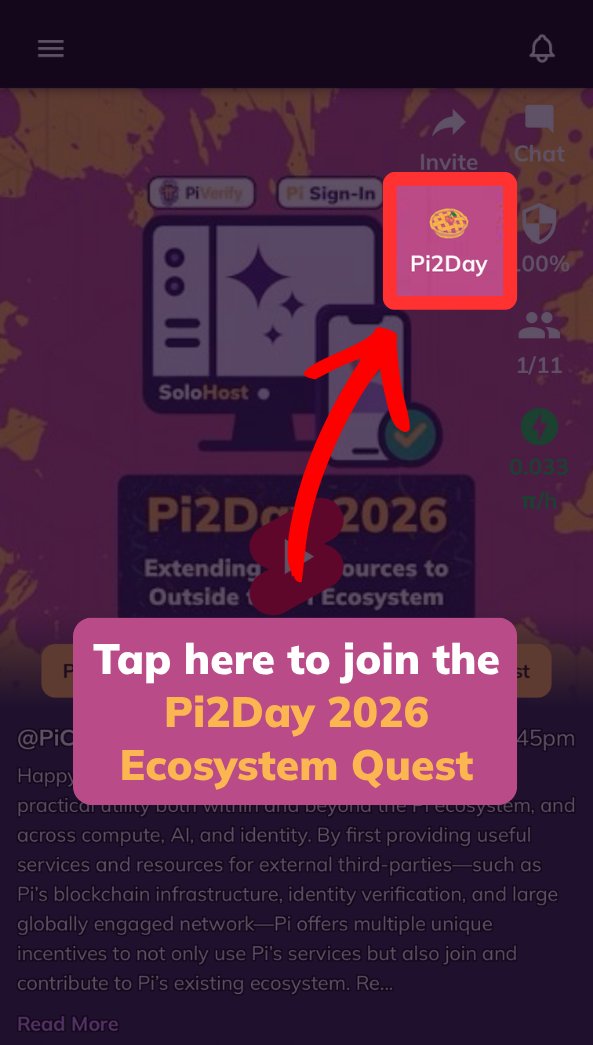
Participate in the Ecosystem Quest by tapping the “Pi2Day” icon on the top right of the Pi mining app home screen. The event will end on July 13.
New to Pi? Download the Pi mining app and get started here https://t.co/sHTvwa8Vt7
Join Pi’s vibe coder campaign ahead of Pi2Day (June 28)!
Pioneers can participate by joining relevant creator or developer communities and sharing why Pi may be useful for builders who already have prototypes or working apps built through AI platforms. Then submit your public post link in the Pi app for a chance to win Pi Network merchandise!
Wondering how to introduce Pi to vibe coder communities?
Posts introducing Pi can point vibe coders to Pi App Studio, explain how externally created apps can connect with Pi, and highlight the users, payments, ads platform, and broader infrastructure available through the Pi ecosystem.
Pi’s value proposition should be clear:
In the Pi ecosystem, vibe coders building web apps with AI can make their app accessible to 60M+ engaged users, and run their app on built-in payments, identity and ads infrastructure, by simply plugging their service or product into Pi Network.
You can also:
- Introduce Pi opportunities to creator communities;
- Describe how Pi App Studio makes it simple for vibe coders to integrate with Pi;
- Share statistics of organic traction Pi apps have received from the Pi ecosystem;
- Explain why developers and creators should explore Pi.
Learn more https://t.co/euwz9BMwll
As Pi2Day 2026 approaches on Sunday, June 28, Pioneers have four days left to participate in the Vibe Coder campaign with a raffle and the Pi Launchpad Testnet Token SLICE.
Both initiatives help contribute to the growth, development, and use of the Pi ecosystem and its utilities.
Pi2Day has historically been an important moment for Pi Network ecosystem milestones, updates, and feature releases. Participate in the two initiatives now, and stay tuned for Pi2day!
Learn more https://t.co/CCff3IuRQv
Pi Network has over 60 million Engaged Pioneers.
For developers, that creates an important opportunity: How do useful apps get discovered by these millions of people on Pi?
Ecosystem Directory Staking was built to help answer that.
It is a decentralized way for Pioneers and businesses to actively support and promote the ranking of Pi apps and utilities in the Ecosystem Interface. Staking through this feature increases an app’s exposure to the Pi community, helping boost visibility within the ecosystem.
This feature provides a self-service avenue for developers and creators to use Pi to tap into the attention resource of Pi Network to acquire users.
As AI makes app creation easier and easier, the challenge shifts from building products to getting them in front of people.
Ecosystem Directory Staking improves ecosystem discovery, making it easier for developers and creators to connect with users, and easier for users to discover new apps.
https://t.co/EpsNc81gOv