AI is the new front door to the internet.
When customers ask ChatGPT, Gemini, or Claude what to buy, every part of digital marketing, from content and PR to partnerships and paid media, shapes whether a brand gets recommended.
That shift is why Alp Aysan and I built Cognizo. Most tools in this space hand you a report card. We wanted a system that does the work: finds where a brand is missing, produces and publishes the content to close the gap, and proves whether it moved traffic and revenue.
Thank you to Nima Olumi and @FoundersPress for taking the time to dig into our thesis, the story behind Cognizo, and what the move from searching to asking means for marketers.
Read the full piece: https://t.co/7z6rL4ijIN
OpenAI's ads push got eye rolls from the public: "cash grab", "enshittification", "there goes the product".. Marketers, meanwhile, are asking how to get in.
There is a more interesting shift: the organic answer just became even more valuable.
3 reasons:
1. Money prices the channel. Once CMOs pay for placement below AI answers, being in the answer gets a benchmark price. Nobody valued Google organic properly until AdWords showed what a click costs.
2. Trust asymmetry. The moment labeled ads appear on a surface, users discount them and lean harder on whatever isn't labeled. Every "Sponsored" tag makes the untagged recommendation more persuasive.
3. The paid substitute proves the value. Sponsored Agents are literally a paid version of what every brand was hoping to earn: a conversation about their product inside ChatGPT. When someone builds a paid substitute for a thing, that's the market telling you what the real thing is worth.
Paid gets you next to the answer. Earned gets you in it.
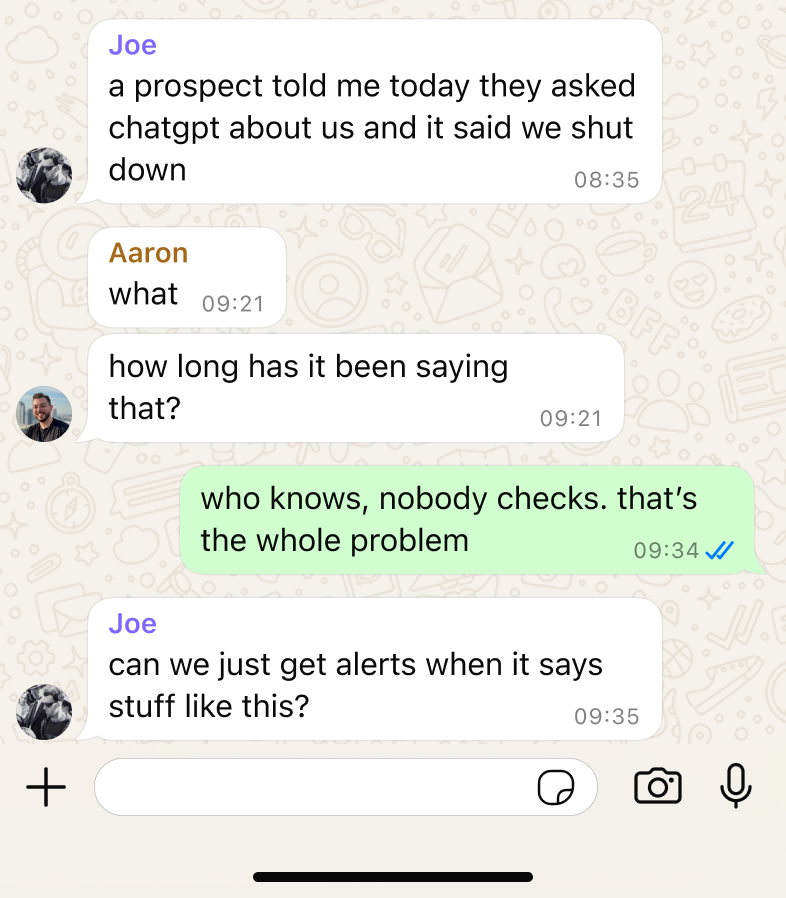
A prospect asked ChatGPT about you. It said you shut down. The only reason you know is that this one told you.
Most don't. They just don't book the call.
Cognizo asks these questions every day and shows you where the answer came from.
ChatGPT just opened the gates.
Yesterday, OpenAI rolled out its self-serve Ads Manager in beta to advertisers across the U.S. complete with CPC bidding, a Conversions API, and pixel-based measurement.
In other words: ChatGPT is no longer an experiment for brands with massive budgets. It's a performance channel.
Three things that actually matter here:
1. The barrier is gone. OpenAI dropped its $50K minimum spend. Any business can now buy placements on a surface where hundreds of millions of people are actively researching what to buy.
2. The intent is unmatched. ChatGPT users aren't scrolling a feed. They're comparing options, evaluating products, and asking for recommendations right before they make a decision. That's the most valuable moment in the funnel, and now it's biddable.
3. This is the playbook, not a pilot. Self-serve buying, CPC bidding, conversion tracking, pixel attribution: that's the same infrastructure Google and Meta took a decade to build. OpenAI shipped it in three months. Every other AI platform is going to follow.
For the last two years, the AI marketing conversation has been almost entirely organic: how do I get cited? How do I show up when ChatGPT recommends a product?
That conversation isn't going anywhere. AEO is still the foundation, and it's what we've built Cognizo around. But there's now a second question marketers have to answer alongside it:
When organic isn't enough, how do I show up in the paid layer too?
Both matter. And we're cooking up something at Cognizo that helps with both.
More soon. 👀
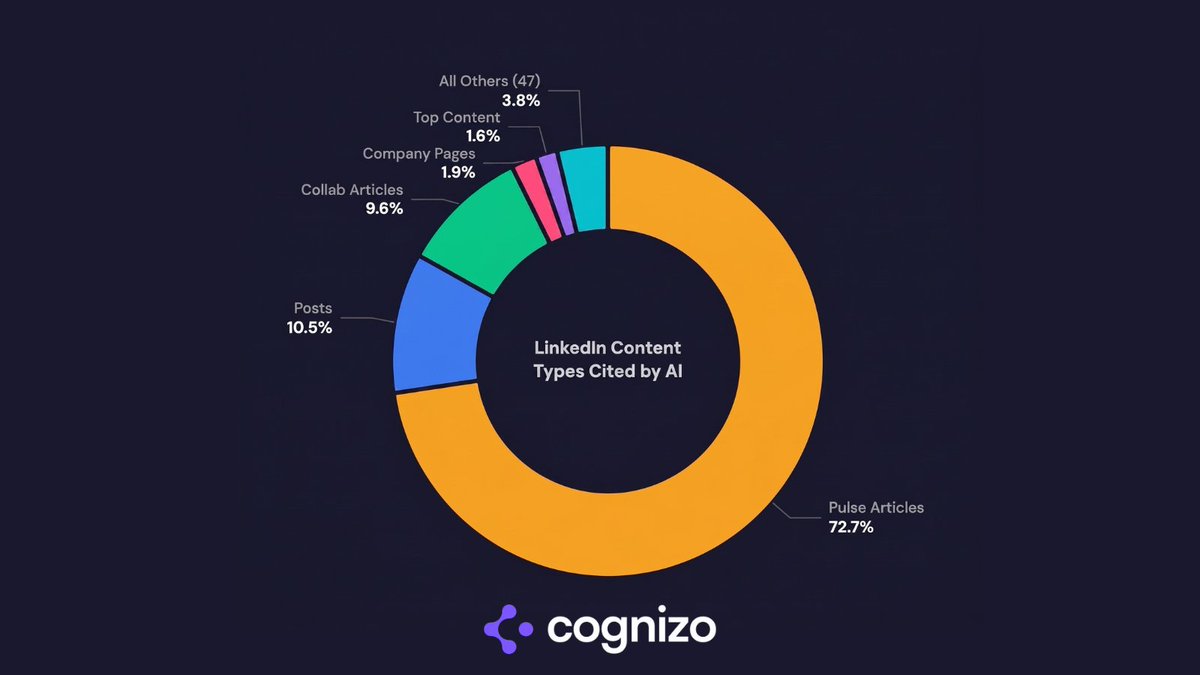
We analyzed 4.6 million LinkedIn AI search citations.
LinkedIn is the 4th most cited domain across all AI engines.
73% of citations came from one source: Pulse (Articles). That is 3,349,887 citations from long-form articles alone.
➡️ Pulse (Articles): 73%
➡️ Posts: 10.5%
➡️ Collaborative Articles: 9.6%
➡️ Everything else: ~7%
AI engines do not cite short-form posts. They cite depth.
If your LinkedIn strategy is built around short updates, AI is not citing your brand. The data confirms it.
Two metrics define LinkedIn in 2026: engagement and citability. Most brands are only tracking one.
Full study in the replies ⬇️
🚢 Introducing our biggest launch yet: Content Studio
AI search is now the primary way people discover brands. Most content teams know they need to show up in AI answers but don’t know how to influence them.
Content Studio turns answer engine insights into AI-optimized content in minutes.
With Content Studio, marketing teams can:
🔹 Identify exactly what moves the needle for the prompts they already track, backed by our proprietary source analysis algorithm
🔹 Create authoritative content with confidence by automatically researching the most credible sources and closing content gaps AI engines care about
🔹 Write in their own brand voice, tailored to specific audiences, tones, CTAs and enriched with internal knowledge
🔹 Move faster with review-ready strategic briefs and AI-generated drafts that get teams 90% of the way to publishing
By analyzing millions of AI answers and their citation patterns, we understand how answer engines recommend and reference brands across topics. Our agents translate those insights into structured content briefs and drafts — ready to be ingested by answer engines.
This isn't just about producing more content.
It's about producing the right content — grounded in real data and designed for how LLMs actually work.
📈 Introducing AI Traffic Analytics
Bots now make up around half of all web traffic. Traditional web analytics leave you blind to how your content is being indexed and referenced by AI bots. With Cognizo, you can finally see how AI crawlers and answer engines access, interpret, and drive traffic from your content.
AI Traffic Analytics gives you full visibility into how AI agents interact with and generate traffic to your site:
🔹 AI Crawler Activity: Track every visit by ChatGPT, Claude, Perplexity, Google, and more
🔹 AI Citations and Indexing: See how often your content is being retrieved and indexed in real time
🔹 Model Training Insights: Detect when and which AI bots visit your site for model training
🔹 AI Content References: Identify which pages AI agents reference most often — and why
🔹 AI Referral Traffic: Attribute when human visitors arrive because of AI-generated answers
The web now serves two audiences: humans and machines — and both shape your reach. You can now get unprecedented insight into AI crawler activity and how it translates to AI-generated referrals.
Preview of the agentic internet we're preparing marketers for.
I asked ChatGPT Agent to find and compare the best AI notetakers. It worked for 10 minutes: ran 9 searches, read 67 sources, and delivered a detailed, personalized comparison based on my needs.
Welcoming xAI’s Grok into Cognizo’s analytics lineup.
🔷 With the addition of Grok, you can now track visibility across ChatGPT, Perplexity, Gemini, Google AI Overviews, Google AI Mode, Microsoft Copilot, Meta AI, Claude, and Grok itself.
@jasonlk@boltdotnew With increasing trust in the models, it's inevitable that every single purchase decision will be made with AI in the near future.
Given the probabilistic nature of the answers, I'm running an analysis on Cognizo. Wonder if Bolt actually wins at scale.
AI is eating search–and it's happening fast.
58% of consumers have already replaced traditional search engines with AI tools for product discovery, up from just 25% in 2023.
Welcome to the new era of search engine marketing, where AI is the mediator for purchase decisions.