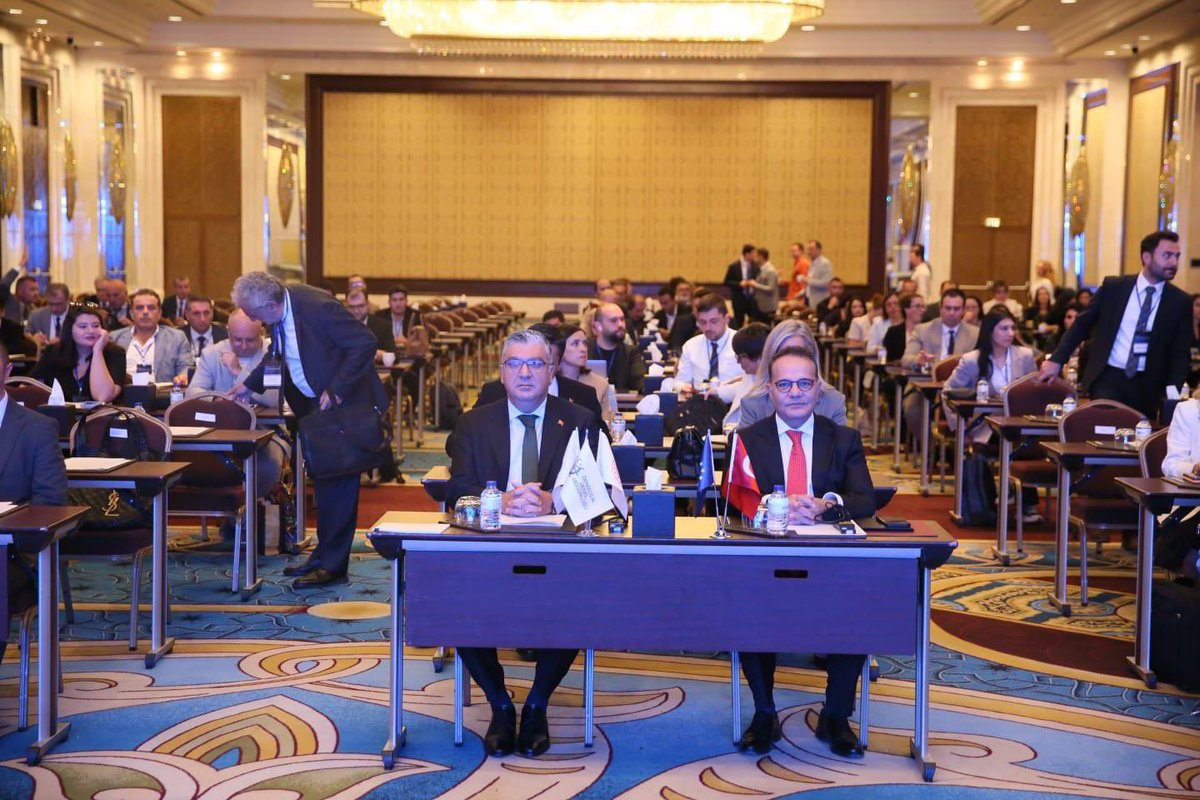
Avrupa İmar ve Kalkınma Bankası (EBRD) ve Avrupa Birliği iş birliğiyle gerçekleştirilen “Denizcilikte Karbonsuzlaştırma ve Yeşil Denizcilik” programı Ankara’da gerçekleştirildi.
🌍 Programda; Bakan Yardımcımız Durmuş Ünüvar, EBRD Direktörü Sn. Elisabetta Falcetti ve AB Delegasyonu Başkan Yardımcısı Sn. Jurgis Vilcinskas ile bir araya gelerek Türk denizciliğinin mevcut durumu ve geleceğine ilişkin hedef, politika ve stratejilerimizi paylaştı.
#TürkiyeHızlanıyor 🇹🇷
Bakanlığımızca, Avrupa İmar ve Kalkınma Bankası (EBRD) ve Avrupa Birliği işbirliğiyle gerçekleştirilen “Denizcilikte Karbonsuzlaştırma ve Yeşil Denizcilik” programı tanıtım etkinliğine katıldık.
Deputy Minister and Director for EU Affairs, Ambassador Mehmet Kemal Bozay, attended the launch event for the "Maritime Decarbonisation and Green Shipping Programme for Türkiye”
📱 Our new Digital Empowerment and Equity Program, in partnership with @gatesfoundation, aims to increase connectivity, smartphone access, and digital skills for millions of women in low and middle-income countries.
Learn more: https://t.co/0AT44xCCOG
For emerging economies, where existing digital divides are already profound, the risks are far greater. Without targeted policies to foster #inclusivity, advancements in #AI may deepen inequalities rather than bridge them. Addressing #digitalinequality is a global imperative.
The rapid diffusion of #GenerativeAI is revolutionizing industries worldwide. But what happens when technological advancements outpace societal readiness?
The study reveals that access, skills, and the ability to utilize #GenerativeAI are increasingly stratified along socioeconomic lines. If this is happening in Switzerland, where digital infrastructure is among the best globally, what about developing nations?
Digital technologies have not only become prevalent in our lives. They also have the potential to shape #ClimateAction.
Check out our report & learn how countries can embark on a green #DigitalTransformation, leveraging tech for a sustainable future. https://t.co/fIVRSNVsmk
Internet access unlocks economic and educational opportunities.
Using (free) geospatial data, we can now identify which areas lack internet access at super granular levels.
Here's the breakdown:
Congrats to my friends and former MIT colleagues @DAcemogluMIT, @baselinescene and James Robinson for being recognized with their well-deserved -– indeed overdue -– @NobelPrize.
Years ago, I had the privilege of serving on Simon’s promotion and tenure committees and remember how excited I was when I first read his papers.
And Daron is, well, Daron, towering above the field. Perhaps my greatest contribution to economics has been to get Daron to spend a little more time thinking about AI and its implications.
They are some of the nicest people on earth, whose intellects are matched by their kindness.
The richest 20 per cent of the world’s countries are now around 30 times richer than the poorest 20 per cent. The income gap between the richest and poorest countries is also persistent; although the poorest countries have become richer, they are not catching up with the most prosperous. Why? This year’s economic sciences laureates have found new and convincing evidence for one explanation for this persistent gap – differences in a society’s institutions.
#NobelPrize
This year’s laureates in the economic sciences have helped us understand differences in prosperity between nations.
Daron Acemoglu, Simon Johnson and James Robinson have demonstrated the importance of societal institutions for a country’s prosperity. Societies with a poor rule of law and institutions that exploit the population do not generate growth or change for the better. The laureates’ research helps us understand why.
#NobelPrize
The introduction of more inclusive institutions, less extraction and the rule of law would create long-term benefits. So why don’t the elite simply replace the existing economic system?
The laureates’ model for explaining the circumstances under which political institutions are formed and changed has three components. The first is a conflict over how resources are allocated and who holds decision-making power in a society (the elite or the masses). The second is that the masses sometimes have the opportunity to exercise power by mobilising and threatening the ruling elite; power in a society is thus more than the power to make decisions. The third is the commitment problem, which means that the only alternative is for the elite to hand over decision-making power to the populace.
#NobelPrize
BREAKING NEWS
The Royal Swedish Academy of Sciences has decided to award the 2024 Sveriges Riksbank Prize in Economic Sciences in Memory of Alfred Nobel to Daron Acemoglu, Simon Johnson and James A. Robinson “for studies of how institutions are formed and affect prosperity.”
#NobelPrize