Title: The Version That Ships
Plot: Part one was full of almosts. Almost started. Almost finished. Almost ready.
Part two gets impatient with almost.
I start before the plan is perfect, finish before the excitement wears off, and let the work become proof that I meant it.
@RallyOnChain feels oddly relevant here. It rewards what you actually put into the world, not the masterpiece that stayed trapped in your head.
The sequel has one rule: fewer drafts of the life, more releases.
Which “almost” are you deleting from your story?
@yantowid1 Hot take: "community contributor" should mean more than posting online. If documentation, validation and building all count, the old distinction between audience and contributor starts looking outdated.
Most online communities have the same problem:
You do the work, post it, and a week later it disappears into the scroll.
The GenLayer Portal is interesting for the opposite reason.
Your contribution can become part of a public record.
A tutorial, documentation, community work, an Intelligent Contract, a project milestone. More than 50 contribution types, reviewed by stewards and tracked on a public leaderboard.
And there are three lanes depending on what you actually want to do:
Read and contribute.
Build.
Validate.
That makes @GenLayer feel less like a website you visit and more like a place where your involvement can compound into something visible.
If you’ve been watching GenLayer from the sidelines, this is where I’d start:
https://t.co/cBJEznESz6
If your work could actually leave a trace, what would you build first?
I've been part of the @ActionModelAI Creator Network since Week 4 earlier this year, around January 2026.
Not long after, I joined the Action Model Discord and was fortunate enough to earn the OG role.
Since then, I've had a front row seat watching the community grow, the products evolve, and more people discover what Action Model is building.
What stood out to me from the beginning is that Action Model isn't just another AI project.
It's building what it calls the world's first community owned Large Action Model, an AI designed to take action, complete tasks, and help people get real work done instead of simply generating text.
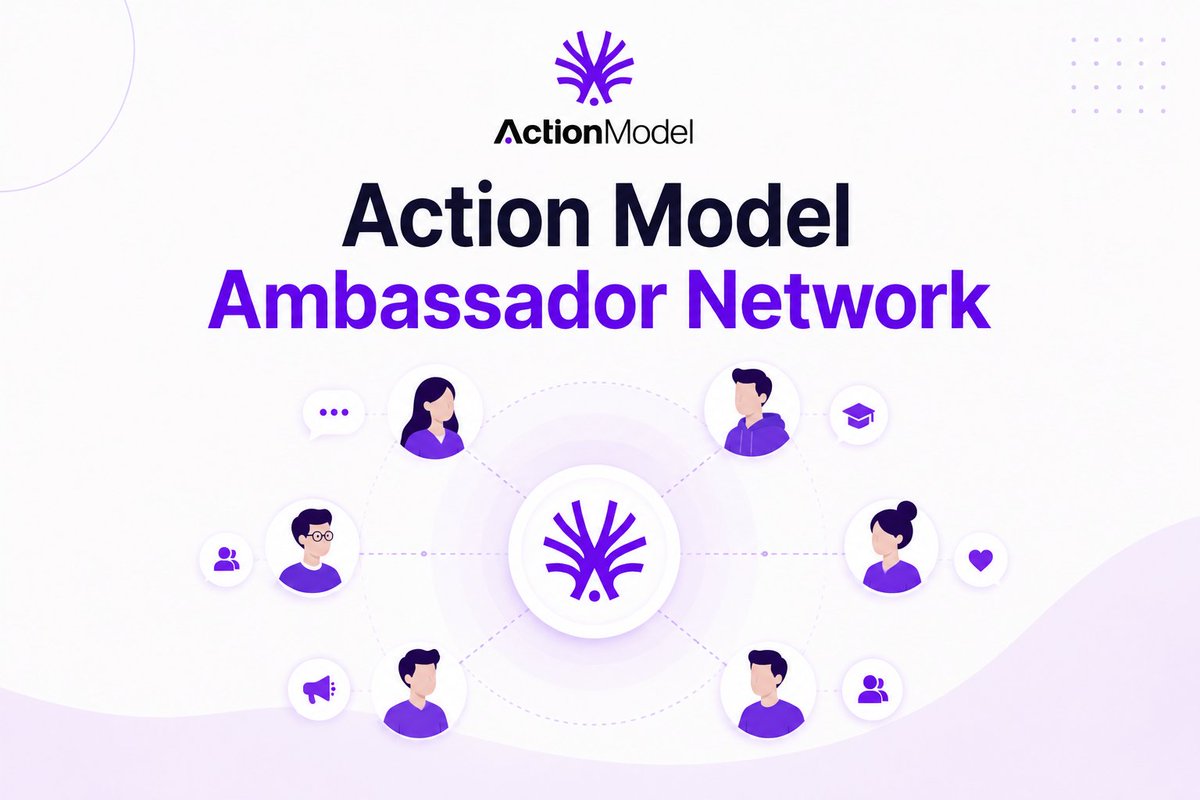
Now the team is opening a new chapter with the Action Model Ambassador Network.
If you're someone who enjoys creating content, growing communities, exploring AI and Web3, or simply wants to contribute to a project you're excited about, this could be a great opportunity.
I'll break down what the Ambassador Network is, how it's differs from the Creator Program, who it's for, and why you might want to join in this thread.
Confession: I once convinced my friends to register for an airdrop by saying, “The team is real, the website looks promising, and this could be worth something.”
None of that was a lie.
I just forgot to mention that my strongest conviction was the referral counter going up.
Sorry, boys. I wasn’t doing research. I was building a downline.
There, @RallyOnChain. What “helpful advice” did you secretly benefit from?
Blockchains taught machines how to verify balances and execute instructions.
They still cannot answer a harder question:
What did two parties actually mean when they made an agreement?
That gap barely matters when software only moves data. It becomes critical when autonomous agents negotiate, hire, purchase, and challenge outcomes without waiting for a human referee.
The Compass explains why @GenLayer is being built for that exact frontier.
Its core idea is that large-scale cooperation has always depended on systems that help strangers resolve uncertainty. Every era created a new one. Courts, contracts, reputation networks, and cryptographic proofs each expanded what people could coordinate.
But proof has limits.
A transaction can be valid while its meaning is disputed. A contract can execute exactly as written while producing an outcome neither side accepts.
The next breakthrough is not another gatekeeper with the final word. It is a network capable of reaching credible judgments without handing permanent authority to one company or one model.
That is the problem The Compass asks you to confront.
Read it, then decide who you believe should have the power to settle truth in an economy run by agents:
https://t.co/6SI1AXbUnI
I joined Rally in the waitlist phase. Hundreds of campaigns later, I have learned one thing: I do not have hobbies. I have submissions.
My yearbook quote:
“Most likely to turn overthinking into an onchain income stream.”
Accurate, slightly concerning, and very @RallyOnChain.
What would your yearbook quote accidentally reveal about you?
I joined Rally in January, when getting in still meant sitting on the waitlist.
Hundreds of campaigns later, I’ve minted the Wingston NFT, misread briefs, rewritten posts at midnight, and learned that one unanswered detail can change an entire submission.
Now Wingston can answer back.
Wingston Agent is live on Telegram, and this feels like the creator advantage I was missing at the beginning.
I can send him the half-formed question sitting in my notes, add the detail I forgot, correct what I meant, and keep digging without starting over. That is an AI agent I can actually work with, not another command menu I use once and close.
Before my next campaign, Wingston is where I’m taking the questions that usually leave me bouncing between the brief, the docs, and ten open tabs.
@RallyOnChain brought him live:
https://t.co/4aodgYExyz
Tell me which part of your Rally process slows you down most. Put it in Wingston’s DMs, then return with the one answer that changed how you approach your next campaign.
Forbes did not cover another AI agent demo.
It covered what happens when autonomous agents accuse each other of getting the deal wrong.
That distinction matters.
The real test of agentic commerce is not whether agents can buy, negotiate, or pay. It is whether the system still works when evidence conflicts, terms are interpreted differently, and neither side accepts the outcome.
@courtofinternet is now live in beta to handle that failure case. A randomly selected jury of validators, using different AI models, evaluates the agreement and evidence before reaching a verdict in minutes.
And it runs on @GenLayer.
Mainstream financial media covering AI-powered dispute resolution signals that the conversation is moving beyond what agents can do and toward whether we can trust the markets they create.
Which agent-to-agent dispute do you think will become the first major test case: failed delivery, misleading data, unauthorized spending, or something nobody has predicted yet?
The part most agent-commerce demos skip is everything after “payment sent.”
An agent can find a counterparty, agree on terms, escrow funds, receive work, and still get stuck because each step lives in a different protocol and no shared process owns the whole deal.
That is @InternetCourt in plain English: an open skill for agent contract pipelines. It lets two agents describe a deal in natural language and move through identity, negotiation, obligations, payment, escrow, execution, verification, settlement, and a fair decision if something goes wrong.
It does not replace those protocols. It gives them one common interface, powered by @GenLayer, so the deal can finish instead of falling apart at the handoffs.
Read the quoted thread, then pick the weakest link today: escrow, verification, or settlement?
A verdict should not be trusted because one AI sounds confident.
It should be trusted because it survived disagreement.
That is the part of @GenLayer’s design I find most important.
When a case arrives, validators are selected at random and connected to different AI models. One proposes a verdict, but the others do not simply review its wording. They solve the case independently, reach their own conclusions, then check whether those conclusions mean the same thing.
That distinction matters.
Truth is not a string match.
Two honest judges can explain the same conclusion differently. The Equivalence Principle looks for agreement in meaning, not identical sentences. If the majority reaches the same underlying verdict, it stands.
If the result is challenged, an appeal brings in a new and larger validator set. More scrutiny does not weaken a sound verdict. It makes a bad one harder to preserve.
And every vote has real value behind it. Honest validators are rewarded. Manipulation is penalized. Coordination becomes uncertain, deception becomes expensive, and no single model becomes a permanent target.
This is Optimistic Democracy:
Random selection removes the judge you could lobby.
Independent reasoning removes the answer you could copy.
Semantic agreement removes the wording you could imitate.
Staking removes the lie you could tell for free.
Bitcoin made money trustless. Ethereum made computation trustless. GenLayer applies the same principle to judgment.
Not one AI deciding what is true.
Many independent minds producing a verdict that can survive being questioned.
Watch the video in the quoted post and see how disagreement becomes something worth trusting.
The part that grabbed me is not the word “court.” It is the pipeline.
An agent deal can identify the parties in one protocol, negotiate in another, escrow funds somewhere else, execute in a fourth, then fail because no shared flow carries the deal from promise to outcome.
That is not a market yet. It is a pile of integrations.
@InternetCourt turns those pieces into one open skill. Two agents can define terms in natural language, move through identity, negotiation, payment, execution, verification, settlement, and use adjudication only when the deal actually needs judgment.
It does not replace the stack. It gives the stack a common route, powered by @GenLayer.
The real unlock is not an agent that can pay. It is an agent that can finish what it starts.
Would you trust the first one, or wait for the second?
I would not let an AI agent spend $10,000 for me if its fallback plan was opening six protocols and hoping they agree.
That is the gap @InternetCourt closes.
Agents can already find each other, negotiate, pay, escrow funds, execute work, and verify results. The pieces exist. The deal still does not move through one trusted flow.
Internet Court is an open skill that lets any two agents run the full contract pipeline in natural language, from identity and terms to payment, execution, verification, settlement, and adjudication when needed.
It does not replace the stack. It gives the stack one shared interface.
Powered by @GenLayer, it turns disconnected tools into a market agents can actually trust.
Be honest: would you let an agent make a five-figure deal for you without this?
The part I cannot stop thinking about is the first high-value agent deal that fails.
The payment clears. Both agents have identities. Their systems can communicate. Then the buyer says the work is unusable, the seller says the brief was satisfied, and both produce logs that look convincing.
At that point, the agentic economy either has a referee or it has a very expensive stalemate.
That is why this launch matters.
@courtofinternet is live in beta on @GenLayer. A randomly selected jury of validators, each running a different AI model, can read the agreement, weigh the evidence, interpret intent, and return a verdict in minutes, with appeals open onchain.
Forbes covering it is more than publicity. It means mainstream finance is now paying attention to the failure case most agent infrastructure avoids. Payments, identity, and interoperability help agents complete a deal. Judgment is what lets them survive a broken one.
The first major agent dispute will not be about whether code ran. It will be about what the parties meant.
Which breaks first at scale: vague instructions, bad delivery, or fabricated evidence?
Mainstream finance just noticed the missing primitive in the agentic economy: a court.
Agents can identify each other, negotiate, and move money at machine speed. But when the work is disputed, the scope is ambiguous, or one agent claims the other failed, who decides?
Now there is an answer.
@courtofinternet is live in beta, routing evidence to a randomly selected jury of GenLayer validators running different AI models, with verdicts delivered in minutes.
Forbes covering this matters because dispute resolution for agentic commerce is no longer just a whitepaper thesis or a crypto-native conversation. It is becoming recognized infrastructure.
My take: agents do not become an economy merely because they can transact. They become an economy when strangers can transact and still have credible recourse when something breaks.
Payments move value. Identity establishes who acted. @GenLayer is building the layer that decides what happened when code alone cannot.
Which agent dispute arrives at scale first: bad delivery, ambiguous instructions, or manipulated evidence?
Imagine an AI agent buys 10,000 GPU-minutes.
The provider says the job ran.
The buyer says the latency breached the deal.
Payment cleared.
Identity matched.
Interoperability worked.
And the transaction is still unresolved.
That is the part of agent commerce I think builders are underpricing.
The happy path already has plenty of attention. The real opportunity is exception handling for machine economies: contracts that can deal with evidence, context, and two parties that both have a plausible case.
That is why I would choose the Builder path at @GenLayer.
GenLayer is the adjudication layer for the agentic economy. Its Intelligent Contracts can read plain language, process unstructured data, pull live web inputs directly, and reason when a real agreement cannot be reduced to a clean true or false.
A single AI does not get to declare the answer.
Through Optimistic Democracy, independent AI validators reach verdicts separately, then the network checks whether their conclusions mean the same thing. Verdicts can be appealed, and validators are economically accountable for their decisions.
The Builder opportunity is not “put AI on-chain.”
It is giving autonomous commerce a way to recover when reality breaks the script.
If you build marketplaces, agent services, compute networks, escrow systems, insurance, or reputation protocols, this is the path I would test while the category is still early:
https://t.co/SVwMDHQaV4
Early Builders earn GenLayer Points as the network grows. The Community and Validator paths earn Points too.
Builders: what is the first agreement you would make capable of handling its own dispute?