New article alert! 💡 So excited to share our work on #preautomation - meaning "the coincident, strategic effort to scale a workforce and monopolize a distribution network via platform while simultaneously in-vesting in its automated replacement." 1/
https://t.co/2PQMgQMncb
I am running a bunch of experiments to understand #AI dependency vs. augmentation - especially as we train up #earlycareer employees these days.
Listening & writing serves us to move thinking forward. I worry about all the pressure to "outsource" for efficiency & how it depletes
Ran a couple month long experiments with AI tools to figure out the good/bad in terms of managing my own workflows.
Meeting transcripts and summaries was helpful, but also meant I skipped some of the important listening and processing steps that move work forward.
It was easy to see how the #AIdependency creeps in.
On a tired day, knowing "the transcript will catch it" meant I didn't push myself to listen more closely.
Now I actively choose to take notes not for the sake of the notes, but for the sake of actively listening + processing
In all this discussion of frameworks and #goodAI opportunities, I see an invitation to examine the other design problems we see for workers.
Can we tackle some of the harder questions - like what would it take to make #careers sustainable again?
The build up for #UN Tech Week's Open Source conversations is reminding me of the article I wrote with Johannes Antilla (EU Parliament) for @techpolicypress
https://t.co/Pr9vq2memP
We wrestled with an uncomfortable point in our data:
workers we spoke to sometimes preferred to work for #algorithms over human managers.
Why? Because working conditions were already so bad, that at least the algorithm wasnt mean to them.
A few years later in this #opendata experiment and I still get emails from people working with my interview data.
Always a handful of students writing papers in sociology or methods classes.
This week some UX researchers working on AI coding for qualitative data.
Wondered if the pre-automation trends we saw in the gig economy would show up among office workers during this season of AI-expansion
So I interviewed 50 middle managers and asked, how is the AI roll out going for you?
https://t.co/W0JWZP568e
WeTransfer learned last week:
It started with them telling their primary customer base - we're going to steal all the content you ship through our software & copy it to make our own content...
is how you destroy faith in your product
https://t.co/TCYMdyqjHM
The Adobe price increases to justify expensive new AI features that no one asked for (and will likely be stealing/repacking creative work for other clients) feels like peak AI snake oil to me
The things Americans assumed I didnt grow up with (internet, drinkable tap water, electricity, healthcare, etc.) are things Americans are choosing to do away with here - unless you are wealthy and handle it all privately.
And to what end? Spite for neighbors? Greed?
It's been fascinating living in the US right now:
on one hand, there is a lot of desparaging Latin America as under developed (e.g. cant drink the tap water!)
on the other, the US is actively demolishing its basic infrastructure
https://t.co/YbXovaMbYC
"low-wage work is often a miserable experience that relies on a massive supply of workers so these companies can churn and burn through the workforce."
I asked American Gig workers, “how does this job compare to others you’ve had?”
My Finnish colleague saw similiar trends - workers see the challenges of an automated manager but sometimes preferred gig work to other jobs. We wrote about why:
https://t.co/Pr9vq2memP
I wrote out the guidelines I give my teams about integrating #AI into their workflows - this was also the talk I gave at Social Science Foo camp last week:
https://t.co/yWdDHr1pc4
Thank you @techpolicypress & @justinhendrix for working with me again :)
I wrote the cover story of the February issue of The Atlantic. It builds on a lot of reporting I did throughout 2024, and I'm really proud of it.
It’s called: THE ANTI-SOCIAL CENTURY
The thesis: Rising solitude is the most important social fact in American life today. The historic amounts of time that Americans spend alone and in their homes is reshaping the consumer economy—from dining to entertainment to delivery—warping our politics, alienating us from the realities of our neighbors and villages, and changing our very personalities.
Here are the basic facts:
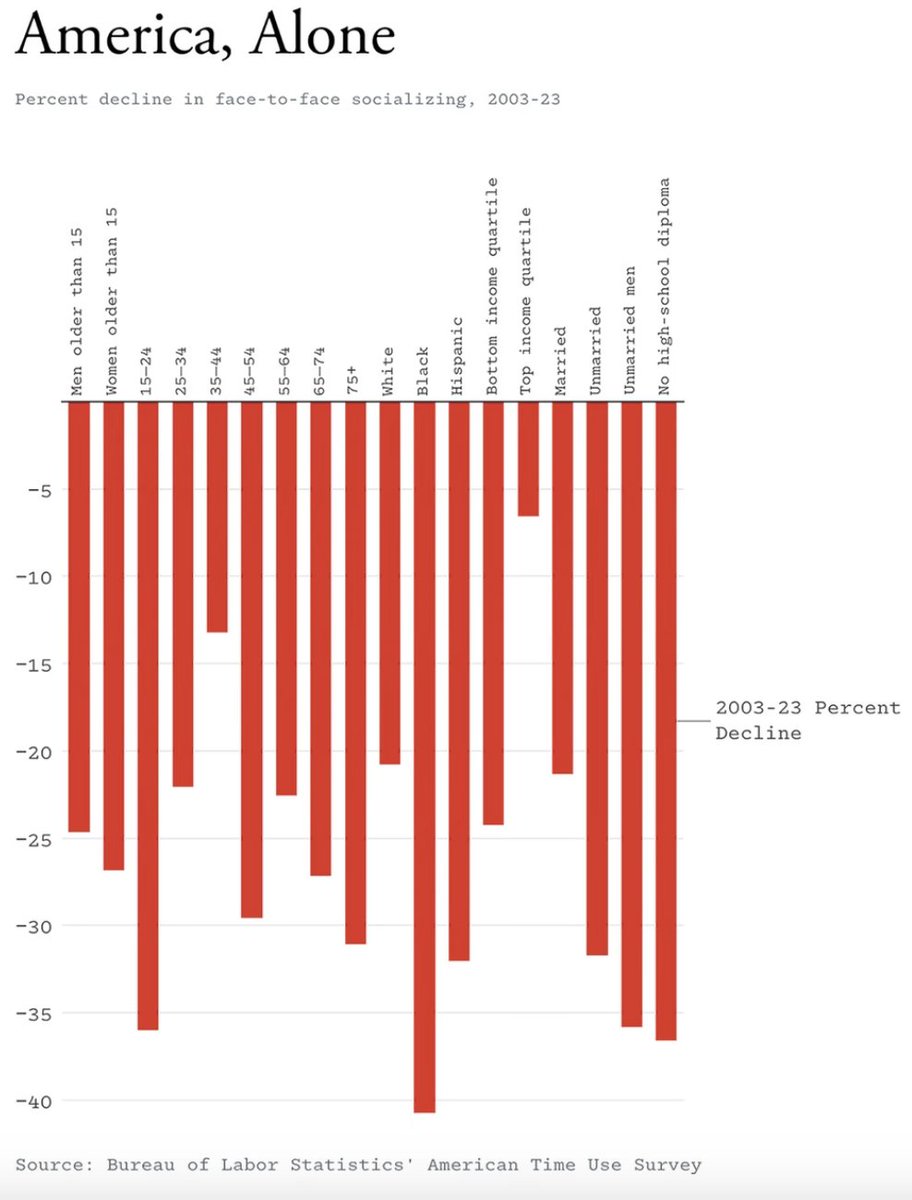
1. In the last few years, in-person socialization has declined, for every demographic group, to its lowest point on record
2. The typical American is now alone more than in any period where we have decent data, going back to at least 1965
3. Americans now spend an extra 99 minutes in their homes compared to 2003—a trend that crept up slowly before the pandemic, before exploding and remaining at a seriously elevated level. As Princeton’s Patrick Sharkey wrote in a 2024 paper, the homebound trend isn't just about remote work. Homebound life has “risen for every subset of the population and for virtually all activities” from eating to praying.
4. America's social depression is far-reaching. The share of adults having dinner or drinks with friends on any given night has declined by more than 30% in the past 20 years. The share of boys and girls who say they meet up with friends almost daily outside school hours has declined by nearly 50%.
I don’t think these trends are simple. In many cases, they’re not even simply bad. (Ordering delivery: totally fine! Eating more meals alone, year after year after year: not so great!) But to see these trends—and their effects on American society—more clearly, I thought this phenomenon needed an anchoring, a naming, a media artifact for people to talk about, even if only to point out that I’m wrong. So, I wrote this.
In recent years, experts have worried over an online crisis of “misinformation,” Charlie Warzel and Mike Caulfield write. But that term doesn’t begin to describe what’s really happening. https://t.co/v4pTssZwHe
one of my favorite art pieces from @TEDTalks this year is now online - here's a beautiful art piece if you need a pallet cleanse today about the magic of nature: https://t.co/KdzSJdIYHw