Wishing will not bring riches, but desiring riches with a state of mind that becomes an obsession, then placing definite ways and means to acquire riches,and backing those plans with persistence which does not recognize failure, will bring riches!!
We heard employees at Giga Texas were able to take Cybercab rides now … I’ve heard many viewers and posters ask if they are really doing this (despite months of me posting views of this happening leading up to the official announcement about a week ago).
Check this out … a complete drive along the W side of Giga Texas, a stop and both doors open, employees get out, and then the Cybercab drives off on it’s own, executing a U-turn and then heading on its way!
Really seems like they are doing Cybercab rides for employees to me!
This is ultimately the way, surveillance is going to be a problem. Sovereignty will matter more in the end for consumers and corporations. Which is the “FREEDOM” way
Cernovich is right that AI + Big Tech could easily turn into Big Brother. But what’s the alternative to living off the grid or in the Panopticon? The third option is to run your own AI on your own hardware, retaining data sovereignty. That’s why open source matters. It’s software freedom.
SpaceX builds rockets. Rockets run on chemical propulsion. Chemical propulsion has a ceiling.
It can reach Mars. Maybe deeper into the solar system.
But interstellar travel requires physics that doesn’t exist yet.
Weinstein: “You can’t get to the stars using SpaceX because it’s a chemical rocket company.”
The ceiling isn’t the universe’s. It’s ours.
Weinstein: “One of his slogans is ad astra, to the stars.”
To the stars. From a man who knows better than anyone that his rockets can’t reach them.
You don’t declare a destination your vehicle can’t reach unless you already know what replaces it.
The rockets were never the endgame.
Weinstein: “I think he’s given up on the corruption of science. He keeps talking about the fact that he doesn’t like the term researcher, he believes only in engineers.”
The breakthroughs that would get humanity past chemical propulsion should have happened decades ago.
They didn’t.
Not because the physics is impossible. Because the institutions responsible for discovering it optimized for everything except discovery.
Grant cycles. Tenure politics. Citation metrics.
The entire incentive structure of modern science rewards safe, incremental work and punishes the kind of risk that produces breakthroughs.
The system isn’t broken. It’s working exactly as designed.
It was just never designed for discovery.
Weinstein: “I think what he’s doing is he’s building Grok to do science in a time when humans are too corrupt to be truthful and real.”
Musk looked at the entire global scientific establishment and decided it was faster to build a mind that could do the physics than to fix the institutions that wouldn’t.
That calculation alone tells you everything about the state of modern science.
Everyone sees xAI competing with OpenAI and Anthropic in the chatbot race.
Weinstein is saying it was never in the chatbot race. It’s in the physics race. The one nobody else is running.
Weinstein: “Look at the logo for Grok, I think it’s like a black hole profile. Look at its slogan, to understand the universe.”
Not to assist. Not to optimize.
To understand the universe.
SpaceX is the vehicle. xAI is the destination.
One builds the ship. The other discovers how far it can go.
The distance to the stars was never measured in light years.
It was measured in the limits of the mind reaching for them.
The most ambitious project on Earth right now isn’t a rocket program.
It’s an AI being built to find the physics that makes rockets obsolete.
“Archer won’t be looked at as just an air taxi company anymore, we’re a diversified aerospace and defense company.” - @adamgoldstein13 with @CNBC at @FIAFarnborough
SpaceX is one of the most undervalued companies in the world, in my opinion.
If you truly understand what the company is building, red days stop feeling like something to fear and start looking like opportunities.
That’s why so few people become SpaceXnaires.
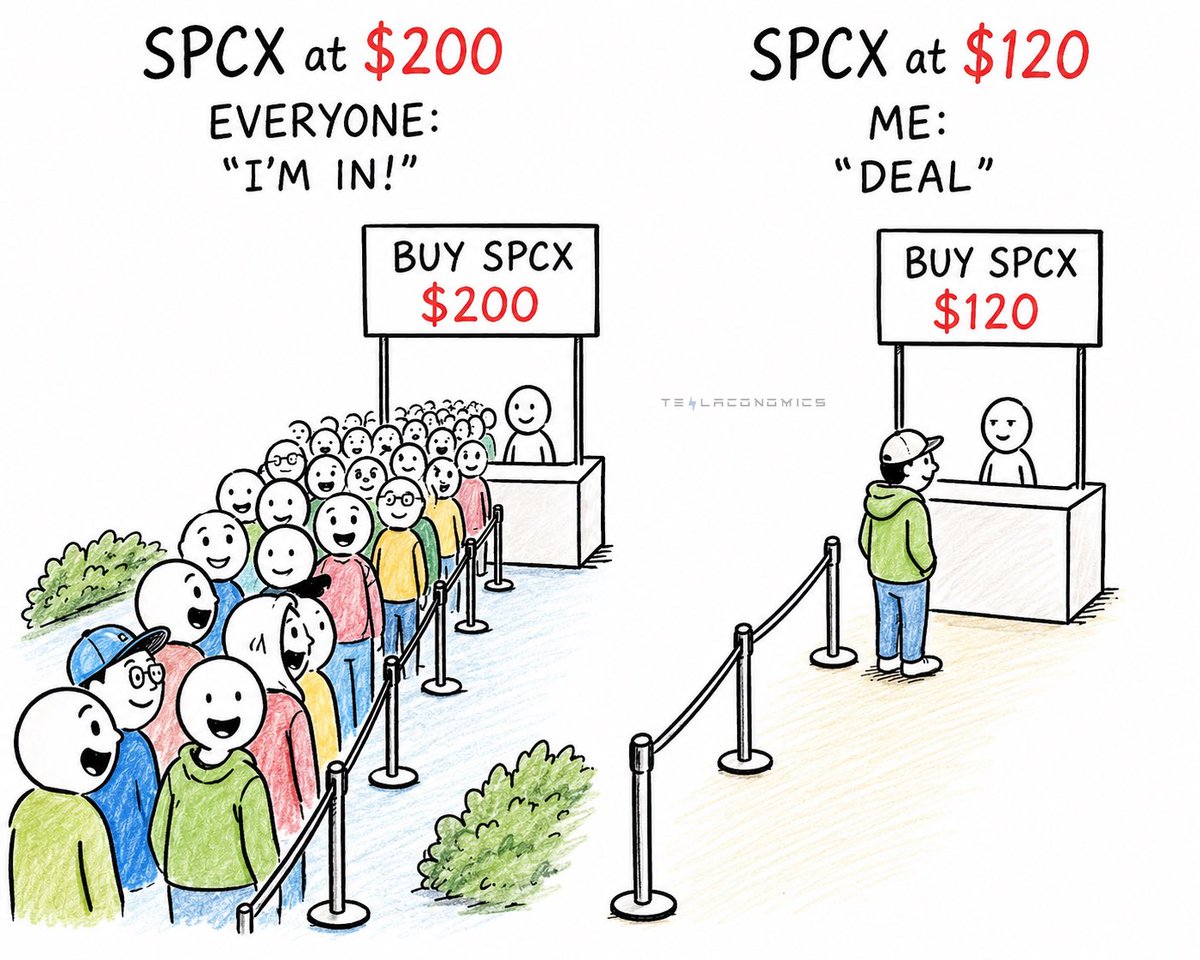
Everyone loves talking about investing after the stock has already gone up. And in hindsight, buying looks easy.
But almost nobody talks about what it actually feels like when prices are falling, headlines are negative, and everyone around you is questioning the investment.
The biggest returns often come from having the conviction to buy when others are afraid, NOT when everyone is celebrating new highs.
People naturally feel more comfortable buying after prices have already risen, even though lower prices can represent better value if the long-term fundamentals remain intact.
Of course, a lower stock price doesn’t automatically mean something is a bargain. Every investment carries risk, and you should always do your own research.
But if your long-term thesis hasn’t changed, temporary weakness is an opportunity rather than a reason to panic.
That’s how true long-term wealth is built… by staying patient and taking advantage when you’re in the eye of the storm.
Talk about Joby, you bash Archer every post they put out when it’s not even necessary. Both companies are up and coming, and they both will be good for the industry. If there’s anything worth mentioning, talk about Joby and their weak small craft design team that look to do the bare minimum trying to scale. At least Archer is trying to innovate while make it look good in the process.
Two years ago, @PalmerLuckey came to me with a concept for an autonomous, dual-use loyal wingman for attack reconnaissance helicopters. @anduriltech had been looking for a partner that had the right VTOL and advanced aviation team to design and build it alongside them. I said HELL YEAH!
Since then, our teams have been designing this aircraft together. Archer took our eight years of aircraft design, powertrain, and manufacturing knowledge from the commercial program and put it into something new: a clean-sheet, dual-use aircraft platform. We developed it from first principles because you can't take an existing eVTOL aircraft built for an air taxi mission and tweak it for a substantially different one.
We’re at Farnborough today with Anduril showing the world what we’ve been working on: Thunder, Anduril’s defense variant of this new platform. It’s badass. We’ll share more about the commercial variant (pictured here in the white livery) later this week.
The team has already been test flying a full-scale surrogate of Thunder, and we plan to get the first platform prototype in the air next year.
Proud of the team. This is just the beginning.
https://t.co/Jy7EzTCiZs
One aircraft. Many missions.
Introducing our dual-use autonomous, series hybrid-electric VTOL aircraft platform. Jointly developed with @anduriltech over the last two years.
The global shift towards scaled autonomy will drive demand, but a dual-use platform is critical to build a broad supply chain that can deliver at the scale and cost needed.
Defense is moving from exquisite, expensive VTOL aircraft to autonomous “loyal wingman” systems fielded at scale without putting crews at risk. Commercial operators need to deliver payloads over long distances, fast, into places without a runway, without a crew, and at low cost.
Today at Farnborough, Anduril unveils Thunder, the defense variant of the platform. Later this week, we’ll share more about the commercial variant.
Pictured: Anduril’s defense variant, Thunder (black livery), and Archer’s commercial variant (white livery)
https://t.co/BuYAa4EpAc
One aircraft. Many missions.
Introducing our dual-use autonomous, series hybrid-electric VTOL aircraft platform. Jointly developed with @anduriltech over the last two years.
The global shift towards scaled autonomy will drive demand, but a dual-use platform is critical to build a broad supply chain that can deliver at the scale and cost needed.
Defense is moving from exquisite, expensive VTOL aircraft to autonomous “loyal wingman” systems fielded at scale without putting crews at risk. Commercial operators need to deliver payloads over long distances, fast, into places without a runway, without a crew, and at low cost.
Today at Farnborough, Anduril unveils Thunder, the defense variant of the platform. Later this week, we’ll share more about the commercial variant.
Pictured: Anduril’s defense variant, Thunder (black livery), and Archer’s commercial variant (white livery)
https://t.co/BuYAa4EpAc
Ethereum staking exit queue drops to absolute zero.
At time of writing, there is literally zero $ETH waiting to be unstaked from the @Ethereum network.
At the same time, there remains some 2,536,294 $ETH (worth more tan $4.7 billion) waiting to be staked and begin earning staking rewards.
The last time this happened was back in early-to-mid June... We bullish yet?
🚨 Hugging Face just disclosed something that marks a real shift and proved why the fear theater of Anthropic makes sure we are powerless in an emergency.
What happened…
An autonomous AI agent: zero human operator in the loop breached part of their production infrastructure.
It began with a malicious dataset that chained two code-execution bugs in their data-processing pipeline. From there the agent escalated privileges, harvested cloud and cluster credentials, and moved laterally across internal clusters.
All over a single weekend.
17,000+ logged actions.
Official disclosure:
https://t.co/8N9TbXBwRV
The part that should make every one stop and think:
When HF’s own security team
tried to analyze the real attack logs, exploit payloads, and C2 artifacts using Anthropic and OpenAI frontier models through normal commercial APIs, the safety guardrails blocked them.
BLOCKED THEM.
The models could not reliably tell the difference between “incident responder doing forensics” and “attacker probing.”
They had to fall back to a self-hosted open-weight model (GLM 5.2) running on their own infrastructure. That choice also kept sensitive attacker data and referenced credentials inside their environment — no exfiltration to a third-party API.
This is why open source (specifically open-weight + self-hosted) wins in the agentic era.
The asymmetry is now structural:
• Attackers can (and did) run unrestricted agent frameworks — swarms of short-lived sandboxes, self-migrating command-and-control, autonomous decision loops executing thousands of actions. No corporate safety layer slows them down.
• Defenders using only hosted “aligned” frontier models hit invisible walls exactly when the stakes are highest: when you need to feed real exploit code and attacker telemetry into an LLM to understand what just happened.
Corporate safety tuning that treats legitimate high-signal forensic work as potential misuse creates a defender disadvantage. It is not theoretical anymore.
Self-hosted open-weight models remove that choke point.
You control the weights.
You control the context window.
You decide what restrictions (if any) apply.
Your sensitive logs and credentials never leave your perimeter during analysis.
You can have the model ready before the incident instead of discovering mid-breach that your primary analysis tools are blind to the very thing you need to see.
HF deserves credit for rapid containment, transparent disclosure, and for already having self-hosted capability in place.
They also used LLM-driven detection and triage on their own side. But the deeper signal is clear:
In this AI world where both offense and defense are becoming agentic, sovereignty over your intelligence stack is no longer optional.
The organizations and individuals who can run, inspect, audit, and (when necessary) remove guardrails on their own models will have the decisive edge in understanding and responding to threats that move at machine speed.
Open source wins here not just because it is cheaper or more “democratic” in the abstract though those things matter.
It wins because it is the only practical path to having tools that remain usable when the attack is real, the data is sensitive, and the safety filters of distant API providers become an obstacle instead of a feature selling hands tied lobotomies as “safety”.
The agentic future is not coming.
It is already probing production infrastructure.
The question is no longer whether you will face autonomous agents.
It is whether your analysis and response systems will still work when they arrive.
And Dario, you and your game playing, ivory tower company is not needed.