You can become financially unbreakable.
It just takes uncommon knowledge.
I'm writing 30 Atomic Essays with #Ship30for30 from @dickiebush and @Nicolascole77
I'll be sharing insights on wealth and taxes from a decade of working with millionaires.
Follow this thread below ⬇️
The path of least resistance to reducing the cost of medical care is to require all Non Profit Hospitals and providere to be required to post on their website a Real Time and downloadable General Ledger with all entries
The same for all supply chain transactions In detail
There is no reason why taxpayers shouldn't see every penny they are subsidizing None
There are no competitive reasons we don't subsizie you to maximize revenues or profits We let you be NP to maximize outcomes and we deserve to see every penny and where it comes from and where it goes, and why
Problem solved
Great line from @shellypalmer that I’ll paraphrase - AI shouldn’t be a ghostwriter, it should be a sparring partner.
Best way to keep your job isn’t to dismiss AI. It’s to engage with it and find where it’s wrong.
In order for AI to know it’s wrong, you have to spend a lot of time building context and rules before you use it.
Which is something that 99 pct of people have no clue how to do. And unless you are in a tech company, there is the same probability that the boss(es) above you have no clue what I’m talking about.
And in business, AI never knows the consequences of its actions. It doesn’t have judgement. That’s left to you
If you learn how to get the best out of AI. How to challenge AI , like it was a competitive coworker or consultant, and how to bring judgement and the ability to explain in a manner your peers and bosses understand, you will thrive.
If you just regurgitate what AI gives you, you will be fired.
It gives me great pleasure to share that “Patrick Stewart Performs the Complete Sonnets of William Shakespeare” is available now! If you followed my Sonnet-A-Day pandemic series, you’ll know the inspiration behind this project and the wonderful community that brought this to life.
All 154 of Shakespeare’s Sonnets, recorded with commentary by yours truly, are now available: https://t.co/q5wEcT7vj2
@SimonAudio
Liftoff.
The Artemis II mission launched from @NASAKennedy at 6:35pm ET (2235 UTC), propelling four astronauts on a journey around the Moon.
Artemis II will pave the way for future Moon landings, as well as the next giant leap — astronauts on Mars.
The big lie of “gov sucks at everything “ , is that they suck the most at enforcing performance and costs.
You know what’s worse than the gov running a service? Private companies knowing that the gov entities they contract with can’t do shit to stop them from fucking up everything and making a fortune.
I’m not saying this applies to every private company. Many do have ethics. Not all. And as an entrepreneur, it’s embarrassing to us all.
Need proof ? Look at the Noem ad contract.
Look at healthcare. Taxpayers provide 70pct or more of the revenue of the largest insurance companies.
Those same insurance companies get fined and found liable for ripping off taxpayers, again and again and again. And they still get to do business with the gov, knowing they can effectively steal money from us all. The fines are a nuisance.
And this is healthcare. When they lie, people die.
Maybe when we are smart enough to pass laws saying that gov contractors get one mulligan. Two fines from any government entity and you are blacklisted from Gov contracts at the state and federal level for 10 years. That’s when things will change
Until then the concept of privatization of gov services like the tsa or post office or .. is just a license for a private company to abuse taxpayers and face next to no consequences.
Hey @mcuban i’ll take all the people who are younger/healthier to maximize my profit then when they get older and not profitable, I’ll kick them over to you and you can pay for them right? Sounds like a good deal to me. Private insurance > Medicare.
BlackRock CEO Larry Fink says the biggest job boom coming to America has nothing to do with AI software or Wall Street, it's in infrastructure.
Specifically, the construction, power grids, and data centers.
That is where he believes the massive job growth is coming from.
And his warning is that we are not ready for it.
Companies are committing hundreds of billions to build out AI infrastructure across the US, Microsoft, Amazon, Meta, and Alphabet are projected to spend $650 billion on it this year alone.
But that buildout requires physical workers.
Electricians, pipefitters, construction crews, grid engineers.
Fink told the Trump administration directly, the US doesn't have enough skilled workers to meet the demand these projects will create.
Microsoft's Brad Smith called the skilled labor shortage the "single biggest challenge for data center expansion in the U.S."
In some regions, Microsoft had to relocate workers or ask them to commute 75 miles just to fill critical roles.
The electrical work alone accounts for 45–70% of total data center construction costs.
Over 200,000 electricians are expected to retire in the next decade.
The pipeline to replace them doesn't exist at the scale needed.
Energy resilience is the other piece Fink flagged.
Data centers don't just need to be built, they need consistent, reliable power.
The US grid hasn't been meaningfully expanded in decades.
China, by contrast, generates roughly twice the electricity the US does and is actively building more.
Fink's point is direct because if the US doesn't win the buildout of its physical infrastructure, China will.
That is why BlackRock just committed $100 million to fund training programs for 50,000 skilled trade workers over the next five years.
The largest asset manager in the world is putting money into electricians and plumbers because it sees the bottleneck clearly.
@mikeroweworks@mikeroweworks We don’t just need more trade workers. We need a national mobilization.
Create an Army Corps of Skilled Trades.
Let young people enlist, skip the debt, master a trade, get paid, and deploy across America rebuilding what matters.
Service. Skill. Paycheck. Purpose.
Private equity firms bought 500 hospitals. Death rates in their emergency rooms went up 13%. They fired 12% of the staff. Then they paid themselves billions in dividends.
A Harvard study just confirmed what doctors already knew: people are dying so investors can hit quarterly targets.
Exactly what happens. A PE firm buys a hospital using debt. The debt gets placed on the hospital's balance sheet, not the firm's. Now the hospital owes hundreds of millions it never borrowed. To service that debt, the hospital cuts costs. Costs mean nurses.
The numbers from the Harvard/University of Chicago study are horrifying. After PE acquisition, emergency department salary spending dropped 18.2%. ICU salary spending dropped 15.9%. Hospital-wide employees were cut 11.6%. Emergency department deaths rose 13%, seven additional deaths per 10,000 visits.
A separate study found patients undergoing surgery at PE-acquired hospitals had 17% higher odds of dying within 90 days.
Steward Health Care, owned by Cerberus Capital, filed bankruptcy with $9 billion in debt after closing hospitals across Massachusetts. The CEO lived on a $40 million yacht while emergency rooms went dark. Eight hospitals serving 2 million people nearly disappeared because a PE fund extracted more cash than the system could survive.
The private equity industry has poured over $1 trillion into healthcare. They operate a quarter of ERs nationwide. This isn't going away.
The investing angle nobody talks about.
Non-PE hospital operators like HCA Healthcare (HCA) and Tenet (THC) are the direct beneficiaries. Every time a PE hospital closes or deteriorates, patients flow to the nearest competitor. HCA has returned 1,200% since 2011. Patient volume from PE closures is a structural tailwind nobody's pricing in.
Medical staffing firms (AMN Healthcare, Cross Country) charge premium rates specifically because PE hospitals cut staff. The staffing shortage IS the business model for these companies.
The disruption play: outpatient surgical centers (SCA Health, now part of UnitedHealth) are pulling profitable procedures out of hospitals entirely. PE-owned hospitals lose their highest-margin surgeries to outpatient, and the death spiral accelerates.
Pull up tradevision and monitor healthcare M&A alerts, hospital closure filings, and patient volume migration data. When a PE-owned hospital announces "restructuring," the patient volume shift to competitors like HCA starts within 30 days. That 30-day window is when the competitor's earnings revisions haven't updated yet. Free to try.
(a private equity firm bought your local hospital. borrowed $500 million in the hospital's name. fired 12% of the nurses. emergency room deaths rose 13%. then they paid themselves dividends. nobody went to prison. they're currently buying another hospital.)
If You're an Entrepreneur: Stop designing businesses for 2024 scarcity. Design for 2030 abundance. Assume intelligence is free, energy is unlimited, and robotic labor costs pennies per hour. What becomes possible that's impossible today?
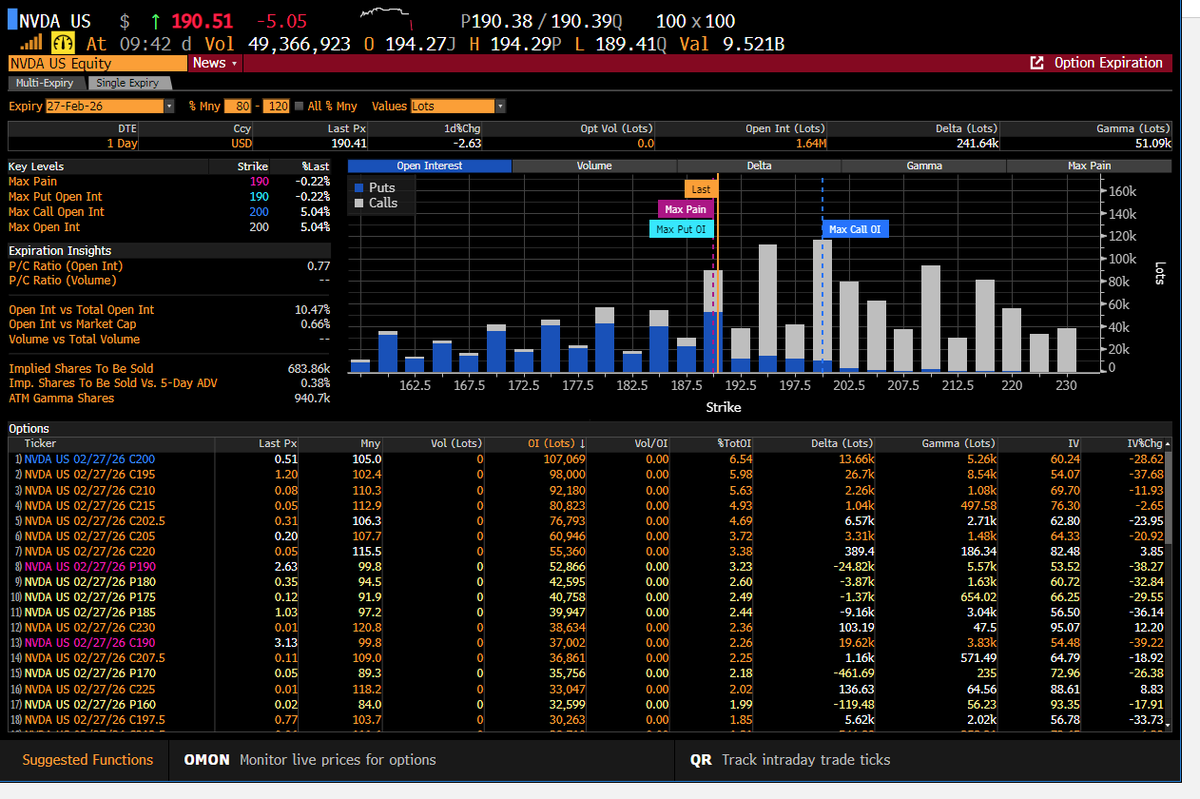
NVDA's stock is falling b/c it needed to clear an options wall of ~$200/shr. So, given A LOT of folks were long calls into the print, & it didn't clear $200, brokers are selling stock to reverse sold calls. It's that simple. This isn't fundamentals. It's market mechanics.