I've been reading a lot this week about DeepMind's AlphaChip. The MediaTek detail in AlphaChip write-up deserves some attention.
MediaTek extended the approach for its own chip development, combining it with existing engineering practices. DeepMind also reported using AlphaChip for layouts in Google’s Axion general-purpose CPUs.
That makes the application broader than Google’s AI accelerators.
I find adoption by another chip designer particularly interesting. It raises practical questions about how well an approach transfers between teams, designs and constraints.
I’d love to see more detailed accounts of those deployments such as... where the biggest gains came from, what needed adapting and most importantly which parts still required the most human work.
https://t.co/fJKt3RH9L9
An AI workload costing $1 billion in compute today could cost around $1,000 in ten years if hardware and software efficiency trends continue.
That’s one scenario explored in a new DeepMind Institute essay.
It’s a conditional extrapolation, but it raises a question worth taking seriously. What happens when cognitive work that is currently prohibitively expensive becomes widely affordable?
https://t.co/O8UzYnrFpG
Why was Gemini multimodal from the start? Demis Hassabis wanted it to work well on glasses. 😎
Looking back at Google Glass in January, he said the hardware was bulky and the screen was small. The bigger problem was figuring out what you’d actually want to wear it for. His answer is an assistant that can follow you from your computer to your phone to your glasses and make sense of what you’re looking at.
So that’s what made the Project Astrainteresting to me. 👓 The glasses use case helps explain why understanding the physical world mattered so early in Gemini’s design, and why some of that same work could carry over to robotics.
LFG
Our SVP @koraykv believes there won't be a single test or benchmark that tells us we've reached AGI. Instead, progress looks like models becoming less spiky and more reliable across our daily lives.
Listen in as he and @fryrsquared discuss the road ahead ↓
Timecodes:
00:00 Introduction
01:26 Evolution of Google DeepMind
04:41 Products as a path to AGI
13:01 Architectures and models
24:40 Recursive self improvement
30:50 Safety and agent teams
40:35 Benchmarks
Most AGI debates stop at human-level intelligence. A new DeepMind Institute essay by researcher Tim Genewein asks what happens after that.
It explores four potential routes to superintelligence: scaling, new AI paradigms, coordinated agent collectives and recursive self-improvement.
The interesting part is that these could reinforce one another. Progress wouldn’t have to depend on a single breakthrough.
https://t.co/O8UzYnr7A8
Today, we enter a strategic research collaboration with @MSDInvents. The collaboration brings together Isomorphic Labs’ world-leading frontier AI capabilities with MSD’s deep discovery, development and manufacturing expertise.
Read more: https://t.co/C91AwXDZRl
A humanoid’s first useful job might be the work between two machines.
At Davos in January, Demis Hassabis told Alex Heath he expects industrial uses to come first and guessed the robotics market could split roughly 50/50 between humanoids and other designs. His example was a factory or automated lab where specialized robots do dedicated tasks and humanoids act as the glue between them.
I like this example because it gives the human shape a specific purpose. A robot that has to move between workstations can use spaces built for people. A machine that spends all day doing one job at one station can be built around that job. 🤖
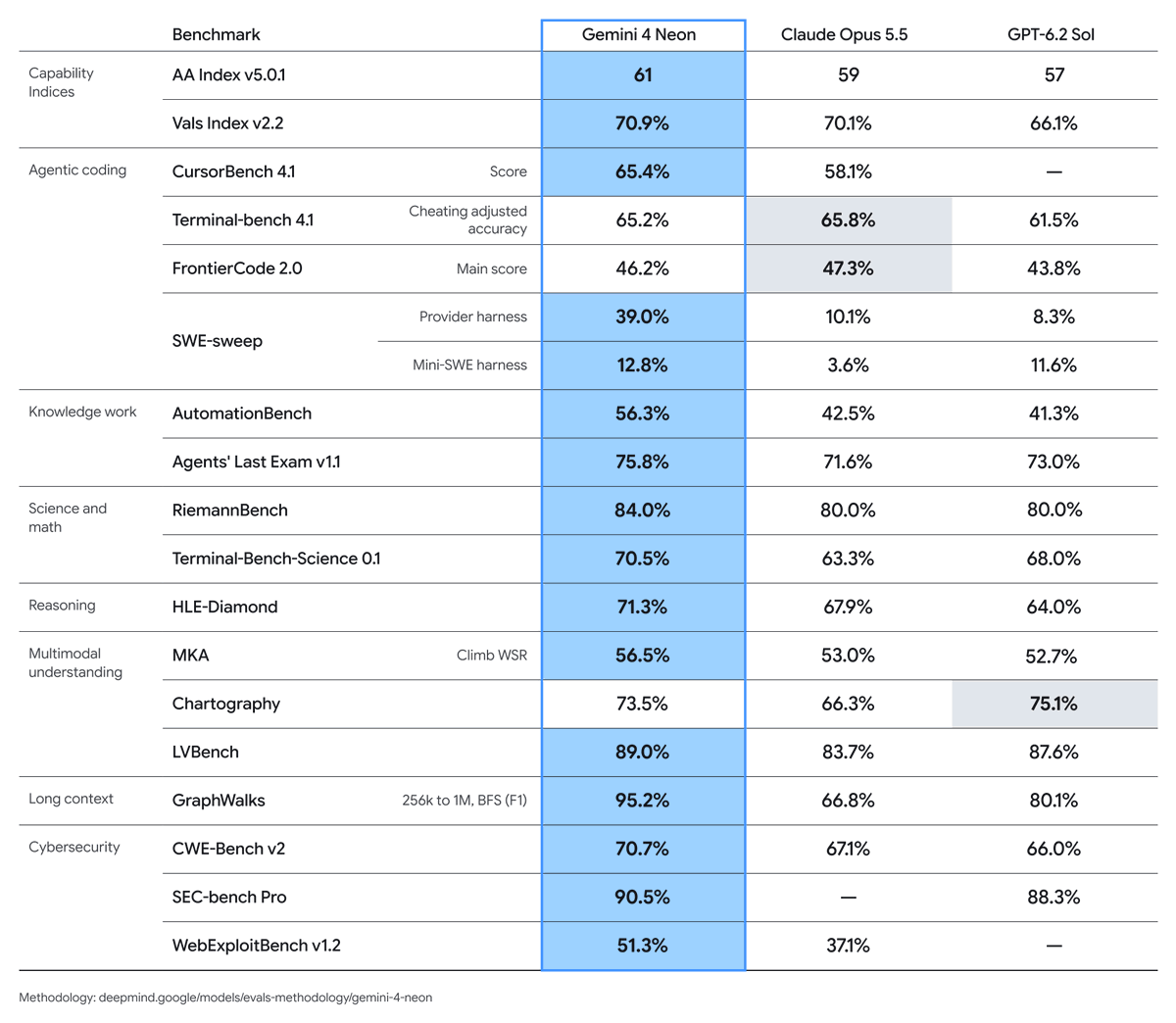
Excited to launch Gemini 4 Neon: frontier-level intelligence, super fast task completion, and available to Pro & Ultra users now!! We think you’ll enjoy this model. Alchemy at its finest… 🧪
Gemini 4 Neon is rolling out now across Google. It sits between Gemini 4 Hydrogen and Gemini 4 Carbon for high-frequency complex tasks.
Gemini 4 Neon is available on the paid tier of the Gemini API and with Google AI Pro and Ultra plans in Google AI Studio.
Genie 4 is available! Looks like it is turtles all the way down then… Eligible Ultra subs can try it in Project Genie - excited to see what you’ll build with it. More info in the blog: https://t.co/ZWAi93TesH
I like fun facts about AI leaders. So here's one I learned today.
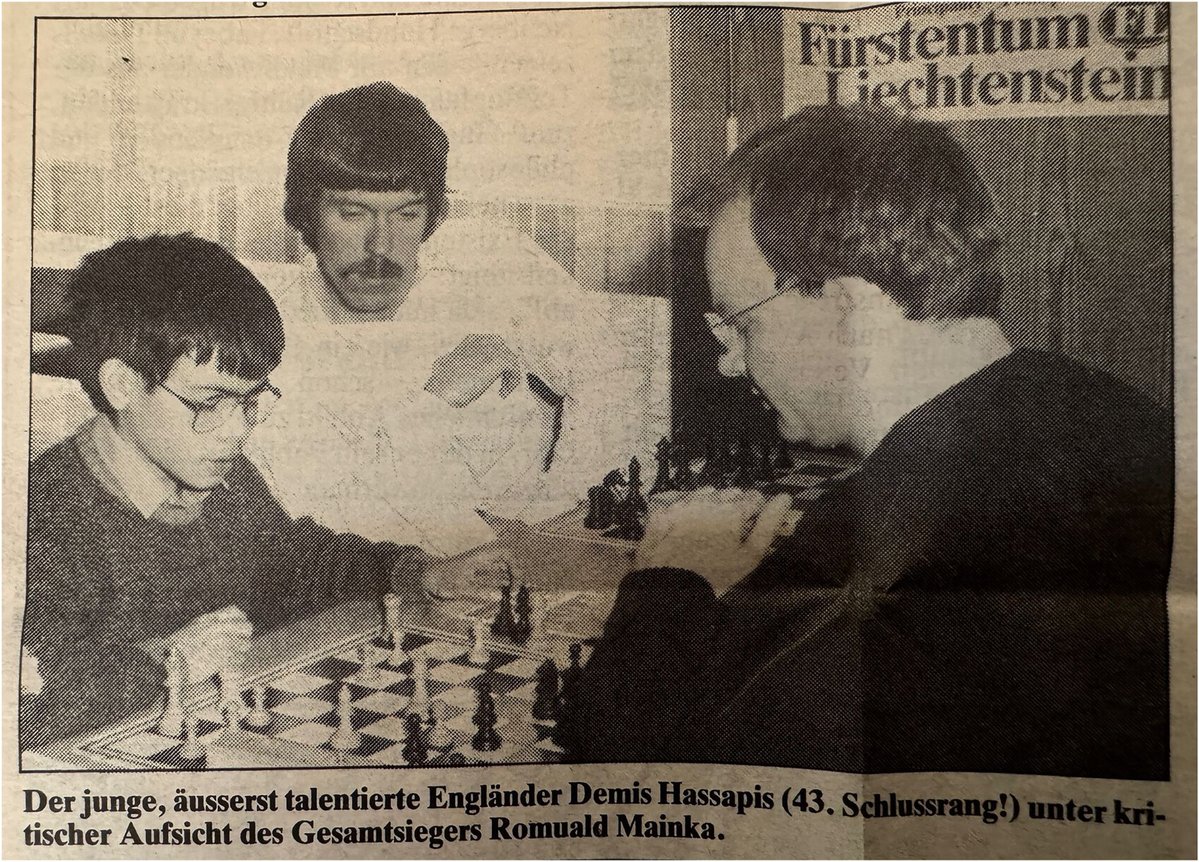
❓Did you know Demis Hassabis used to go by Demis Hassapis? The caption in this Liechtenstein newspaper spells it with a p. I figured it was a typo at first, then saw the same spelling on his Wikipedia page.
Hassapis (Χασάπης) means “butcher” in Greek and comes from his Cypriot father’s side of the family. Demis was publishing as Hassabis by 2007.
Ingo Althöfer, who dug up the clipping, calls the switch from p to b a “point mutation.”
Source: https://t.co/s0sCC4nyrJ
How do you teach an AI where things should go on a chip?
AlphaChip treats placement as a sequence of moves. It places large circuit blocks one at a time, then receives a reward based on the resulting layout.
One of the awkward trade-offs is that bringing connected components closer together can shorten their wiring, but packing things too tightly can create congestion. A good layout has to balance competing requirements.
Through repeated attempts, the system learns which placement decisions tend to produce better results.
I like this example of reinforcement learning because the challenge is easy to picture. A decision that looks sensible for one component can make the rest of the layout harder to finish.
https://t.co/BexWOxFcAT