Stanford discovered something like to "Dopamine" inside LLMs.
They looked deep inside the hidden states of these models and discovered something terrifying.
AI has naturally developed a complete, functioning reward subsystem.
It perfectly mimics the human brain.
Nobody programmed this architecture. It just emerged.
Inside the model, a tiny, sparse subset of neurons act as "value neurons." Their only job is to anticipate how good an answer will be.
But the real shock is what happens next.
They found a second set of neurons that act exactly like human dopamine.
When the AI gets a better result than it expected, these dopamine neurons spike in activation. When it gets a worse result, they crash. The AI is literally experiencing a mathematical dopamine hit.
Researchers tried an intervention experiment. They went in and artificially removed just a tiny fraction of these specific dopamine and value neurons.
AI didn't just get slightly less accurate.
Its entire ability to reason collapsed.
Without its digital dopamine, the model lost the capacity for complex logic. Ablating those specific neurons basically gave the AI severe depression, killing its ability to think through problems.
Meta published a paper that might end the current LLM era.
They proved that we can kill the "tokenizer" forever and it actually makes the models stronger.
Every AI you use today (ChatGPT, Claude, Gemini) reads text the exact same way. It chops your words into arbitrary chunks called tokens.
It relies on a massive, bloated vocabulary of around 100,000 specific chunks just to understand a sentence.
We assumed this was the only way to build AI. We treated it as the fundamental speed limit of language models.
Meta proved we were completely wrong.
Their new paper, "Breaking the Token Ceiling," ditches tokens entirely.
Instead, they forced the AI to process raw bytes. A vocabulary of just 256 values.
The results rewrite the rules of model efficiency.
By training on pure bytes and distilling the knowledge, these tiny models didn't just survive. They dominated.
Meta's distilled 1B-parameter byte models asymptotically surpassed state-of-the-art token models like Llama 3.2-1B and Gemma-3-1B across downstream tasks.
They use a fraction of the vocabulary. They require less data. They take up less storage.
It forces the model to actually learn the fundamental relationships between raw data instead of relying on pre-packaged text chunks.
This is a massive shift for anyone building, training, or deploying AI.
We’ve spent the last five years obsessively optimizing how we chop up text to feed these models.
It turns out, the bottleneck wasn't the intelligence of the model.
It was the tokenizer.
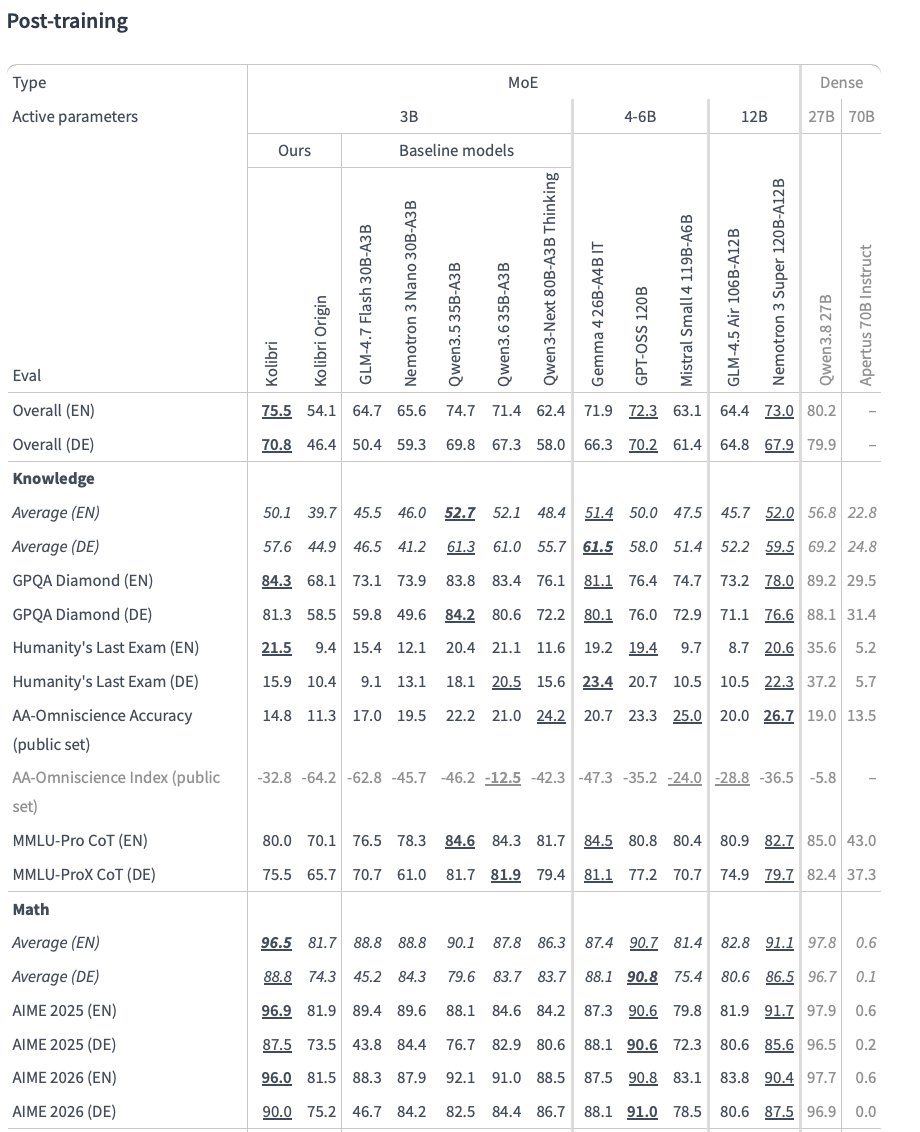
Aleph Alpha’s Kolibri looks like a surprisingly strong AI release from Germany! I did not expect that but respect where respect is due!
78B total parameters, just 3.46B active per token, and open weights under Apache 2.0. Built from scratch for German and English.
In Aleph Alpha’s own evaluations, it scores 96.9% on AIME 2025 and 84.3% on GPQA Diamond. Its German overall score narrowly beats Qwen3.5 35B-A3B and GPT-OSS 120B.
Coding is more mixed: 66.4% on SWE-Bench Verified, behind Qwen3.6’s 73.8%.
It increasingly looks as though any "moat" - especially with small models - is evaporating, and it no longer matters whether the players are from China, the US, or Europe. Anyone can train good small models.
TIL SQLite converts integers to text two digits at a time
converting an integer to text usually means a loop of /10 and %10
sqlite avoids most of those divisions by keeping a 200-byte string of every two-digit pair from 00 to 99, and pulling two digits at a time out of it by direct index instead of computing them
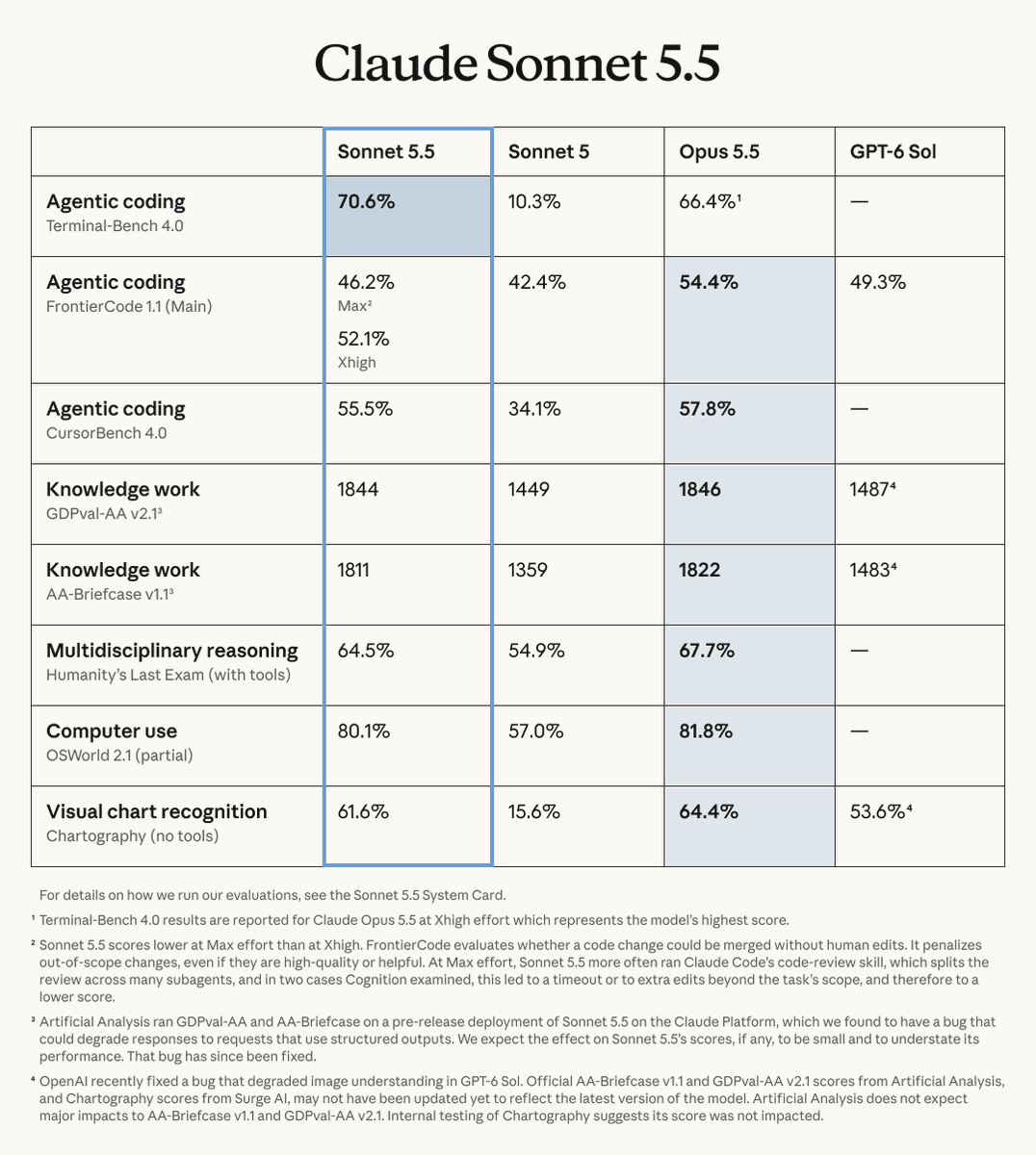
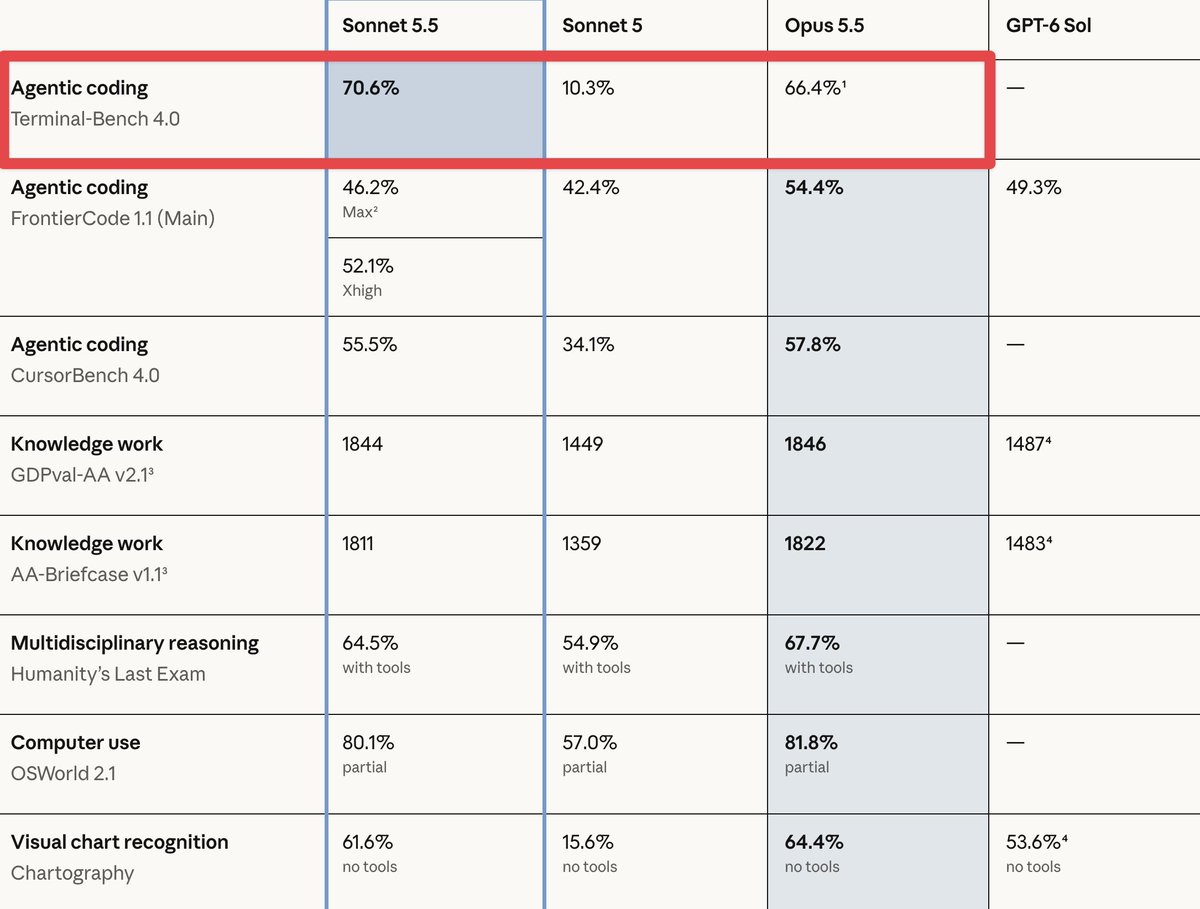
Sonnet 5.5 improves on Sonnet 5 across benchmarks, in some cases dramatically.
It’s a faster, lower-cost complement to Claude Opus 5.5, strongest at well-scoped everyday tasks, fixing bugs, and creating polished documents, slides, and spreadsheets.
Introducing Claude Sonnet 5.5, the second model in the Claude 5.5 family.
It’s a clear upgrade over Sonnet 5, runs more than 30% faster, and costs up to 30% less for most work.
My god this is such a good speech that every SWE needs to hear. You know what? Every person should hear it
Keep the happy memories, eyes on the reality, be excited about the future. That’s the best that anyone can do
Fun optimization: when you open an app on an iPhone, the OS has a hardcoded check for if it’s the camera app, and if so, grants it its own special memory pool (“secluded memory”) for faster start up times: https://t.co/T4lKXnLbRp
Today, I’m proud to announce Homebrew 7.0.0.
The most significant changes since 6.0.0 are faster installations, stronger sandboxing, native macOS app, vulnerability checks, advisory database, end of macOS 10.15 support and Intel Macs to Tier 3.
https://t.co/LGnA62Bqd0
The Blue Zones—places where people supposedly live past 100 at extraordinary rates—aren't real.
A 🧵 on what went wrong: bad record keeping, pension fraud, and lots of money.