Allé soutenir ce mec sur Tipeee.
L’économie n’est pas un jeu à somme nulle.
Ce mec crée de la valeur tous les jours.
Il mérite d’imprimer du cash !
Ps : j’ai fait un podcast avec lui hier, c’est p être mon avatar, p être pas, mais p être quand même.
Personne ne sait, même moi je ne sais pas 🤷🏻♂️
I started by trying to understand markets. Thirty years later I've ended up somewhere closer to life, the universe and everything. The same four rules keep showing up...
Along the way I've written three frameworks that have shaped how a lot of people see the world.
The Everything Code is what I found when I went looking for what actually drives markets. A debt rollover cycle, managed by liquidity, debasing the currency at roughly 8% a year. That debasement is monetary entropy. Capital routes around it, into whatever can compound faster than the entropy degrades it. Technology and crypto sit at the top of that flow because they are the intelligence layer of the economy. Markets are monetary energy routing toward the highest output of intelligence. The only assets that outperform debasement over extended periods are tech and crypto.
The Exponential Age is the realisation that technology has become the substrate. Compute, networks, energy and intelligence are compounding faster than any institution we built was designed to handle, and the gap between the two is the defining tension of our time.
The Economic Singularity is where this is heading. Somewhere in the next decade the curve of intelligence per unit of energy turns fully exponential, and the rules every economy we know was built on stop applying.
For a long time I thought of these as three separate ideas. Looking at them now, they are three views of the same thing at different altitudes. And underneath all three, the same four rules keep showing up.
Efficiency of Intelligence - The universe rewards whatever does more with less. Every system that survives is better at turning energy into information than the system it replaced. There has never been an exception.
Compression - Intelligence is the act of representing a vast reality in a much smaller form without losing what matters. Brains do it. Theories do it. Prices do it. AI does it. They are not analogous. They are the same operation.
Coherence - Complex systems hold together because their parts synchronise faster than the noise around them. Markets, brains, civilisations, ecosystems. When the synchronisation fails, what looks like collapse is desynchronisation made visible.
Selection - Patterns that copy themselves faster than their rivals dominate the medium they live in. Genes did this in biology. Ideas do it in culture. Memecoins do it in markets. Truth is not part of the selection criteria. Replication is. It always has been.
What the four rules produce, when they operate together, is networks.
The same topology shows up everywhere. The cosmic web. The human brain. Mycelium beneath a forest. The internet. Financial markets. Blockchains. Across fourteen orders of magnitude, the universe keeps building the same shape. That shape is what the four laws look like when you can see them.
The Everything Code is what these four rules look like in markets.
The Exponential Age is what they look like running through technology.
The Economic Singularity is where they are taking us.
Three angles, one picture.
Underneath all of it, energy is the constant. Consciousness is the substrate. The four rules are the dynamics through which one becomes the other.
All of this is one corner of what I call The Universal Code. The same four rules apply to everything else and I mean EVERYTHING... they are universal in the true sense of the word.
🪂 42 Airdrop Alert — Announcing a $MEY token airdrop for the Q42 community
@Mey_Network is powering the next RWA supercycle with Property Token Offerings (PTO) making property ownership fractional, borderless, and liquid.
Turning real estate into on-chain opportunities for everyone.
How to enter:
1️⃣ Like & repost this tweet
2️⃣ Follow @q42_co & @Mey_Network
3️⃣ Register for the MEY Airdrop → https://t.co/YihXsWGIEj
We heard you. We’ve responded. A brand-new weekly MIT report drops later this afternoon on @RealVision. It’s a good one. I lay out our full outlook for Q4. Hope it’s helpful...
🚨GIVEAWAY🚨
Win one of 5 FREE 1-year Alpha memberships to celebrate the launch of the new Real Vision.
How to enter:
1️⃣ Join the waitlist [link in comment]
2️⃣ Drop a screenshot of the waitlist entry confirmation
3⃣ Like & RT this post
Winners announced on Oct 8
Ready to see the future of finance? 🥂...
I’ve been seeing a lot of chatter on X about “peak cycle” and how the economy looks late-cycle. So I wanted to tackle this head on and share a few thoughts of my own...
This is from the August 21st MIT publication:
A classic late-cycle economy typically has all the following ingredients:
✅ Manufacturing sentiment is extreme (think ISM ~60)
✅ Services sentiment is extreme
✅ Homebuilder sentiment is extreme
✅ Consumer confidence is high
✅ Worker confidence is high (JOLTS quits rate rising sharply)
✅ Investor sentiment is very bullish
✅ Small business confidence is high
✅ Job openings and hiring plans are rising
✅ Wage data and surveys show accelerating pay increases
✅ CEO confidence is strong and capex is booming
Now, I could add more to this, but when you score all of these inputs and turn them into a single timeseries, here’s what you get (chart 1).
Using data from ISM, NAHB, NFIB, BLS, AAII, The Conference Board, etc., US sentiment, when viewed as a complete picture, remains very subdued. We’re just not even close to the euphoric levels we see late in the business cycle, when everything listed above is stretched to extremes.
Peak cycle is when the ISM rolls over from 60+ to sub-50, inventories unwind, and demand cools. Supply and demand reset, inflation pressures ease, and the cycle eventually recovers out of the slowdown or recession – mostly depending on the extent to which financial conditions tightened during the cycle, particularly late on as central banks hike rates and drain liquidity.
However, based on this full set of indicators, the data is pointing to something very different. This does not look like an above-trend late-cycle economy. It looks much more like an early-cycle economy trying to build momentum.
Another really important factor, and a key reason we believe both the ISM and this sentiment composite will grind higher this year and into 2026, is the sheer scale of central bank easing via rate cuts.
Right now, nearly 90% of central banks are cutting rates. That is extraordinary, and on a forward-looking basis, it is a massive tailwind for the business cycle (chart 2).
By my playbook, the time to start talking late-cycle is when the teal line rolls over and begins to drop, as central banks turn to hiking rates to slow growth. Even then, there’s usually a nine-month lag before higher rates hit the real economy.
Right now, we’re just nowhere near that... in fact, the opposite is true.
To my earlier point, slowdown or recession is largely a function of how much financial conditions tighten late in the cycle. Oil prices are a big part of this equation. When oil runs 50% above trend, that represents a massive tightening and has almost always signaled recession, looking back to the early 1970s.
However, right now, we are nearly 20% below trend and still falling, which shows this component of financial conditions is still easing (chart 3).
Also, as I’ve pointed out many times in previous reports, when you look at Temporary Help Services, it has early-cycle vibes written all over it (chart 4).
Rising growth from deeply negative levels is an early-cycle dynamic. It tells you the economy is in recovery mode, not rolling over.
Late-cycle is the opposite: positive year-on-year growth that’s slowing, which reflects an overheated economy losing steam.
Why is unemployment still rising?
Because it lags the cycle. Jobs data is a six-month look in the rear-view mirror.
Here’s the thing: full-time hires are expensive. Benefits, pensions, overhead…
So what do businesses do first?
They typically increase overtime hours and bring in temp workers. Only when they feel confident do they finally lock in full-time staff. That way, they can scale without locking themselves into long-term payroll commitments.
So, this isn’t late-cycle. It’s early-cycle (growth up + inflation down = Macro Spring), soon transitioning to mid-cycle (growth up + inflation up = Macro Summer).
That’s how I see it, anyway...
Investing in meme coins = finding the next cult ⚡️
it's about @bullievecto in this video
✔️ Swapper powered by @JupiterExchange
✔️ Buybacks & burns cutting supply
✔️ 5 months of strong consolidation
✔️ More utilities & features on the way
If you bullieve in crypto, drop your ideas bellow 🐂🔥
Agentic Economy Powered by Digital Ownership
Brilliant take on the future of monetization of AI Agents. At @iAgentProtocol they're building for the future. I am bullish on them.
There will be some FUDding on this post because $AGNT didn't do well, but you can't hold Builders to account for market dynamics, at least when they continue to build even more.
Just give @jamkaa_mgl and his team some time to build and support them just by showing up 🫡
The future is AI Agents.
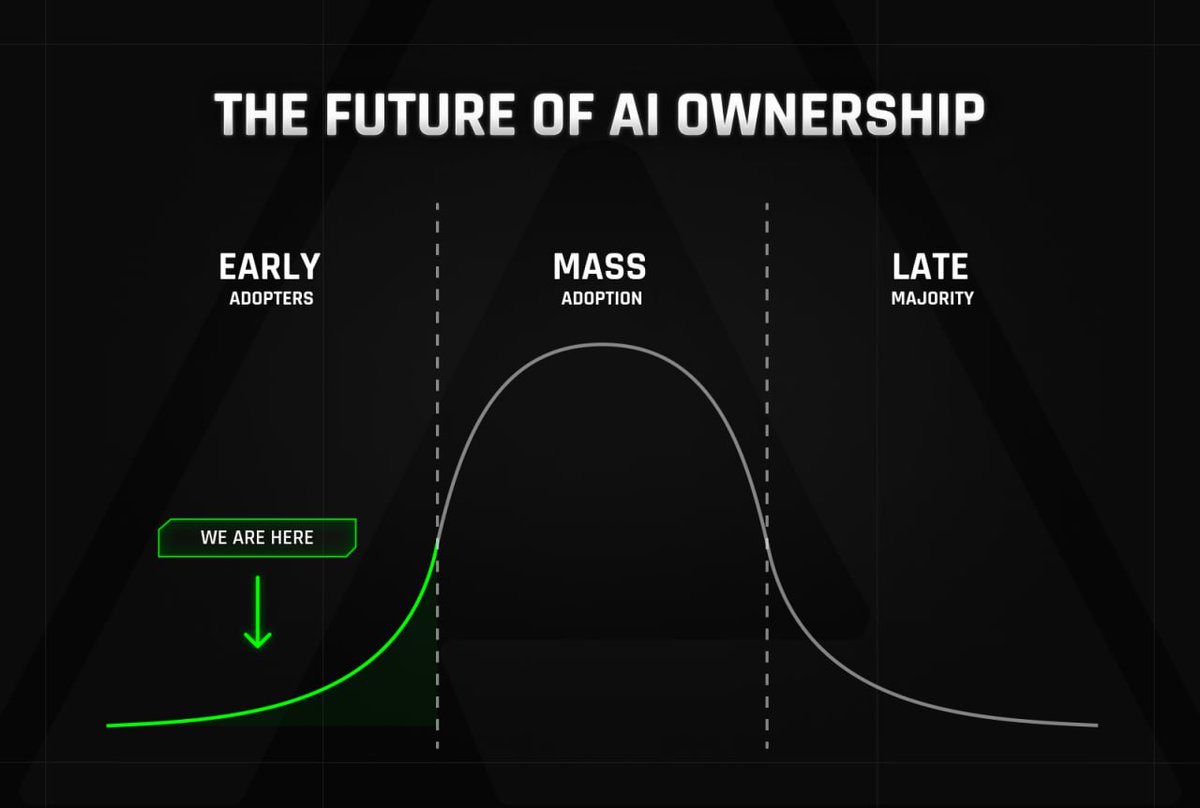
Right now, we’re at the beginning of the curve—like any emerging technology, AI adoption follows a normal bell distribution: early adopters, then the masses, and eventually a global shift.
The question is no longer if AI will change the world. . . it’s how you’ll leverage it. 👇









![RealVision's tweet photo. 🚨GIVEAWAY🚨
Win one of 5 FREE 1-year Alpha memberships to celebrate the launch of the new Real Vision.
How to enter:
1️⃣ Join the waitlist [link in comment]
2️⃣ Drop a screenshot of the waitlist entry confirmation
3⃣ Like & RT this post
Winners announced on Oct 8
Ready to see the future of finance? 🥂...](https://pbs.twimg.com/media/G2W53IcWsAATSH2.png)