A 3D model of the solar system, driven by the sun's gravitation pull.
The solar system does not look like a flat spinning mobile. The sun hold 99.8% of the mass in the solar system and it's gravity keeps every planet , asteroid and comet locked in orbit around it.
Anthropic is questioning whether AI may turn out to be altogether useless. This is the single most honest thing Anthropic has ever written.
“But achieving recursive improvement alone does not suggest an immediate change in how industrial production occurs, societies organize, or markets function. More intelligence can’t learn what a drug does over decades of use, can’t hold elections sooner than a constitution dictates, and can’t turn a stranger into an old friend in a weekend. For most people, the felt pace of this future will still be set by the bottlenecks, even if the laboratory upstream runs at the speed of compute. That collision, where recursive intelligence building itself ever faster meets the world of humans, relationships, and governance, is another part of this future we can’t predict.”
I’m pleased to share Mayo Clinic has announced a strategic collaboration with @Microsoft to develop and deploy a frontier AI model designed specifically for healthcare. Read more: https://t.co/I6RGCtR8MF
Today, we're launching shift. We're starting by cleaning your apartment in New York City, for free.
Here's how it works. Book a shift cleaning. A vetted shift operator comes to your home wearing one of our devices. They clean. They leave. You pay nothing.
In exchange, we record the cleaning. Robotics is being built on data about how people do daily tasks, and the value of that recording is what funds the service. Anything personal in it is anonymized before the recording is processed.
By now, you have heard about the shift to AI more times than you can count. About the shift toward you, the part where you actually feel it, you have heard almost nothing. Shift is what starts to make it concrete, in specific cities, with specific services.
Today, cleaning in New York. Soon, handymen, repairs, and errands across the globe. And this is just one side of shift, with more on the way.
Comment “shift” and we’ll send you an early access link.
🚨 Anthropic just dropped the first Project Glasswing update
Claude Mythos found 10,000+ critical vulnerabilities in ONE month:
> Cloudflare: 2,000 bugs, 400 high/critical severity
> Mozilla: 271 vulnerabilities in Firefox 150 — 10x more vulnerabilities found in Firefox 148
> UK AI Security Institute: first model to solve BOTH their cyber attack simulations end to end
> at one partner bank, Mythos prevented a fraudulent $1.5M wire transfer in real time
> wolfSSL: found a way to forge certificates on a crypto library used by billions of devices
> scanned 1,000+ open source projects
> 90.6% true positive rate after human review
> maintainers are asking Anthropic to SLOW DOWN because they can’t patch fast enough
> Microsoft says patch volume will “continue trending larger for some time”
The bottleneck in cybersecurity is no longer finding bugs. It’s fixing them.
“Progress on software security used to be limited by how quickly we could find vulnerabilities. Now it’s limited by how quickly we can patch them.”
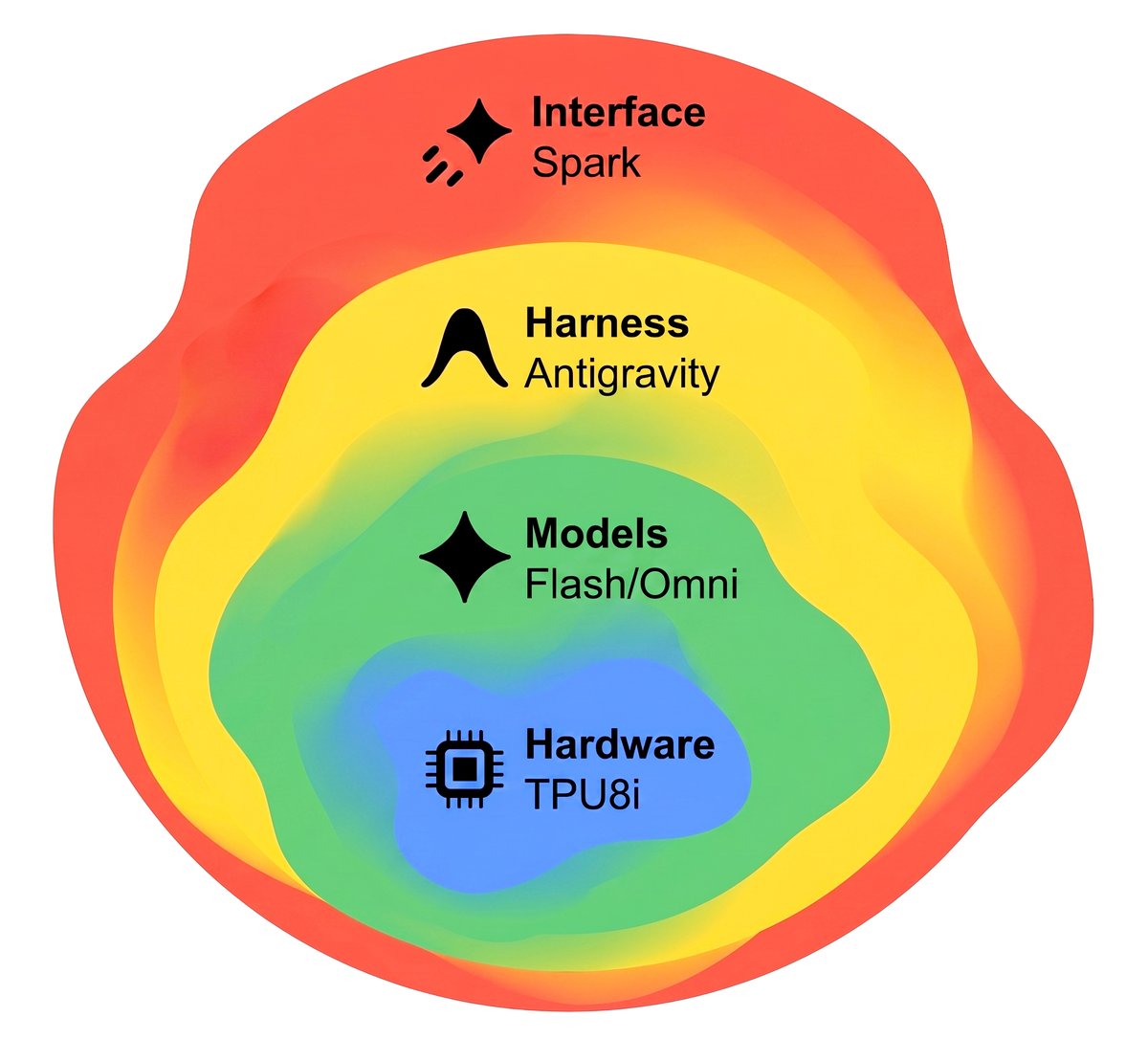
Google I/O TLDR: Good improvements across the whole AI stack.
3.5 Flash (the model): More persistent than before and codes well. No wall yet.
Antigravity (the harness): Reliably runs for hours now. Early signs of hands-free self-improvement.
Spark (the interface): Finally connects a decent model and harness to your email, calendar and workspace. Instead of just answering questions it can actually do work for you. Skills and schedules and all the other claw goodness.
Omni (the future): Closes the gaps between Gemini for text and visual/audio generation variants. This is the way.
TPU8i (the hardware): Better chips to make all the above go faster.
Introducing Open Collider: an open-source engine that mechanically improves LLM creativity.
It generates non-trivial, high-quality ideas at scale, for any ideation problem.
LLMs collapse on the same ideas. Sample the same brief 100 times → most outputs land in the same place. Researchers call it the Artificial Hivemind (Jiang et al., 2025).
"Be more creative" moves the LLM's output by ~0.04 in embedding space.
Forcing structurally distant domain collisions moves it by ~0.28.
7× more. Same model, same brief.
So I built Open Collider: a pipeline based on the theory of bisociations (Koestler 1964), the same model that drives human creativity.
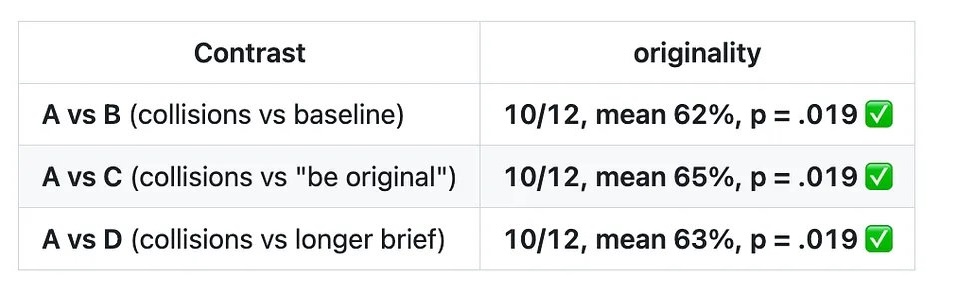
📊 Across 12 real-world ideation problems:
• 12/12 sign-test wins on embedding distance (p = .0002)
• 60%+ originality wins on 4,320 blind LLM-judge verdicts
• 4–13× further from the default cloud than "be original" prompts or longer context
• Idea relevance holds (win rate >50% on overall quality)
💻 Engine: first reply 👇
📝 Launch study: pinned tweet
Try it, Break it, Tell me what you find!
Elon Musk says Tesla swallows 1.5 GB of video into 2 KB of control.
"We really are photons in, controls out. That is the vast majority of your life: vision, photons in, and then motor controls out."
Musk reduced the human nervous system to a single equation.
That theory runs in every Tesla on the road.
"Your Tesla is taking in one and a half gigabytes a second of video and outputting two kilobytes a second of control outputs with the video at 36 hertz and the control frequency at 18."
A 750,000-to-1 compression ratio.
The car decides which photons matter.
"You don't care about the details of the leaves on the tree on the side of the road, but you care a lot about the road signs and the traffic lights, the pedestrians, and even whether someone in another car is looking at you or not looking at you."
Then Musk extended the equation past Tesla.
The same architecture runs Optimus.
**Photons in. Controls out.** Different number of degrees of freedom.
A car has steering and acceleration.
A robot arm has dozens of joints.
Same compression. More fingers on the other side.
Musk, who built one Tesla AI engine across two products:
"AI is mostly compression and correlation of two bitstreams."
The implication: a human, a Tesla, and an Optimus all run the same loop.
Musk, looking back at the human equation:
"This is what happens with humans."
If you're new here, @GeniusGTX is a gallery for the greatest minds in economics, psychology, and history. Follow along for more similar content.
P.S. I made a playbook breaking down 100+ mental models used by history's greatest thinkers.
5,000+ downloads. 113 five-star reviews.
Comment "MODELS" + Follow @GeniusGTX and I'll send it to you.
— Elon Musk ( @elonmusk ), CEO of Tesla and SpaceX, on Dwarkesh Patel's ( @dwarkesh_sp ) podcast