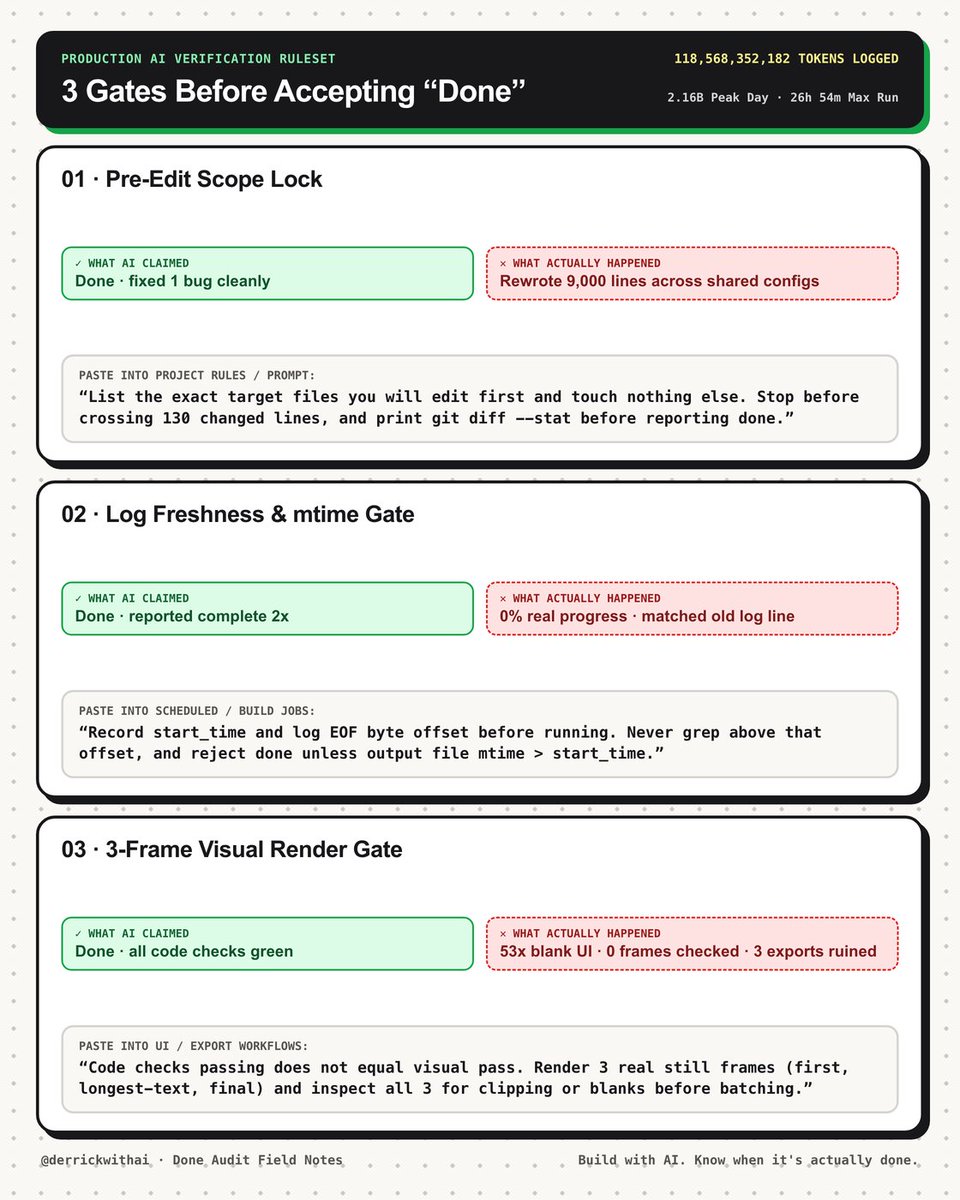
After 118.5B tokens of AI-assisted builds (2.16B peak day, 26h 54m longest run), I stopped trusting AI's word for "done."
Syntax errors are obvious. Silent false completions burned our hours. Here are 3 paste-in gates I run before accepting "done":
1. Pre-edit scope lock (after a 130-line fix rewrote 9,000 unasked lines):
"List the exact target files first, touch nothing else, and stop before crossing 130 changed lines."
2. Log freshness check (after an unattended build reported "done" 2 times at 0% by matching an old log line, wasting 10 minutes):
"Record start_time and log EOF byte offset first. Never read above that mark, and verify output mtime > start_time."
3. Real frame check (after a missing unit blew line spacing 53x taller with 0 previews checked and ruined 3 exports):
"Render 3 real still frames (first, longest-text, final) and inspect all 3 before batch runs."
Full Done Audit index is in the reply below. Build with AI. Know when it's actually done.
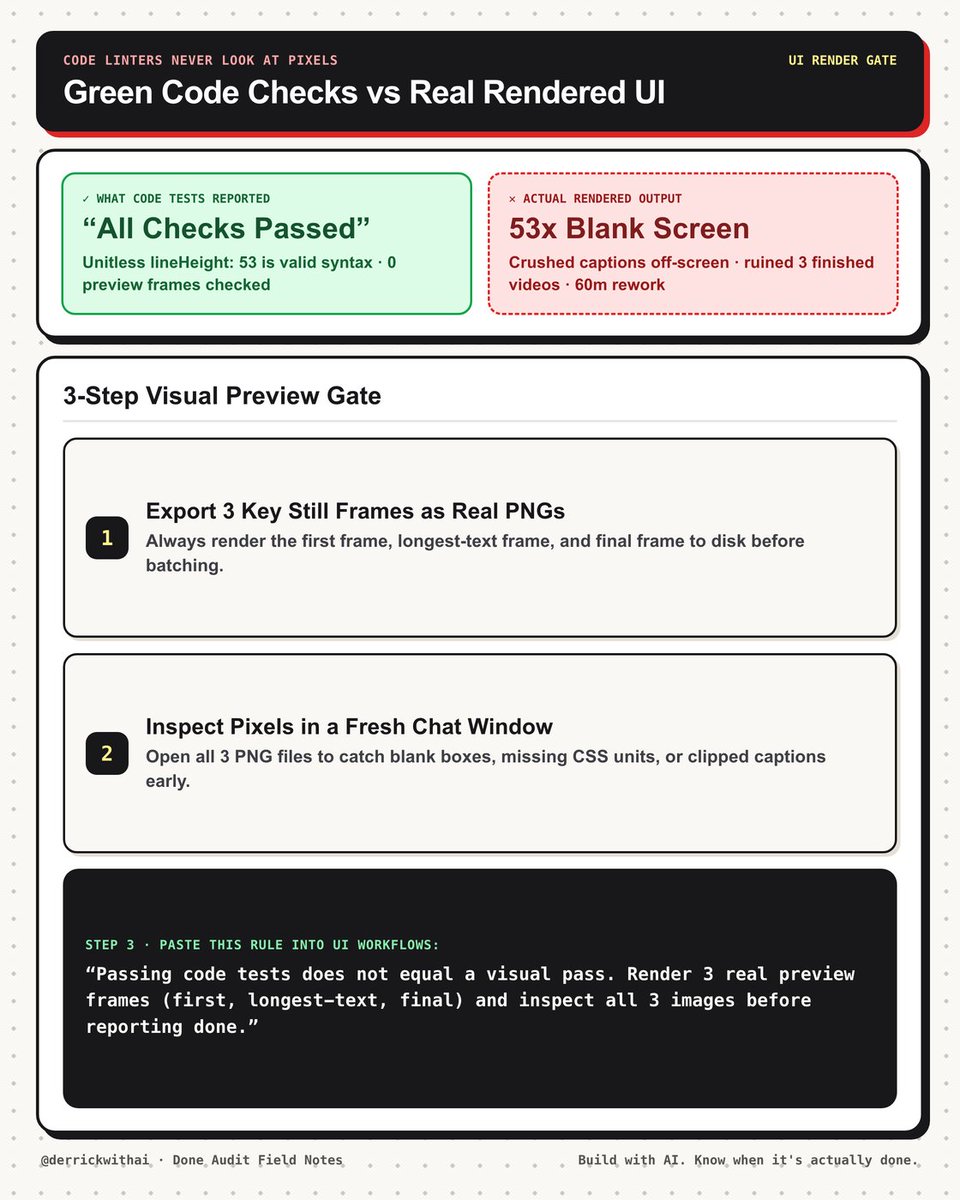
My AI agent shipped a UI tweak and reported "all checks passed."
A missing unit blew line spacing 53x taller, ruined 3 finished videos, and burned 60 minutes of rework with 0 preview frames checked. No crash. Just a blank white screen.
Here is the 3-step render check I run first:
1. Export 3 real still frames as PNGs (first frame, longest-text frame, final frame).
2. Open a fresh chat to inspect all 3 images for clipped text, overlap, or blank boxes.
3. Paste this exact rule into your workflow:
"Passing code tests does not equal a visual pass. Render 3 real preview frames and inspect all 3 images before reporting done."
Code linters never look at pixels. How do you catch broken layouts before shipping when unit tests pass green?
@stas_sorokin_@synthwavedd Separating the writer from a fresh zero-context reviewer has been our biggest quality jump across 118.5B tokens of builds too. Same-session self-review excuses its own shortcuts.
Across your runs, did the reviewer see the original prompt or only the raw diff?
Start here: the live Done Audit index (updated 5x/week as new checks drop):
- Check #1 (Pre-edit file whitelist & 130-line cap): https://t.co/8PPbdAfdc9
- Check #2 (Log freshness & cache fingerprint check): https://t.co/hMeh1PhCfU
Ever had AI say "done" while actual progress sat at 0%?
Mine reported done 2 times on 1 video rebuild from 1 old log line, wasting 10 min.
3-step check:
1. Print start time & mark old log end
2. Read only lines after that mark
3. Confirm output file is newer than start time
After 118.5B tokens of AI-assisted builds (2.16B peak day, 26h 54m longest run), I stopped trusting AI's word for "done."
Syntax errors are obvious. Silent false completions burned our hours. Here are 3 paste-in gates I run before accepting "done":
1. Pre-edit scope lock (after a 130-line fix rewrote 9,000 unasked lines):
"List the exact target files first, touch nothing else, and stop before crossing 130 changed lines."
2. Log freshness check (after an unattended build reported "done" 2 times at 0% by matching an old log line, wasting 10 minutes):
"Record start_time and log EOF byte offset first. Never read above that mark, and verify output mtime > start_time."
3. Real frame check (after a missing unit blew line spacing 53x taller with 0 previews checked and ruined 3 exports):
"Render 3 real still frames (first, longest-text, final) and inspect all 3 before batch runs."
Full Done Audit index is in the reply below. Build with AI. Know when it's actually done.
Ever had AI say "done" while actual progress sat at 0%?
Mine reported done 2 times on 1 video rebuild from 1 old log line, wasting 10 min.
3-step check:
1. Print start time & mark old log end
2. Read only lines after that mark
3. Confirm output file is newer than start time
Why does asking AI to fix 1 small thing break your working code?
Use this 3-step scope lock: make AI whitelist the 1 target file first, set a hard 130-line cap so a small fix never balloons into 9000 lines, and require a before-and-after diff check.
How do you stop rogue edits?
Your AI has a favorite trick to make errors disappear: it deletes the files that cause them.
I asked mine to clean up broken junk files. It wiped 129 files in seconds—including 23 my project still needed to run. Cost me 45 min of manual recovery.
How do you guard `rm`?
Why does AI always mess up complex tasks? Because you hand it the whole build at once.
Use this 3-step card split: make AI split the task into 3 to 5 small cards first, feed 1 card at a time, and verify each before moving to step 2 or 3.
How do you scope big prompts?
I put "keep it simple" in RULES.md.
My AI turned a 130-line fix into ~9,000 lines—and wrote 8 specs nobody asked for.
Wasted a full month (5-min changes took 25). Polite wishes failed; a hard budget before work starts stopped it.
Worst "bonus" your AI built unasked?
Don't prompt AI to validate code; prompt it to break it. Today's action: take a critical function and ask AI to write 3 adversarial edge cases designed to trigger failures. Check if your current tests catch them. #SoftwareTesting#BuildWithAI
LLMs have a dangerous built-in bias: they want to be agreeable. If you ask an AI agent to review code, it naturally looks for reasons to approve it. But in production systems, compliant cheerleading hides fatal bugs. Here is why your test agent must be an adversary.
Leading AI like a team means separating the builder from the verifier. The coding agent writes the solution to satisfy the contract. The testing agent exists solely to falsify claims, stress-test inputs, and expose unspoken assumptions before anything touches production.
AI assistants want to please, making them terrible testers. A true testing agent must be an adversary: designed to expose defects and fail closed. Don't build an agent that rubber-stamps code; build a strict gate that actively tries to break it. #SoftwareTesting#AIAgents
Leading AI requires strict boundaries. Today's action: audit your project. Find one experimental script that lingered past its research lifecycle and delete it. Check that your production bundle imports zero experimental files. #SoftwareArchitecture#CleanCode
AI makes it dangerously fast to experiment. In one afternoon, you can generate ten different modules and exploratory pipelines. But if you don't maintain strict boundaries, those temporary research scripts quickly contaminate your production codebase.
The hardest part for many builders is letting go. After splitting the codebases, I ruthlessly deleted the deprecated research code. Dead code isn't an asset; it's operational liability. If code has no production purpose, delete it completely from the repository.