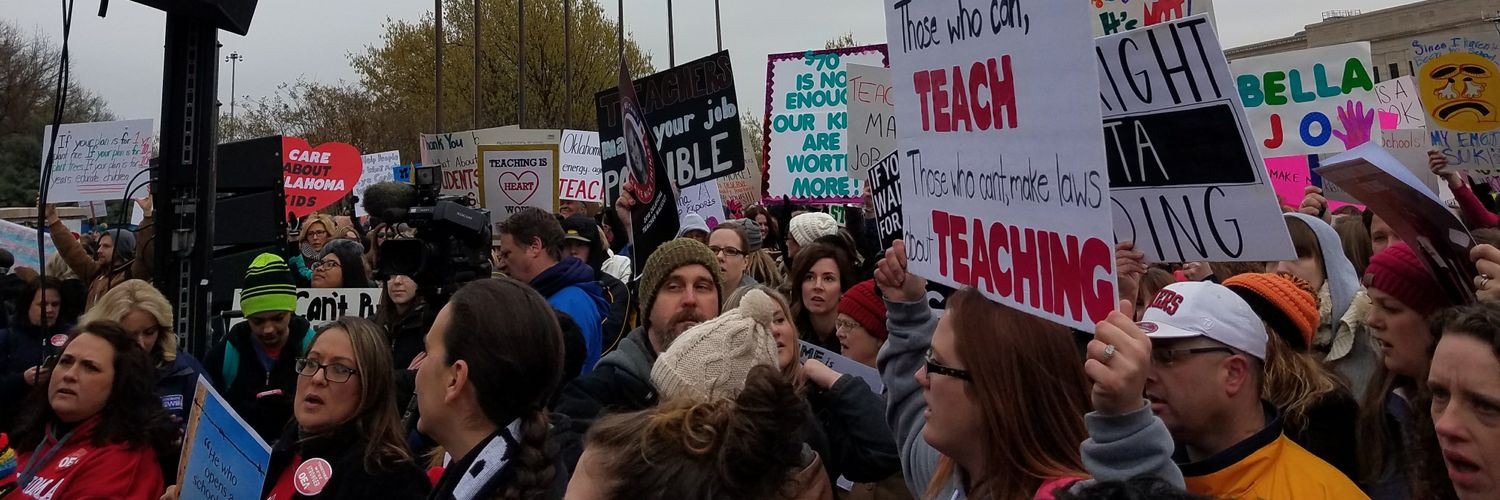
Teacher, leader, advocate. I'm pro-public education and chair of the @AdvocacyTeam in Duncan. I'm also now a board member of the Oklahoma Education Association.
The attack on public education must stop. Teachers work hard to ensure their students learn, but teaching to hate our country isn't one of the things we teach. We teach our students to ask questions and to find information.
The constant push for teachers to “find their why” is professionally insulting.
Purpose isn’t the issue—we already have it.
What’s missing: time to plan, autonomy to teach, freedom from micromanagement, and real consequences for the kid throwing darts into the ceiling.
Fix #5: Stop treating teachers like they are the problem.
They are the ones in the room. They are also the ones being blamed for every decision made above them.
#YouWantToFixEducation
Somehow, we’ve forgotten a simple truth: the best learning happens in silence.
You can’t read and talk at the same time.
You can’t think clearly with constant distractions.
Every classroom should nurture silence as a habit, not an exception.
You want to fix education?
Stop treating teachers like they're the problem. They're the ones who showed up every day, documented everything, and told you the truth all year. Start there.
Nobody talks about what it costs a school when a good teacher walks out the door for good. The kids lose the relationship. The department loses the institutional knowledge. The next hire starts from zero. And everyone pretends that's just how it goes.
The desire to be liked by your students will hinder everything you do.
Your classroom management will suffer.
Your ability to challenge students will be limited.
Being authoritative without being an authoritarian should be the goal.
We spend so much time worrying about children coming to school lacking academic skills.
But many are coming to school lacking relational skills.
Some children struggle to communicate face to face.
To handle conflict.
To hear “no.”
To work through frustration.
To cooperate, wait their turn, read social cues, or build healthy relationships.
And we should not ignore what is contributing to it.
Many children today are spending more time interacting with screens than interacting with people.
Less conversation.
Less eye contact.
Less play.
Less unstructured interaction.
Less practice navigating real human relationships.
But human beings are relational by nature.
Children learn communication, empathy, emotional regulation, accountability, confidence, and social awareness through real interaction with other human beings, not through constant technology, isolated screen time, and reduced human interaction.
Because schools are not just places of academic learning.
They are human environments built on interaction, communication, relationships, accountability, emotional regulation, and respect for others.
A child can often catch up academically.
But when children struggle with basic relational skills, it impacts behavior, learning, confidence, friendships, classrooms, and eventually the ability to function successfully in life and the workplace.
This is also why recess and play matter so much.
They are not distractions from learning.
They are some of the primary ways children develop the relational and emotional foundations that learning depends on in the first place.
Because when relational development suffers, academic development eventually suffers too.
CHALLENGES THEY EXPECT TEACHERS TO IGNORE
• Large class sizes
• Students lacking sleep, exercise & proper nutrition
• Parents not teaching discipline & respect
• Expecting schools to solve every problem students face
• Low pay
• Constant student behavior issues
I would argue that most of these lost skills have little to with COVID and a lot to do with the move to 1 to 1 devices. Kids are on Chromebooks and tablets all day; there needs to be a move back to pencil and paper for the majority of the school day.
Since COVID, I’ve seen a sharp rise in students struggling with foundational school skills:
-Legible handwriting
-Bringing basic supplies
-Following verbal directions
-Spelling & punctuation
-Reading & writing stamina
Before we push for “rigor,” we need to rebuild the basics of learning.
Every once in a while, we should have a PD session where all school staff talk about teaching simply.
No jargon. No acronyms. No data slides.
Just an honest, human conversation about what really happens in classrooms, free from all the pedagogical clutter.
Limiting school suspensions is not the answer.
When people argue that suspensions “don’t help the student who misbehaves,” they often forget about the students who are there to learn.
Negative behavior impacts the entire class, not just the one student causing the disruption.
Yesterday, Trump said (out loud!) that he doesn’t care about the impact his war is having on Americans’ finances. He literally said he doesn’t care about us. Well, I care. And I think our elected leaders should, too.
Teachers make around 1,500 decisions a day.
In a 10 hour day thats 150 decisions an hour.
That’s a decision to make every 24 seconds.
Nearly 300,000 decisions in 39 weeks of teaching.
Such a mentally demanding job.
Too many holidays, yeah right!
One of the most disastrous shifts in education has been this:
Teachers are being given more responsibilities while simultaneously losing the power to enforce meaningful consequences for misbehavior.
You cannot continually increase expectations for teachers while stripping away the authority needed to maintain order and accountability.
A teacher can only inspire, instruct, and connect up to a certain point.
Eventually, students must take ownership of their work.
When they refuse to take responsibility for their learning, an “F” isn't just a grade, it's a necessary lesson.
Teachers are not afraid of failure, 𝐭𝐡𝐞𝐲 𝐚𝐫𝐞 𝐚𝐟𝐫𝐚𝐢𝐝 𝐨𝐟…
• False accusations
• Not being able to support their own families
• What is happening to their own mental health
• Lack of teacher resources
• The growing apathy from students
• The growing disrespect
If you haven’t taught in a classroom post-Covid, you don’t know what it is like to teach the modern student.
The students have changed.
Teaching has changed.
You have to be in the classroom daily to understand what I mean.
When kids choose NOT to brush their teeth, should we blame the dentist? Obviously not.
Why do we blame teachers when students choose NOT to complete even the most simplest of assignments?