@bradneuberg Congrats! Increasing compute in orbit is exciting to see in the space industry.
Curious what “first to space-qualify” entails and how that is different from other Jetson based platform that have flown(?) in LEO? Is the distinction in using Orin or in Pelican qual requirements?
Yesterday we officially launched CAESAR: the Stanford Center for AEroSpace Autonomy Research: https://t.co/qrMFgH0FF5. Goal: solve the hard problems in spacecraft autonomy through the judicious incorporation of AI. More here: https://t.co/vAizb6mZla @StanfordEng@StanfordAILab
@_ericrosen Yes!
I really like to go back to it in *preface* of the Strang’s (6th ed) textbook. That preface is so elegant and self-contained that you get a profound insight into the subject before you even start reading the first chapter.
@_ericrosen Oh, there is this one I used to refer to the Gauss-Newton method :
https://t.co/5NhY9LbTzv
But, not all of them would be equally helpful for all purposes, I suppose. Nonetheless, they are accessible resources when going between theory and implementation.
@_ericrosen Multiple facets of SVD was a big part of the story for me. I spent quite some time refreshing on SVD and the connection with PCA. The following two references helped me (in addition to Strang text book).
https://t.co/Yoz7FlWnv7
https://t.co/3Hwel6alfA
Large language models and web-scale data have some use in robotics as a user interface as nicely demonstrated here, but in my opinion they are not what we need to help with perception, object representation and precise planning which are the real current barriers in robotics.
I take back so much from the conference and it’s all thanks to my supervisors @mo_robotics and Carol Martinez.
They not only made it possible to participate but also made the week a lot more fun.
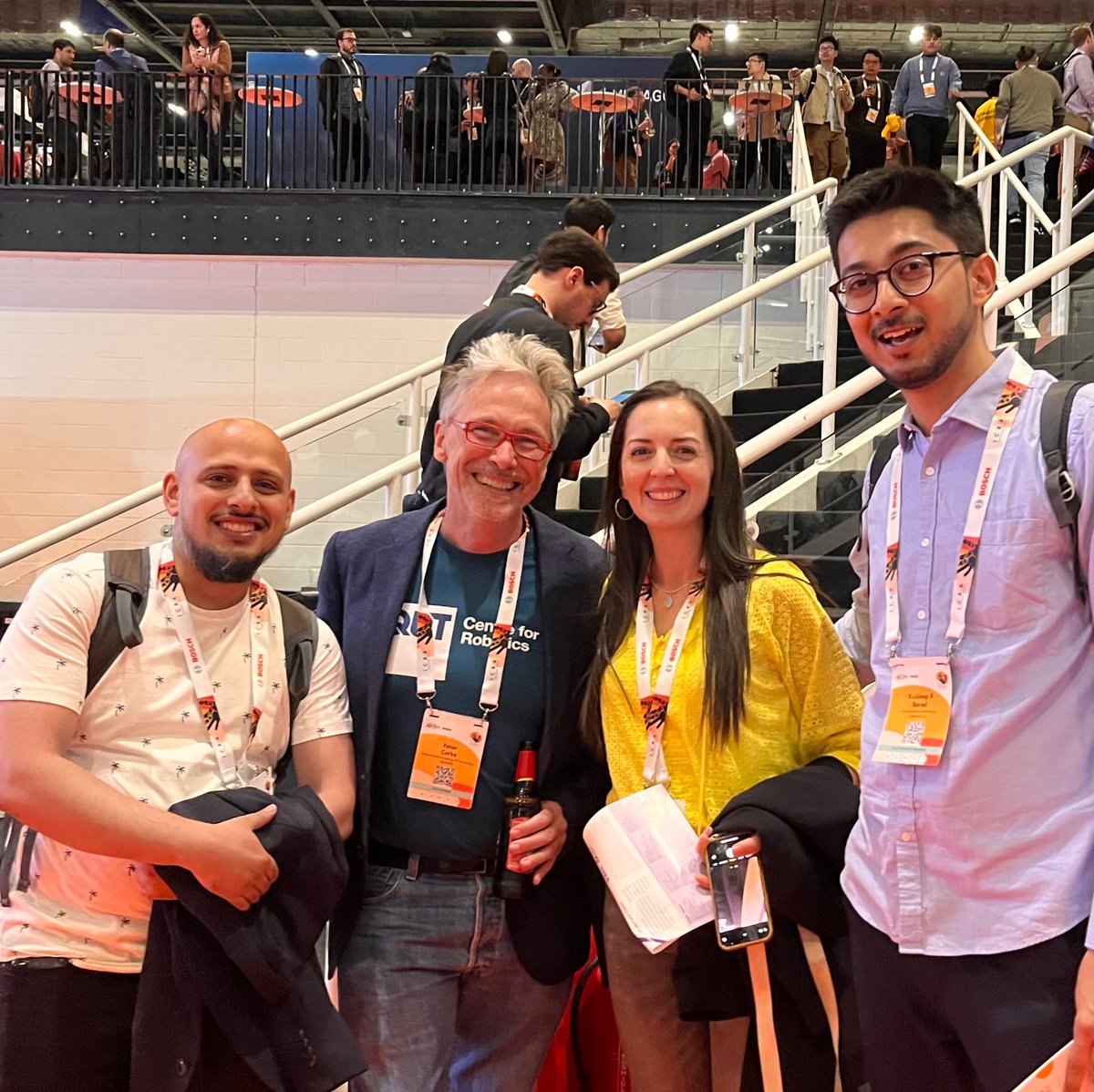
#ICRA2023 was my first robotics conference and wow what a blast it was.
Met so many exceptional people- from young researchers carving up new directions to leaders who shaped the robotics of today.
Kudos to the community for making it super friendly for junior researchers.
Excited to announce our Deep Learning Tuning Playbook, a writeup of tips & tricks we employ when designing DL experiments. We use these techniques to deploy numerous large-scale model improvements and hope formalizing them helps the community do the same! https://t.co/vDhSwZyHJm
Its super weird to end the year with an incredible amount of learning and growth, but disproportionately high dissatisfaction at the same time.
On the positive side, I have felt internal momentum building up to change this lately. So, the next year is full of optimism.
Russel Kirsch was the inventor of the pixel. He passed away only a couple of years ago. The 172 x 172 image of his son made in 1957 is the 1st digital images ever made. It's a photo that changed the world. His legacy lives on in the billions of photos we take and share each day.
Blender visualization of a flexible camera model I made for rendering in #InstantNeRF so you can see what’s going on. Who says we have to use perspective cameras all the time?! I love NeRF so much. Cheap and easy photorealistic renders is a game changer for digital surrealism.