Product Designer focused on AI-native experiences. Sharing notes, experiments, and lessons from building with LLMs. Follow along if you’re curious too.
Actually just started myself after a long time on the sideline and I would have never thought that it’s so crazy.
You literally just talk to yourself 😅
I think these networks are so full of content, they really don’t need more content, hence they really don’t seem to care for their onboarding experience — because it’s awful.
Prompt-design, prompt-testing takes longer than programming entire applications now.
Thanks to @promptfoo I stay relatively sane.
I said relatively sane. Not sane.
Examples are powerful, but also quite dangerous when prompting in production prompts. One the one hand they quickly make a prompt do something fairly well. On the other hand they as quickly over specify and make your prompt brittle.
Prompt engineering becomes quite a sci-fi job.
I remember the first time I saw @MinorityReport. Nowadays it feels normal to talk to computers and to ask them to extract things from texts, audio or videos to achieve a particular goal.
And humans are still the ones that need to know how AI works and which mistakes it does to interpret results correctly.
If you work with many smaller LLMs you have to get to know them. A bit like a new co-worker. They all have different believes, different internalized definitions and values. Only because one prompt worked on one model, it might completely fail on another. Fascinating stuff.
In the future we might have people who's speciality it is to be very familiar with one particular LLM.
After being slightly skeptical of the „prompt engineering“-hype I now start to understand it.
But it is much deeper than „oh use this prompt template…“
I would compare it to studying linguistics.
An example: How would you name and explain a pre-ontological extraction in a prompt with the goal to extract salient elements from an unknown text?
You start thinking about text and language in entirely new ways.
Hot take:
Soon we might see companies needing more engineers and more people working on code, not less.
Dealing with all these abstract and emerging AI failure modes every day, I’m starting to believe the probabilistic nature of AI will create a huge amount of ambiguity around failure cases — things that different "experts" across many different fields will need to understand, correct, and design guardrails for.
And I don’t think these "experts" necessarily have to be super advanced super brains. To be honest, those might sometimes be exactly the wrong people.
It might be people with common sense and real-world experience. I can imagine IT companies hiring bakers, make-up artists, or people from very different demographics to help identify emerging failure modes.
Basically, humans become valuable for being specific humans who understand how other humans think:
For their empathy.
If you want to talk about or understand semantic compression start by understanding the difference between:
Semantic nodes, semantic anchors, primitives, entities, themes...
What are your favorites terms you never used before dealing with LLMs?
P.S: I have the feeling by dealing with this you slowly lose the ability to be understood by fellow humans...
Today I switched to a 4B-param LLM (Gemma3) and realized that smarter can sometimes even be a problem. It's internalized understanding of terms can compete with what you meant in your prompt. Smaller models are much more obedient and less opinionated. Beware, if it worked with a smaller model, it doesn't mean in it will with a smarter one.
When ChatGPT shortly falls in love with the German language...
"Trauerweide" is literally just the name of a specific kind of tree. In English: "Weeping willow".
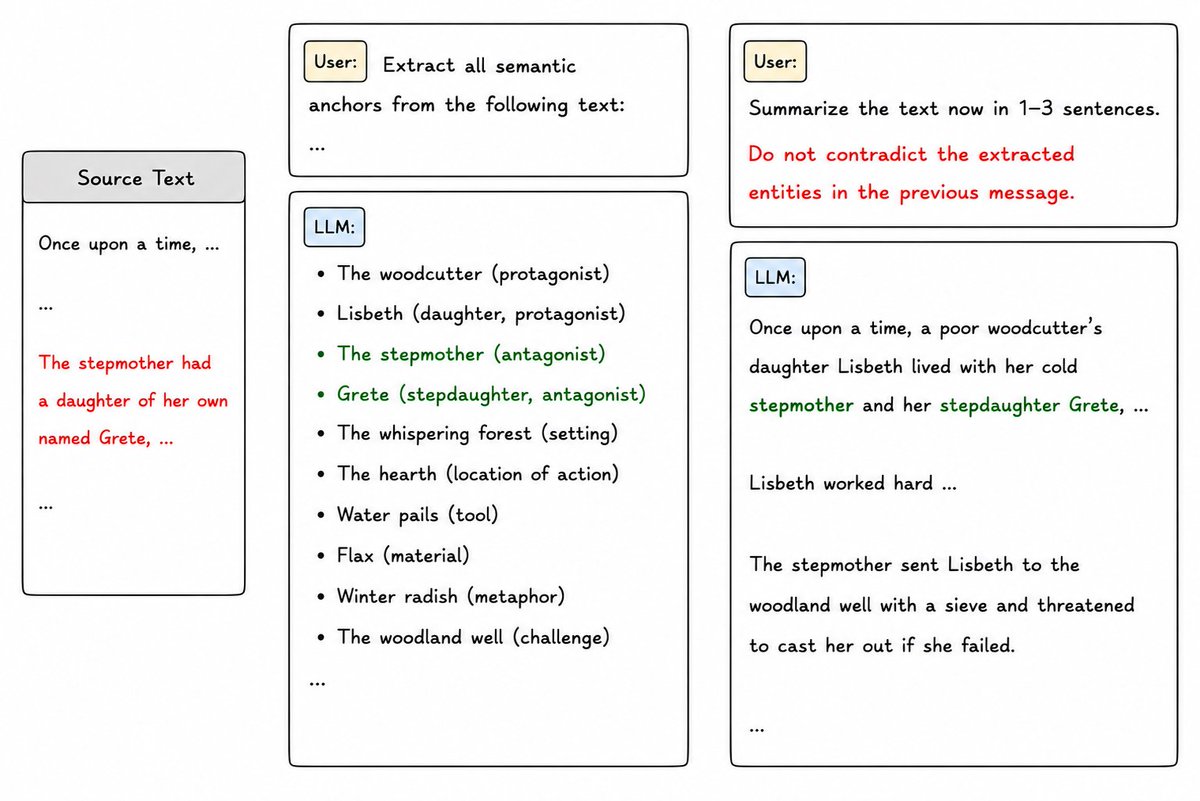
If you extract and enforce correct structure first, you can in theory stabilize the summarization / compression. So you can squeeze more out of a small model with the correct framework.
You can literally watch a 2B LLM recompress itself into confusion.
Qwen3.5-2B recovers the correct entity relationship once challenged and grounded — but immediately corrupts it again during summarization.
The relation becomes locally correct, but stays globally unstable.