🧵 DESH is back on the timeline
1/ after five months heads-down, we’re back on the timeline. we rebuilt our stack and the way we ship.
same taste and pace, broader surface area. we were desh team — now rebranded as DESH Group. we’re a full-cycle web3/ai studio. we design, develop, and market from zero to launch to growth. execution first, decks later.
HypeHunter x DESH Group
We’re excited to start working with @deshgrp - a strong agency working at the intersection of Web3, AI, and digital growth.
This partnership reflects a shared view: the next stage of marketing will be built around trust, creator-driven visibility, and stronger connections between brands, agencies, and digital talent.
Glad to have DESH Group joining the HypeHunter ecosystem.
🚫 @coingecko rejected your listing. Here's what actually went wrong.
It's rarely one thing. It's usually a combination:
- Volume that looks engineered - bursts that never repeat, a cadence that feels manufactured 📉
- Liquidity that makes trading look risky - thin order books, sharp slippage, underfunded pools
- Social signals that don't match the market - dormant channels, dead links, abandoned community
- Brand red flags - trademark conflicts, copycat naming, plagiarized materials 🏴
- Supply logic nobody can follow - circulating supply that contradicts what explorers show
The fastest way to kill a listing: wash trading. ⬛
Reviewers and the market can spot patterns that don't look organic. The downside is either a stalled review - or a page that never becomes a reference people trust.
✦ Strong markets still get rejected when the public package doesn't match what the market is showing.
🔷 Getting listed on CoinGecko is not the finish line.
It's the moment the page becomes the first thing people share when they're deciding whether to invest.
What happens after approval determines whether that page becomes a stable reference - or a snapshot that quietly drifts out of sync with reality. 📉
What most teams get wrong post-listing:
- Links go stale. Outdated pages create the same doubt as missing pages. 🚫
- Liquidity thins out. The first place it shows up is the one page everyone shares.
- Volume patterns get weird. Nobody monitors it until it becomes a fundraising question on a call. ⚠️
- Community stops treating it as a canonical source. Price context fragments across bots and screenshots.
📊 Doubt is expensive when you're in market with a fundraising timeline.
◆ A CoinGecko page is a public control panel. Treat it like one.
📊 @coingecko pulls 21M visits a month. The mobile app has 5M+ downloads.
That's not a data aggregator. That's where investors and communities run their first pass on whether your project is real or just loud.
Most teams treat a CoinGecko listing like paperwork. 📋
Then they learn that review follows market reality - not your deck.
CoinGecko explicitly prioritizes:
Tokens already trading on a tracked exchange
Organic liquidity and volume across multiple days
Circulating supply that can be validated without guesswork
Public footprint with links that actually match 🔷
Miss any one of these and the review turns into back-and-forth. You end up fixing fundamentals under fundraising pressure.
⬛ The page doesn't make your project credible. A credible project makes the page worth having.
⚠️ 90% of Web3 startups fail within two years.
The post-mortem rarely says "bad idea."
It says: product review in the morning. Security call before lunch. Token narrative to sign off. Community flare-up. Legal check-in that quietly rewrites half the roadmap.
None of those is a crisis on its own. 📋
But they land in the same week and eat the same 2–3 people who are supposed to be building.
That's not a funding problem. That's not a product problem.
That's an execution sequencing problem - and it shows up as a slower round before anyone calls it a delay. 📉
🔷 The follow-on isn't lost in one bad meeting. It's lost in weeks of quiet drift that nobody named in time.
🚫 Founders add a transfer tax to "protect" the token price.
Market makers like Wintermute remove it from their requirements list. 🏴
Here's why:
Algorithmic market makers run high-frequency bots that capture microscopic price differences. A transfer fee on every execution means they operate at a loss on almost every trade.
Their standard requirement: zero percent transfer fee. 🔷
⬛ Without institutional depth, your order book runs on fragmented retail liquidity alone - which means it can't absorb normal market stress.
The tax that was supposed to protect the price ends up being the reason professional liquidity never showed up. 📉
✦ Artificial friction doesn't slow down sellers. It drives away the infrastructure that could have defended the chart.
⚠️ In January 2026, one week of routine token unlocks put $940M of supply into the market.
LayerZero alone: a single scheduled release pushed $42M - 6.36% of circulating supply - into the order book. 📊 The start of a two-year continuous vesting cycle.
Here's what teams get wrong about vesting:
They spend months designing the model. Then hand the rest to a calendar and hope the order book figures it out.
🏴 It doesn't.
Predictable linear vesting is an open roadmap for traders to position against your supply. The overhang prices itself into the chart weeks before the unlock date. 📉
The fix isn't a longer lockup. It's dispersing supply block-by-block so no single event becomes a public countdown.
✦ The market doesn't punish unlocks. It punishes predictability.
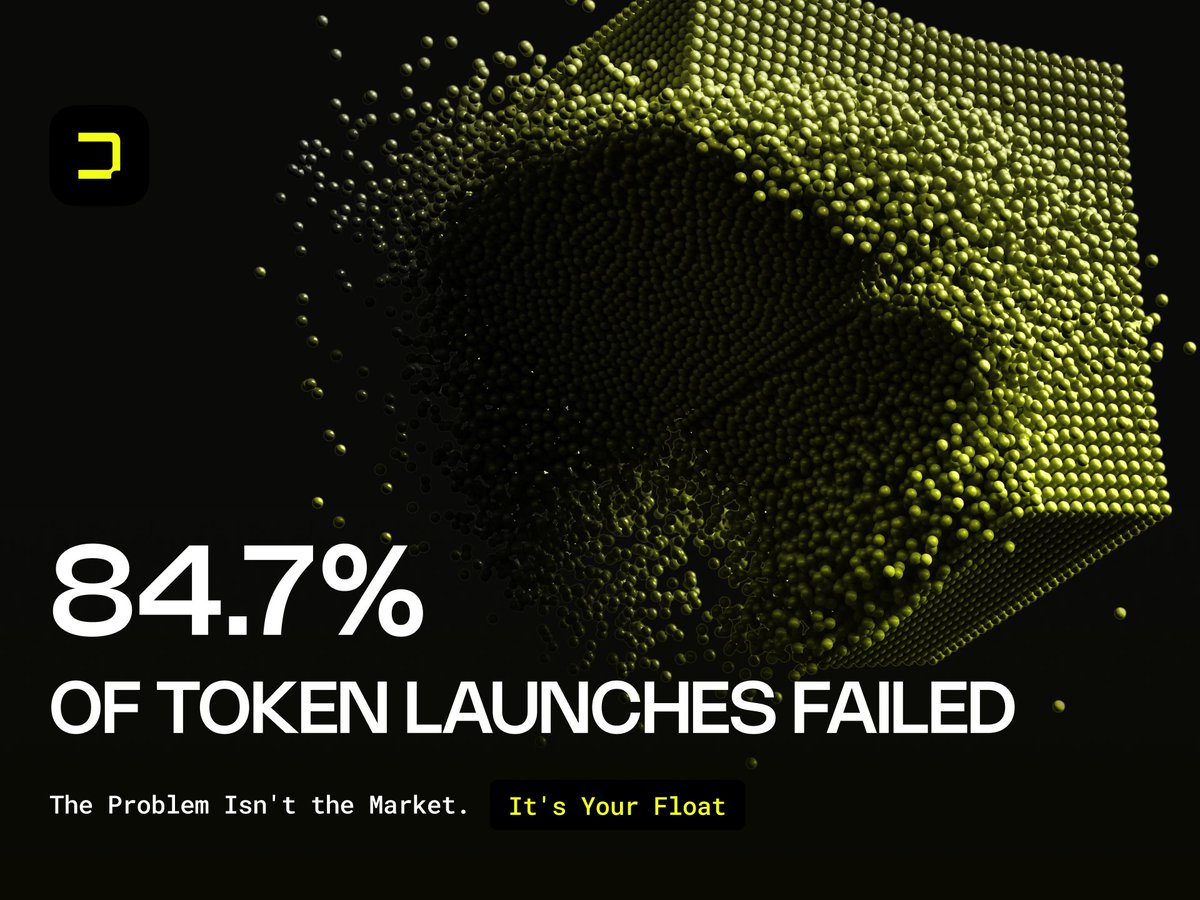
📉 84.7% of 2026 token launches traded below their launch price.
Not the bear market. The same structural mistake, repeated.
Low float. Massive FDV. The chart looks strong on day one because almost nothing is actually circulating. Then the unlocks start. 🔓
Sophisticated buyers figured this out in 2024. A 6% starting float doesn't signal scarcity anymore - it signals that someone else will be asked to absorb the other 94% later.
💰 $155B in scheduled unlocks are hitting the market by 2030.
🔷 The projects that survive aren't the ones with the best pitch decks. They're the ones that gave their market maker enough supply to build a real price curve from day one.
Artificial scarcity isn't a growth strategy. It's a delayed collapse. ⬛
the alt season you're waiting for isn't coming
and here's why that might be the best thing that could happen to you
in previous cycles, BTC pumped → retail rotated into alts → everything mooned. that playbook is dead
what changed:
→ $62B flowed into crypto ETFs this cycle. almost all of it stayed in $BTC and $ETH. institutions don't ape random alts
→ 85% of tokens launched in 2025 are trading below their TGE price. median drop: 71%. the "early" advantage is gone
→ altcoin rallies compressed from 45-60 days (2024) to under 20 days (2025). by the time you hear about a narrative, it's already over
→ token supply exploded. $35B in unlocks this year alone. way more tokens chasing way less liquidity
the graveyard of 2025 so far:
@MANTRA_Chain ($OM): $6.30 → $0.40 in one hour. $5.5B wiped. team blamed "reckless liquidations"
$LIBRA: promoted by Argentina's president. hit $4.5B market cap. collapsed 95% as insiders dumped. now under investigation
$TRUMP / $MELANIA tokens: peaked at $75 and $13 respectively. both down 90%+
AI tokens: most popular narrative of the year. average returns: -50%
and that's just the headlines. on https://t.co/MAafYiKsyr alone, 98.6% of tokens launched since 2024 were rugs or pump-and-dumps
the uncomfortable truth: waiting for "alt season" is hoping the market will bail out your bags it's a passive strategy in a market that rewards active positioning
the winners this cycle aren't holding and hoping. they're:
→ trading narratives in compressed windows (weeks, not months)
→ focusing on utility over hype
→ exiting before the crowd realizes the party's over
→ building conviction positions in 2-3 projects max, not spreading across 50 alts
the old model: buy alts, wait for rotation, exit at 10x
the new model: identify trends early, size appropriately, take profits fast, or get left holding the bag
alt season isn't delayed. it's structurally broken
the capital concentration, token oversupply, and institutional dominance have changed the game permanently
stop waiting. start adapting
what's your read - is alt season dead or just different?
a hole in @VitalikButerin's sock didn't crash ETH 40%
but it's a perfect symbol for what did
the photo went viral at $ETH Chiangmai on January 30. internet loved it. "too busy changing
the world to worry about his wardrobe"
within days:
→ Vitalik sold $13M+ in $ETH for "research and privacy projects"
→ $ETH dropped from $3,300 to under $2,000
→ $1.1B in longs liquidated in a single day
→ ETF outflows hit $400M+ in 48 hours
→ six consecutive months of negative returns - worst streak since 2018
the sock became the meme. the selling became the story
but the real problem isn't @VitalikButerin's wardrobe or his wallet activity
it's the narrative gap:
→ every $ETH metric is at all-time highs - TVL, transactions, stablecoins, active users
→ price is down 60% from peak
→ institutions are buying $BTC, ignoring alts
→ @VitalikButerin himself said L2s "no longer make sense" for scaling - the thesis that carried ETH for years
the sock didn't cause the crash
but it captured something true: the guy building the world computer genuinely doesn't care about optics
and right now, optics are all $ETH has left to fight the narrative war
what's your read - is this capitulation or opportunity?
the airdrop paradox:
you need activity metrics to raise → so you incentivize farming → farmers inflate numbers → you raise on fake traction → token launches → farmers dump → real users see -80% and leave
projects with >40% sybil activity at TGE see 3x higher sell pressure in first 48 hours. the hunters were never staying. but now neither is anyone else
filtering signal from noise pre-launch is the difference between building and bleeding
how do you break the cycle?
engagement farming tells you how many people want your airdrop
real interest tells you how many people want your product
compare replies vs quote tweets. farmers reply (low effort, airdrop eligible). real users quote with opinions (high effort, genuine interest). ratio below 10:1 replies-to-quotes usually signals organic traction
one metric looks good in investor decks. the other determines if you survive the bear
most projects can't tell the difference until the chart tells them
crypto narratives follow the same loop:
early believers find alpha → content creators explain it → capital rotates in → latecomers ape →
saturation → collapse → "the tech was never real"
narrative half-life has compressed from ~14 months (2020) to ~3-4 months (2025). by the time most people hear about a meta, the edge is already gone
AI agents. DePIN. RWA. the labels rotate but the cycle accelerates
the play isn't predicting what's next
it's knowing where in the cycle you're entering - and admitting when you're late
where are we right now?
current meta: one block costs you 148 likes to recover
X's new Phoenix algo weights negative actions HARD
controversial content might drive engagement but if people hit block instead of scroll, your entire account takes the hit
is virality worth tanking your reach floor?
Why Web3 Raises Tank Pre-Diligence
Solid decks don't bomb in data rooms.
They flop earlier — ignored before questions even fly.
Intros first.
→ Warm ones snag eyes, not checks.
→ Cold? Buried in the spam pile, no matter the shine.
The tough truth.
→ VCs skip risks they can peg fast? Nah.
→ They bail on fog they can't cut through quick.
Hence the cash clump.
Handful of deals get deep dives.
Bulk? Glanced, passed, ghosted.
Seed stage thrives.
But demands a doubt-killer signal:
→ Organic traction (ditch the bribes),
→ Token setup sans alarms,
→ Pitch that echoes easy, no backstory needed.
Raising ain't chaos.
Not the clock.
It's clarity upfront — pre-burning that golden lead.
Key: Intros spotlight cracks.
They don't patch 'em.
Bear markets don't vaporize cash - they funnel it to the few.
Fundraising's real grind?
Not crafting slides.
It's cracking into those circles where the calls get made.