All seven Databricks co-founders began our journey together at UC Berkeley. We started the company in a room in Soda Hall, moved to a small office on Addison Street, and spent our first few years in Berkeley before eventually heading to SF. Two of our co-founders are still on the faculty.
Today we announced Databricks Field at California Memorial Stadium, our first collegiate athletics sponsorship.
Berkeley shaped everything about how this company thinks, and this is our way of investing in the next generation of students and builders who'll do their best work on that campus.
Go Bears!
https://t.co/JO3aBx99Z5
Hello. How are you? Thank you. I love you. Please.
Some of the most frequently translated phrases of the past 20 years!
Google Translate began twenty years ago with a mission to help people understand one another, regardless of the language they speak. What started as a small experiment has become a global tool that helps over 1 billion users every month.
In that time Translate has evolved from simple pattern matching to true understanding. In 2006, it relied on statistical machine learning to look for patterns in small word clusters. By 2016, we pioneered a shift to neural networks to move beyond literal word-for-word translations, and today we’re using our powerful Gemini models to make Translate even more helpful.
We are moving from text to fluid, real-time conversations. With our latest models, you can even use your headphones as a personal interpreter that preserves your original tone and cadence - it’s an amazing experience!
One of the interesting things about AI is that as we make progress, we begin to take it for granted. If you met a person who could translate across a hundred languages faster than any human can, you would be so impressed. Today, one product does that for nearly 250 languages, and we kind of just shrug.
Being able to say thank you in 250 languages is not something I take for granted. So to the 1 billion who use Google Translate - merci, dhanyavaad, arigatō, gracias, and thank you! Let’s see what the next 20 years will bring.
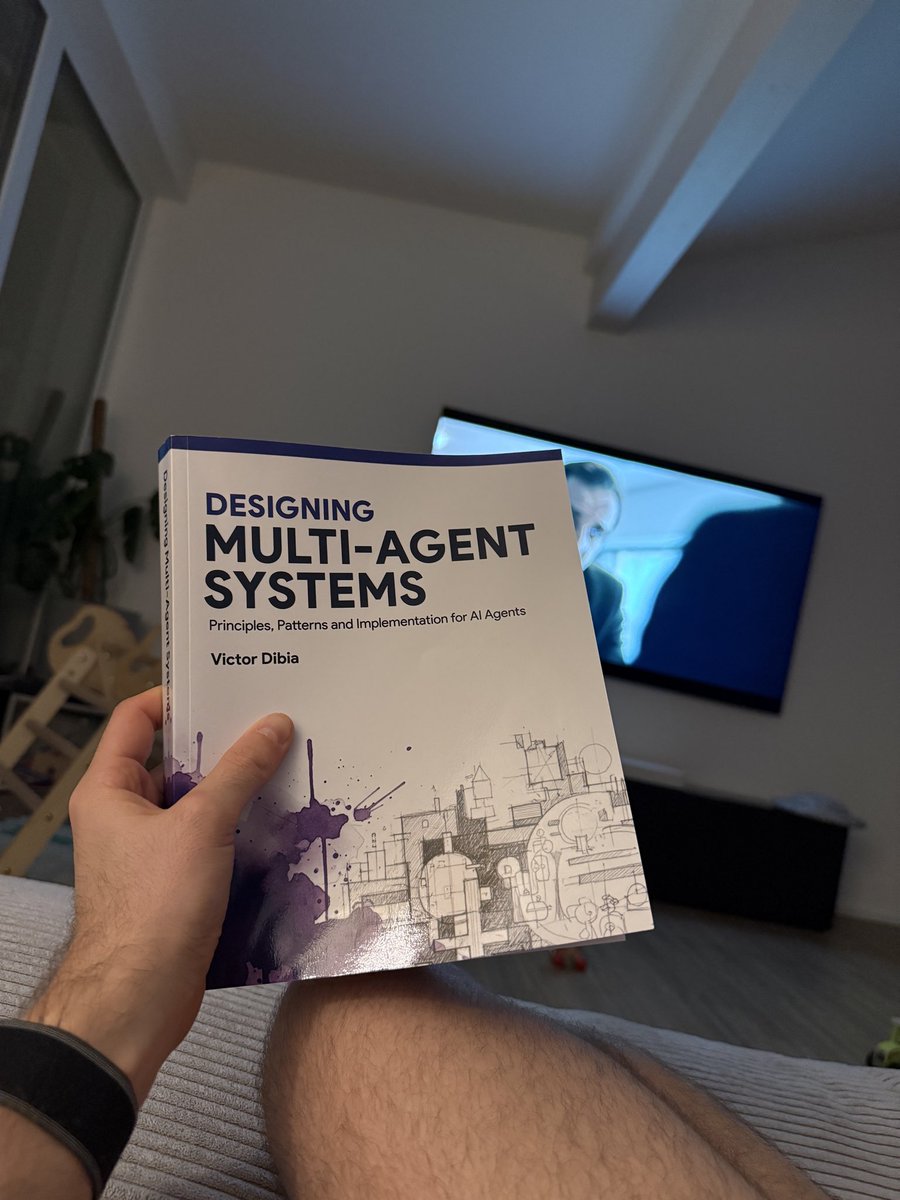
While my partner was watching Netflix, I started reading this gem. I recently got into building AI agents, but I had just been hammering Claude with my ideas and letting it decide how to implement things. This book will give me a solid understanding of how to build AI agents. Thank you @vykthur
5 Books to Help You Build AI Agents Like Claude Code in 2026
1. Designing Multi-Agent Systems
Author: Victor Dibia | Published: 2025 | Pages: ~395
2. Generative AI Design Patterns
Authors: Valliappa Lakshmanan & Hannes Hapke | Published: 2025
📣 Day 2/7 - a demo a day on building with @Microsoft Agent Framework - Workflows!
In Day 2 of my demo-a-day series, I cover how to use the workflow api to build a multi-agent workflow that generates personalized children's books on any topic. Structure planner → parallel content/image generation → QA with smart retries → final compilation .
This one was fun to build (I am already using it with my 6yr old).
Some useful design choices used in this demo:
- Parallelism: Workflow-level (fan-out edges) plus internal (asyncio.gather()) for within executor level concurrency (faster workflow runs)
- Structured outputs: Pydantic models ensure reliable, typed responses from all agents. This shouldn't need to be said, but always used structured outputs where possible.
- Quality gates with retry loops: Conditional edges route based on QA approval with constraints (max 3 attempts)
If you have used @pyautogen and have explored the Graphflow feature but needed more, this could be the tool for you.
🚀 New AutoGen release python-v0.5.4 is live — and it's packed with new features and upgrades!
✨ AgentTool & TeamTool — build multi-agent patterns using tool calls.
🛡️ Azure AI Agent adapter — now available as an Extension.
🐳 DockerJupyterCodeExecutor — sandbox your Jupyter code in Docker.
🧠 Canvas memory — shared "whiteboard" memory between agents.
🔁 CodeExecutorAgent update — now supports iterative self-debugging.
🎯 SelectorGroupChat improvements — supports streaming-only reasoning models and can emit inner reasoning events.
⚡ New sample on how to use autogen-core with FastAPI
🐞 Lots of bug fixes for Azure AI search and more.
Massive kudos to all the contributors who made this release happen! 🙌 @ekzhu@jay9thakur@pjausovec@enhao_zh@Henrymiller2012 @ethan045627
- Achieves 70.3% on SWE-bench Verified with high compute setup (vs 63.7% without)
- State-of-the-art performance on TAU-bench for real-world tasks with user/tool interactions
- Reduces unnecessary refusals by 45% compared to predecessor
Interesting updates from Anthropic
A continuation of trends [1] with AI agents is efforts to lift "agentic capabilities" up into the model itself.
The new Claude Sonnet 3.7 follows this direction
- Offers standard and extended thinking modes with visible step-by-step reasoning
Introducing Claude 3.7 Sonnet: our most intelligent model to date. It's a hybrid reasoning model, producing near-instant responses or extended, step-by-step thinking.
One model, two ways to think.
We’re also releasing an agentic coding tool: Claude Code.
- Introduces Claude Code (pretty much an agent) that can search/read code, edit files, write/run tests, commit/push to GitHub, and use command line tools. It runs as a command line too for now (will surely benefit from a UI IMO)
Full video walk through: https://t.co/9lQpl08gaf
AutoGen Studio Documentation: https://t.co/jOAHPBoxms
AutoGen Studio v0.4.1 release notes https://t.co/ta6gglsvo3