Some days I close this app 30 seconds after opening it.
Not because people are annoying.
Because they're too good.
I see:
- Solo designers pulling $40k months
- Portfolios that look like a team of 8 made them
- Founders shipping 3 products and posting twice a day
I know the advice.
"Don't compare yourself."
"People exaggerate online."
"Most of it isn't real."
All true. I still feel it anyway.
Some days it pushes me. Some days it discourages me.
Here's what helps me recalibrate:
I've probably made someone else feel small too.
Not on purpose. But I post my wins. I share the projects that worked. I leave out the slow weeks, the rejected proposals, the ideas that went nowhere.
Everyone's feed is the top 5% of their year.
So if you're reading this on a flat day:
You're not behind.
You're seeing 100 people's highlight reels stacked on top of each other and comparing them to your full week.
Average days count. Slow weeks count. The work you did this morning that nobody saw counts.
Build at your own pace.
Here's a snapshot of my life the past week as a solo designer:
- Wrapping a pitch deck with one client. After that we start building their platform from 0 → 1.
- Kicked off a new engagement with another client. Designing UI graphics for some AI features they're launching on their product pages.
- 32 new newsletter subscribers after only promoting it 1x. Up to 621 total, (not a ton but beats 0) https://t.co/bV0VuWETDP
- Shot a 38 in the golf league I play in every week, my lowest round in a while. Played a tournament with a friend too and we shot a 76. Won $150 between the two rounds :)
- Watched a bit of the NBA playoffs. Rooting heavily against OKC...
That's the week.
How was yours? What are you up to this week?
Everyone with a social media account has a crystal ball now.
More than half of the AI posts I scroll past lately aren't really about AI. They're predictions about what AI will do to us. 6 months from now. 1 year. 5 years. 10 years...
Everyone has a different crystal ball.
Some are sure the economy is cooked and knowledge work is over. Others are sure this is the greatest opportunity of our lives. Most fall somewhere in between. But almost all of them share an unshakeable certainty that they, specifically, can see what's coming.
I think a lot of it is fear. Predicting the future is a way to feel like you're preparing for it. Some of it is positioning, because if your prediction turns out to be right, you become the trusted voice who saw it coming. And most of it, honestly, is engagement bait. Confident takes about an uncertain future.
But many of these predictions are going to be wrong.
Two years ago, the loudest voices were saying ChatGPT had cooked everyone. Knowledge work was finished. Entire industries were about to collapse. And here we are. There's still an enormous amount of work happening. People are still getting hired. The economy didn't end. The specific predictions didn't come true. The predictors just moved their timelines further out, or pivoted to a new angle.
What I actually find useful is when people post about what's working right now.
How are you actually working today?
What changed about your workflow this month?
What experiments are paying off, and what flopped?
That kind of post is grounded in something real. It can be tested. It can be borrowed. It helps me do my job better today, which is the only day I actually have to work in.
Predictions about 2030 don't help me get my work done in 2026. They mostly just make me anxious or roll my eyes, depending on the day.
I'm not against thinking ahead. There's a real difference between predicting the future and preparing for it. Preparation means building skills, staying curious, paying attention to what's actually happening in your field. Prediction is pretending to know something nobody can know.
If you're going to post about the future, the most useful version is probably "here's what I'm doing today to be ready for whatever comes next." That's honest, it's useful, and it respects the fact that none of us actually know.
Put the crystal ball down. Tell me what's working today.
I illustrated these badges for one of my past product design teams.
They represent 5 design principles our team followed:
1/ Make it fun
2/ Trust the data
3/ Keep it simple
4/ Design for humans
5/ Understand the problem
These principles are still applicable to great product design today.
(except now we also need to design for 'agents' not just humans, lol)
I miss my old feed.
Tool discourse used to be part of the conversation. Now it feels like the whole conversation.
And I get it. New tools drop, the algorithm rewards it, everyone piles on. I've done it too. I actually love talking about tools.
But here's what bothers me.
A junior designer with the most powerful AI tools is not going to produce the same output as an experienced designer using those same tools. There is so much going on behind the tool that's doing most of the work.
When tools are all we talk about, we accidentally tell the world that the tools are the point.
They're not.
I miss the variety that used to exist in my feed. Things like:
Design process and how you actually work
Career advice + how to grow as a designer
Portfolio and case study breakdowns
Design principles and fundamentals
Typography, color, and layout craft
Client stories and lessons learned
Freelance business and pricing
Design critiques and teardowns
Industry debates and drama
The tools are worth talking about. Just not at the expense of everything else.
Designers are great at solving problems for clients.
We’re pretty bad at doing it for ourselves.
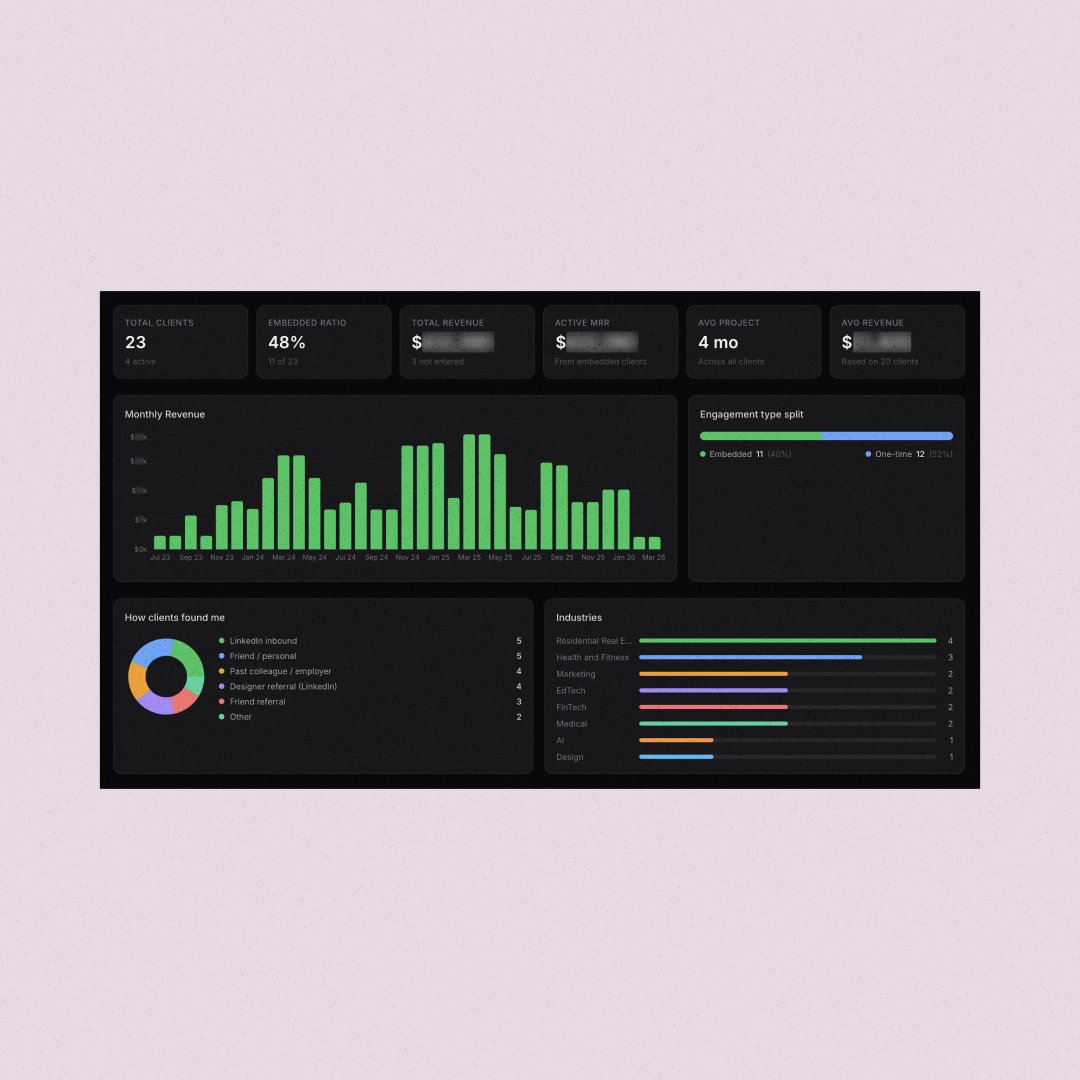
I had 3 years of client data sitting in a Google Sheet.
Every project. Every client. Every dollar.
So I finally built a simple visual dashboard for myself.
Very quickly I started seeing things I hadn’t noticed before.
Where clients actually came from.
Which industries kept popping up.
Whether the work I’m getting is even what I want more of.
We solve other peoples' problems all day.
Probably worth doing it for ourselves too.
It’s harder to get the job than to do the job.
This has never been more true than it is today.
Even landing interviews is harder than ever.
A friend at a FAANG company even told me this:
”It’s harder to get an interview here than to get the job here.”
Of course many design jobs require highly complex work.
But it seems no design job is as challenging as the effort to obtain a design job in the current market.
Interviews are grueling.
Waiting for offers is suspenseful.
Preparing portfolios is exhausting.
Continual rejections are painful.
I don’t envy anyone on the FT job hunt right now. It’s brutal.
Talking about this stuff is important.
Go easy on your designer peers trying to find work.
If someone is looking for a long time, it doesn’t mean there’s something wrong with them.
There’s an abundance of highly qualified designers without work.
Nobody tells you this when you get into design.
The actual work of opening the software and making the thing?
That's maybe 20% of the job.
The other 80%:
- Managing expectations with people who all want something different
- Having challenging conversations
- Compromising on your strong opinions
- Dropping your pride when you're wrong
- Knowing when to praise and when to push back
- Speaking up even when it slows the whole team down
No tool eliminates any of that.
Bold proclamations about new tools replacing designers get all the clicks. It's a shame. It sends a message to people unfamiliar with our craft that what we do is so small it can be contained to the basic outputs of new technology.
That's never been the reality.
The obsession with tools makes sense (I admit I do love my tools). Tools are concrete and easy to talk about.
But half the job, if not more, is human to human.
Nobody talks about that.
2025 doomers: “AI will replace every tech worker in X months.”
2026 doomers: “AI costs are exploding. The bubble will pop soon.”
Nobody ever says “I was wrong about AI.”
They just swap their prediction.
Want better design feedback? Show more options.
Too many designers present just one solution. One layout. One logo. One flow. Then they wonder why clients push back or go silent. The problem isn't the design. It's the process.
I recently took on a logo project from a client who had just fired their last designer. Their biggest complaint wasn't the quality of the work. It was that they only ever got one logo to react to. No options. No exploration. Just "here it is." That felt like a closed door, not a collaboration.
Clients don't want your favorite. They want to compare, react, and choose. Most people can't visualize what they haven't seen yet, and that's not a character flaw. It's just how humans work. Our job is to show them the possibilities, not expect them to imagine from nothing.
I've tested this across logos, UX flows, and feature ideas. Every time I show 3 to 5 directions instead of one, clients feel more involved in the process. The conversations get better. Buy-in gets faster. It works because showing options signals that you explored deeply, not that you guessed and got lucky.
If you're only showing one idea, you're missing a collaborative opportunity. Design isn't about being right. It's about exploring possibilities together.
Great work doesn’t speak for itself.
It’s your job to speak for it.
I used to think talent was enough.
That if I just worked hard, opportunities would follow.
But silence is expensive.
If no one knows you exist, they can’t hire you.
Obvious, I know.
Yet, it's so easy to stay quiet.
When fear creeps in, these beliefs help me post anyway:
– Someone needs what you know right now
– Visibility creates opportunity, silence doesn’t
– Most people aren’t thinking about you
– You grow faster when you show up
– Sharing builds trust before they hire you
– Posting helps clarify your own thinking
– Imperfect work still inspires others
You've gotta make your work discoverable.
Easier for clients. Easier for hiring managers.
Make it easier for luck to strike.
So many designers hate wireframing.
I'm not one of those designers.
AI can generate high fidelity screens in seconds. Figma has auto layout, variables, components. The bar for a polished prototype has never been lower.
Yet, I still love starting projects with a black and white wireframe.
Even when I'm using AI to generate early concepts, I'll specifically prompt it to stay wireframe-only.
No color.
No shadows.
No corner radius.
Pure outlines.
This is a psychological decision, not a technical one.
When I show up to an early client review with even a partially styled UI, the conversation drifts.
Suddenly we're talking about the button color or the font weight instead of the flow, the information architecture, or whether the core experience actually makes sense.
Wireframes remove that distraction.
They force the conversation to stay on what matters early:
Does this work?
Does the information make sense?
Can a user complete the task?
You can always add the visuals later. You can't easily undo a client who's already anchored on the wrong thing.
Do you still wireframe, or have you skipped straight to high fidelity?
AI can generate images, code, ideas, and designs.
But it cannot generate ambition.
I've been building with some of the most capable tools ever made this past year. And what I've realized is that even with the best technology in my hands, it is not converting me into some overnight success. It hasn't done that for anyone.
What it has done is shown me how much work still lives on the other side of a good idea.
Focus. Grit. The willingness to go deep on one thing long enough to actually build it out, test it, and see it through. You cannot prompt for any of that.
Here's what I keep realizing:
No one is coming to hand you skills, money, achievements, or freedom. You have to get up and go get it.
And the good news is you can. You don't need permission. You don't need someone to tell you which path is best. You just need to be decisive and trust that you are more capable than your own doubt is telling you.
Whatever it is you want, go get it.
Flashback to my top 12 Dribbble posts circa 2019.
These 12 posts alone generated about 400k views.
That exposure led to several job opportunities.
That was my first taste of the power of finding work by putting your work online.