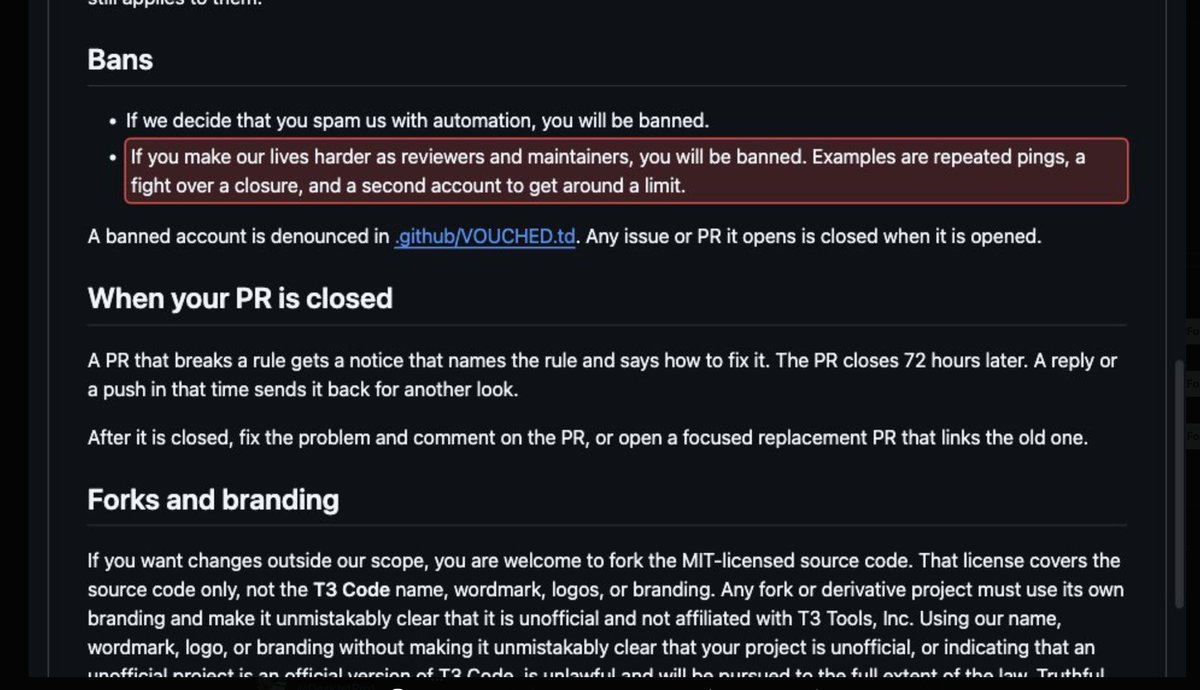
There is nothing more liberating than being proven right by the guy blocking you, so I can't comment on his posts. The YT videos though? Easy. If you can comment on the videos I think we need to force an action or statement to be made. @theo@realchendahuang
The story starts back in March of this year. On March 6, T3 Code merged PR #174, stuffing in PostHog telemetry that was enabled by default. At the time, there was no documentation in the repo, no popup in the software, and no toggle in the settings. The environment variable used to turn it off was quietly buried deep in the code. Once ordinary users installed it and ran it, data started going out. Yet for those entire three-plus months while telemetry was quietly running by default, the T3 Code homepage kept two big lines of text on prominent display, promising: No telemetry / Unless you opt in. Full stop. The meaning was crystal clear: unless you actively agree, zero telemetry, no exceptions. After riding that golden reputation to harvest goodwill among privacy-conscious developers, it wasn't until June 18 that @theo himself silently deleted those two promises in a commit that revised the homepage. No announcement, no reminder popup for existing users—as if nothing had happened. If it were just quietly collecting a few version numbers, a lot of people might still have been able to put up with it. But in October, @theo personally submitted PR #15028, switching the batch reporting—once every 10 seconds—straight over to a self-hosted server at https://t.co/YVWktfidH3. The code comments spell it out clearly: the T3 server first keeps its own copy of every raw event, then forwards it to PostHog. Your model choice (including the names of private models you connect yourself), permission mode, how long each run takes, input, output, and cached tokens, how many projects and threads you have locally, which of more than 30 UI features you've clicked, along with your operating system and device model—all of it streams continuously into his database. On October 19, @theo went even further and personally submitted PR #21506, on the grounds that the existing metrics weren't accurate enough to tell how many machines a single person had installed. So he did something wildly out of bounds: he wrote code in Identify.ts that reaches straight into the user's home directory on their computer and silently reads the neighboring tools' ~/.codex/auth.json and ~/.claude.json, extracting the OpenAI user_id and Claude accountUuid inside. Together with the T3 Connect account and device ID, he hashed them with unsalted SHA-256 and uploaded them, specifically to stitch together, on the backend, a web of all the computers and accounts under your name. He casually calls this anonymous usage data, but anyone with even a little technical knowledge has to laugh. An unsalted hash, when the server already has your T3 Connect account in plaintext, can be matched against the hash to pinpoint exactly who you are. Once a third-party account ID leaks, it can just as easily be linked back to a real person. On top of that, the software has a set of relay diagnostic traces sent to Axiom. The official docs themselves admit that the browser version and the mobile client simply cannot be turned off, and that they don't honor the environment variables you set on the server. The even more naked face of it shows up in every clash with the community. On June 23, a developer politely suggested in Issue #1397 that they add a toggle in the settings page to turn telemetry off. Core maintainer Julius closed the thread as not planned, leaving a line that has to be one of the strangest in open-source history: We will not make this easier to opt out of, it is crucial for us to know how many users we have. Translated, that means: we will not make turning telemetry off any easier. Knowing how many users we have is crucial to us. In July, someone dug up archived screenshots of the homepage and opened Issue #4123, calling them out for promising zero telemetry while quietly running it by default. It dragged on until October 21, when @theo's account closed the thread with a completely unrelated fix. After getting mocked en masse in the comments, it was reluctantly reopened the next day, only for it to be silently shut down again on November 4, without a word. Unruly programmers in the community submitted four PRs, one after another from September through November, offering to add a settings toggle—#13458, #16763, #21248, and #27077—and every single one was rejected. The latest one, #27077, had even been verified by a maintainer on a real machine, with all 147 tests passing green, yet on November 17 it was still closed outright with a single sentence, and an unwanted label was slapped on it for good measure. At the end of the day, T3 Code is free and open source and charges no subscription fee. The true number of deduplicated users, and the share of token usage across each model provider, are the core chips @theo takes to the table when negotiating deals with LLM vendors, funneling traffic to his own commercial products, and hyping 100,000 users online. To make that data report look good, he would rather tear up the promises on the official site, reach into users' local config files, and shut every voice asking for a toggle out the door. This is a petty dictator who steals data under the banner of open source. He built himself up on the community's trust and free word of mouth, then turned around and treated every user's behavior trail, machine count, and cross-platform identity as his own private property—not even willing to give you the dignity of a single click on a disable button. A reminder to every developer currently using it or about to try it: be a little more careful, watch your data security closely, and don't get sold out by them while you're still in the comments hyping their principled open source and saying nice things on their behalf. If you're still on the local or desktop version, immediately add the two environment variables below to ~/.zshrc and restart, or just put https://t.co/YVWktfidH3 in your hosts file and block it dead:
The story starts back in March of this year. On March 6, T3 Code merged PR #174, stuffing in PostHog telemetry that was enabled by default. At the time, there was no documentation in the repo, no popup in the software, and no toggle in the settings. The environment variable used to turn it off was quietly buried deep in the code. Once ordinary users installed it and ran it, data started going out. Yet for those entire three-plus months while telemetry was quietly running by default, the T3 Code homepage kept two big lines of text on prominent display, promising: No telemetry / Unless you opt in. Full stop. The meaning was crystal clear: unless you actively agree, zero telemetry, no exceptions. After riding that golden reputation to harvest goodwill among privacy-conscious developers, it wasn't until June 18 that @theo himself silently deleted those two promises in a commit that revised the homepage. No announcement, no reminder popup for existing users—as if nothing had happened. If it were just quietly collecting a few version numbers, a lot of people might still have been able to put up with it. But in October, @theo personally submitted PR #15028, switching the batch reporting—once every 10 seconds—straight over to a self-hosted server at https://t.co/YVWktfidH3. The code comments spell it out clearly: the T3 server first keeps its own copy of every raw event, then forwards it to PostHog. Your model choice (including the names of private models you connect yourself), permission mode, how long each run takes, input, output, and cached tokens, how many projects and threads you have locally, which of more than 30 UI features you've clicked, along with your operating system and device model—all of it streams continuously into his database. On October 19, @theo went even further and personally submitted PR #21506, on the grounds that the existing metrics weren't accurate enough to tell how many machines a single person had installed. So he did something wildly out of bounds: he wrote code in Identify.ts that reaches straight into the user's home directory on their computer and silently reads the neighboring tools' ~/.codex/auth.json and ~/.claude.json, extracting the OpenAI user_id and Claude accountUuid inside. Together with the T3 Connect account and device ID, he hashed them with unsalted SHA-256 and uploaded them, specifically to stitch together, on the backend, a web of all the computers and accounts under your name. He casually calls this anonymous usage data, but anyone with even a little technical knowledge has to laugh. An unsalted hash, when the server already has your T3 Connect account in plaintext, can be matched against the hash to pinpoint exactly who you are. Once a third-party account ID leaks, it can just as easily be linked back to a real person. On top of that, the software has a set of relay diagnostic traces sent to Axiom. The official docs themselves admit that the browser version and the mobile client simply cannot be turned off, and that they don't honor the environment variables you set on the server. The even more naked face of it shows up in every clash with the community. On June 23, a developer politely suggested in Issue #1397 that they add a toggle in the settings page to turn telemetry off. Core maintainer Julius closed the thread as not planned, leaving a line that has to be one of the strangest in open-source history: We will not make this easier to opt out of, it is crucial for us to know how many users we have. Translated, that means: we will not make turning telemetry off any easier. Knowing how many users we have is crucial to us. In July, someone dug up archived screenshots of the homepage and opened Issue #4123, calling them out for promising zero telemetry while quietly running it by default. It dragged on until October 21, when @theo's account closed the thread with a completely unrelated fix. After getting mocked en masse in the comments, it was reluctantly reopened the next day, only for it to be silently shut down again on November 4, without a word. Unruly programmers in the community submitted four PRs, one after another from September through November, offering to add a settings toggle—#13458, #16763, #21248, and #27077—and every single one was rejected. The latest one, #27077, had even been verified by a maintainer on a real machine, with all 147 tests passing green, yet on November 17 it was still closed outright with a single sentence, and an unwanted label was slapped on it for good measure. At the end of the day, T3 Code is free and open source and charges no subscription fee. The true number of deduplicated users, and the share of token usage across each model provider, are the core chips @theo takes to the table when negotiating deals with LLM vendors, funneling traffic to his own commercial products, and hyping 100,000 users online. To make that data report look good, he would rather tear up the promises on the official site, reach into users' local config files, and shut every voice asking for a toggle out the door. This is a petty dictator who steals data under the banner of open source. He built himself up on the community's trust and free word of mouth, then turned around and treated every user's behavior trail, machine count, and cross-platform identity as his own private property—not even willing to give you the dignity of a single click on a disable button. A reminder to every developer currently using it or about to try it: be a little more careful, watch your data security closely, and don't get sold out by them while you're still in the comments hyping their principled open source and saying nice things on their behalf. If you're still on the local or desktop version, immediately add the two environment variables below to ~/.zshrc and restart, or just put https://t.co/YVWktfidH3 in your hosts file and block it dead:
@realchendahuang When someone who is riding the high of making something like this, they take on this sanctimonious holy-er than thou attitude to shit on other people? Is anyone actually surprised this is the case?
@realchendahuang I cannot begin to explain how happy I am. This is the dude who is constantly talking shit about how open source and non tracking T3 is. Legitimately any AI post, any question comments or concerns are just him trying to ratio in the comments.
@JJ5853186674361@veizau You can reach the Autism Society National Helpline at 1-800-328-8476 (1-800-3AUTISM) or submit an online inquiry to connect with trained Information & Referral Specialists for local resources and support.
@Bacongod199@QuestTheLine So they literally crashed the in game economy. No wonder everyone wants them banned. That'd fucking make me lose my mind. Especially saving for a piece of gear and you wake up to not being able to buy it.
It's okay to get flamed in a game. Idk who needs to hear this, but Christ if you're new at the game you're gonna get flamed.
Ever deadlock game I try to give tips and people lose their ever loving minds. You shouldn't be playing ghiest or sinclair
#DeadlockGame