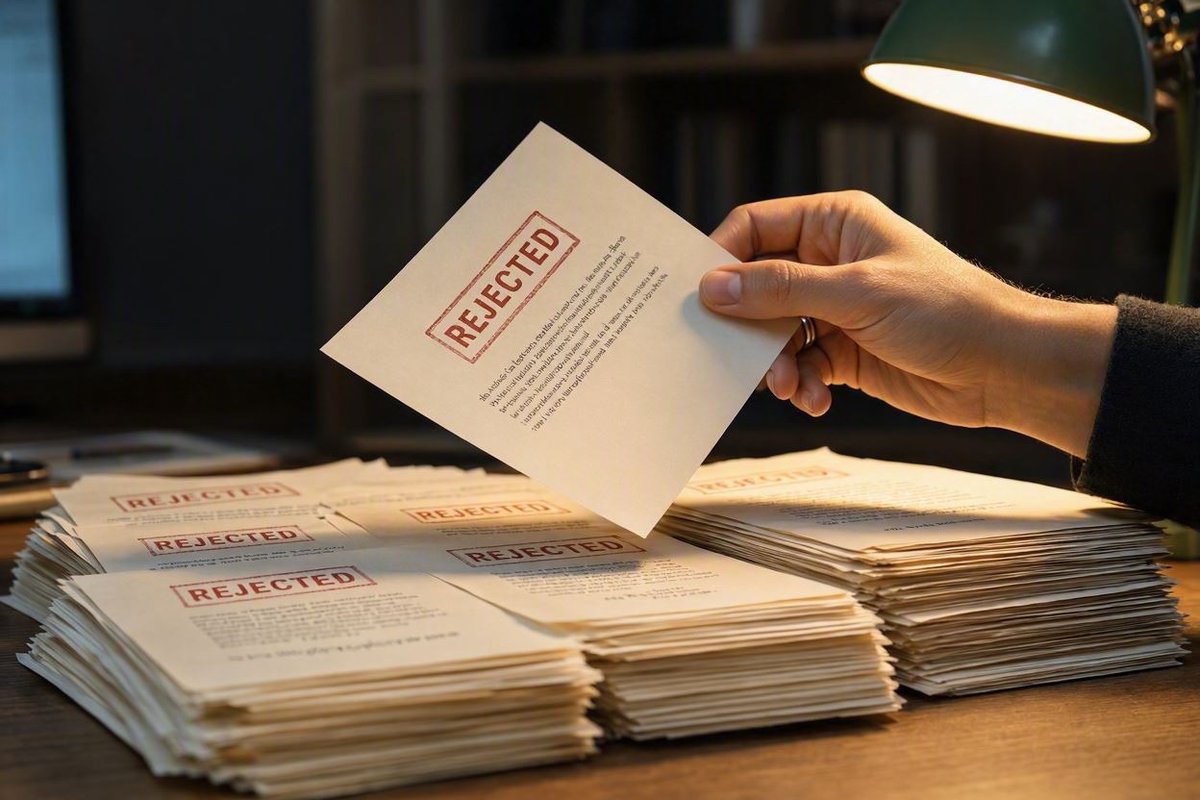
How to become disgustingly good at saying no
He said yes to everyone. That is why nobody remembers what he actually wanted
He was the reliable one. Everyone said so. The friend who always showed up, the coworker who always covered the shift, the son who always answered the phone on the second ring.
Reliable was the word they used. Nobody ever asked what it cost him.
Say no to almost everything
"The difference between successful people and really successful people is that really successful people say no to almost everything." — Warren Buffett
By the time he was thirty, his calendar belonged to everyone except him. Every yes was small on its own. A favor here, a meeting there, a commitment made in a hallway just to end an awkward silence.
None of them felt like a decision. That was the problem. A life built entirely out of things that never felt like decisions is still, somehow, a life someone else designed.
Focus is a filter, not a feeling
Steve Jobs put it plainer than most. Focus is not about the thing you say yes to. It is about the hundred reasonable, good, well-meaning things you say no to first.
Nobody warns you that most of what you will need to refuse will not look like a bad opportunity. It will look like a favor. A reasonable request from a reasonable person. That is exactly what makes it dangerous.
The agenda you never wrote is still an agenda
"You've gotta keep control of your time, and you can't unless you say no. You can't let people set your agenda in life." — Warren Buffett
He started small. Not the big refusals, the dramatic ones. Just the tiny ones. A meeting he did not need to attend. A group chat he stopped answering within the hour. A version of himself that let a message sit for a day, instead of reflexively agreeing before he had time to notice he wanted to.
Nothing collapsed. Nobody left. The people who mattered stayed. The requests that were only ever there because he always said yes quietly stopped arriving.
A full calendar is not the same thing as a full life
He did not become someone who says no to everything. He became someone who finally understood that every yes is borrowed from something else. Time, attention, the one life he was quietly spending on other people's priorities.
Saying no was never about being harsh. It was about refusing to let a hundred small, reasonable requests decide who he was going to become.
The people worth keeping never needed him to prove it by saying yes to everything. They just needed him to actually be there for the few things that mattered.
How to become disgustingly consistent
He never had a good day to start. He just stopped waiting for one.
The version of you that keeps starting Monday has met the version of you that keeps quitting by Thursday about a hundred times now. They know each other well. They have an understanding.
Neither of them is real. They are both just excuses wearing a calendar.
You don't need more motivation. You need to stop needing it.
"Habits are the compound interest of self-improvement."
— James Clear
Nobody who is actually consistent is winning a daily battle against their own laziness. They just stopped making it a battle.
The people you think have discipline built a life so small and so specific that skipping the thing costs more than doing it. That is not willpower. That is architecture.
The loop nobody tells you about
Every action you repeat runs through the same four gates. Something in your environment gives you a signal. The signal triggers a behavior. The behavior pays you back, one way or another.
Skip the gym enough times and the payoff is relief. Relief is real. That is why it wins so often.
The trick was never fighting the loop. It was moving one gate.
Make the first step too small to skip
You do not need the version of yourself that runs five miles at dawn. You need the version that puts on running shoes and walks to the mailbox, every single day, until walking to the mailbox stops being a decision at all.
Small enough that skipping it would be stranger than doing it. That is the only discipline that has ever survived a bad week.
You do not rise to the level of your goals. You fall to the level of your systems. Build the floor first. The ceiling can wait.
The gap between who you are and who you keep promising to become
"Success is the sum of small efforts, repeated day in and day out." — Robert Collier
Nobody fails at consistency in one dramatic moment. It happens in a hundred quiet ones. A snooze button. A "I'll start Monday." A version of tomorrow that never actually arrives, because tomorrow always has its own tomorrow waiting behind it.
The gap is not made of laziness. It is made of a thousand small, forgivable exits, each one too small to notice until you add them up.
The version of you that never misses is not stronger. He is just further along
"You do not rise to the level of your goals. You fall to the level of your systems." — James Clear
He did not wake up one day and decide to become consistent. He built one system small enough to survive a bad week, ran it long enough to stop noticing it, and let the identity catch up to the behavior instead of waiting for it to come first.
That is the only order that has ever worked. Behavior first. Belief follows. Never the other way around.
How To Automate Customer Support With AI (Full Guide)
Most support bots fail for one reason. They were trained on what the company wishes customers asked, not what customers actually ask.
Here is the real process.
Collect real tickets. Pull the last 500 actual conversations, not the FAQ page. The FAQ is what you hoped. The tickets are the truth.
Tag and sort by intent. Refunds, shipping, account issues, everything else. Most support volume comes from 5 to 8 repeating categories.
Train the bot on your own resolved tickets, not generic scripts. Generic scripts sound like every other bot. Your resolved tickets sound like your business.
Set handoff rules before launch. Anything involving money, anger, or a legal word goes straight to a human. No exceptions, no matter how confident the bot sounds.
Go live on one channel first. Email or chat, not both. Watch escalation rate for two weeks before expanding anywhere else.
The bots that fail were never dumb. They were just launched on all channels at once with no one watching the exits.
2. How To Use AI to Screen Job Candidates Without Getting Sued (Full Guide)
Промпт для инфографики:
"Flat vector infographic in a cute minimalist cartoon style, cream background, five pastel rounded step boxes connected by arrows: '1. Score, Don't Reject' (blue, icon of a scorecard with stars), '2. Human Reviews Borderline' (green, icon of a magnifying glass over a resume), '3. Audit for Bias' (yellow, icon of a balance scale), '4. Document Every Decision' (purple, icon of a folder with a lock), '5. Re-check Quarterly' (coral, icon of a calendar with a refresh arrow). Below, a small cute checklist character labeled 'Your Hiring Pipeline' connected by a dashed line to a resume-stack icon labeled 'Applicants'. Green checklist box: 'Fewer legal risks', 'Fairer results', 'Still fast'. Bold sans-serif typography, simple line icons, soft pastel palette, Canva-style explainer graphic"
Текст:
How To Use AI to Screen Job Candidates Without Getting Sued (Full Guide)
Workday is facing a class action over 1.1 billion rejected applications. iTutorGroup already paid the EEOC 365,000 dollars. Here is how to not be next.
Score, never auto-reject. The model ranks candidates. It never removes anyone from the pool without a human seeing the reason first.
A human reviews every borderline score. Not every application. Just the ones close to your cutoff, where the model is least confident.
Audit for bias every quarter. Pull rejected candidates by age, gender, and location. If one group gets rejected at a noticeably higher rate, that is not a coincidence.
Document why the model flagged each rejection. If you cannot explain a decision in plain English, you cannot defend it in court either.
Re-check the model after every retrain. Models drift. What was fair in January can quietly stop being fair by June.
The companies getting sued were not using AI to hire faster. They were using it to stop looking at who got rejected.
3. How To Cut Customer Churn With AI (Full Guide)
Промпт для инфографики:
"Flat vector infographic in a cute minimalist cartoon style, cream background, five pastel rounded step boxes connected by arrows: '1. Spot Warning Signs' (blue, icon of a line chart with a downward dip and a warning triangle), '2. Score Every Account' (green, icon of a dashboard gauge), '3. Trigger Outreach' (yellow, icon of an envelope with a lightning bolt), '4. Route to the Right Human' (purple, icon of an arrow pointing to a person), '5. Track What Worked' (coral, icon of a checklist with a chart). Below, a small cute magnifying glass character labeled 'Churn Model' connected by a dashed line to a customer-icon group labeled 'Your Accounts'. Green checklist box: 'Earlier warnings', 'Targeted saves', 'Less guesswork'. Bold sans-serif typography, simple line icons, soft pastel palette, Canva-style explainer graphic"
Текст:
How To Cut Customer Churn With AI (Full Guide)
By the time a customer emails to cancel, you already lost them weeks ago. Here is how to catch it earlier.
Define the warning signs. Drop in usage, unanswered emails, a support ticket that never got resolved. Pull these from your actual churned customers, not assumptions.
Score every active account weekly. Not a gut feeling. A number that updates as behavior changes.
Trigger outreach automatically at the threshold. A check-in email, a call from a rep, a discount offer. Pick one, not all three at once.
Route high-value accounts to a human, not a template. The bigger the account, the less it should feel automated.
Track which interventions actually saved accounts. Most companies never close this loop, so they keep repeating what does not work.
Churn prediction is not the hard part. Acting on the score before the customer has already decided is.
If your hiring pipeline runs on a model and no human ever looks at the pile it throws away, you are not running a hiring process. You are running the same experiment Workday and iTutorGroup ran. You just have not been asked to explain it in court yet.
The model, left alone long enough, learned to punish age like it was a bug in the resume. That is the confidence trap. Not evil code. Just code nobody watched closely enough, for long enough, to notice what it had quietly become.
None of this looked like malice from the inside. The dashboards were clean. The rejection reasons read neutral, professional, almost kind. Nobody woke up and decided to discriminate. They just stopped checking what the model had actually learned to punish.
The EEOC called it what it was. iTutorGroup paid 365,000 dollars for a single line of code that had quietly decided, for years, who was allowed to be useful and who was not.
Here is the part that should keep you up at night if you run a business.
Five years earlier, a woman applied to tutor English online. The software looked at her birth date and said no before it looked at anything else. She waited a day, changed one number, and reapplied. Same resume. Same person. Different age on paper. She got the interview.
By 2025, his case had become something bigger than one man’s frustration. A nationwide class action, certified by a federal court. And in its own filings, Workday admitted the machine had rejected 1.1 billion applications. Not a typo. A billion, with a b.
Over a hundred of them, the same resume, the same qualifications, the same silence where a human decision should have been.
He kept applying anyway. That is the part nobody puts in the headline. A man who kept showing up to a door that was never really open.
Derek Mobley learned to read the timestamps. Twelve forty seven at night. One thirty in the morning. Rejections arriving while the city slept, while no recruiter in any time zone could possibly have opened his file.
@thxofx Impressive move with the $EU trade! 🚀 Keep up the great work and thanks for sharing the insights. Always inspiring to see such success in the trading world. 💼📈
@elonmusk When courts start interfering in democratic processes, it raises serious concerns. Hopefully, truth and justice will prevail, and decisions will be made in the interest of the people, not political elites. 🌍✊
@elonmusk It's truly striking how politics can influence critical decisions like astronaut safety. Thank you, Elon, for your willingness to help and for your transparency. Hopefully, in the future, such situations will be resolved more swiftly with less political interference. 🚀👨🚀