We're excited to announce that the doors for SEO Blueprint 3 are now open for a very limited time.
Packed with insights we've never seen shared elsewhere, this is a training course aimed at leveling-up your SEO skills, quickly.
Learn more, here: https://t.co/hJrMaDuNVj 🤝
Ahrefs' Domain Rating endpoint is now free! You don't even need an API key.
I built a tool to show it off (and possibly send you some visitors?) 🎉
The idea is simple: Enter your site, reveal your DR, and find other sites with the same score.
If you like, you can also submit your domain to be one of the recommendations, and potentially get some visitors sent your way.
See it in action over on detailed dotcom /dr/
Of course, I'm not expecting this to go viral in any way, but you might reach a few marketers and webmasters in your niche.
The idea is a little cheesy, I know, but I had to test out the new endpoint myself.
Simplified, DR aims to show the strength of a website's backlink profile compared to other sites in the Ahrefs database.
It works on a 0-100 scale, and can be useful for quick competitor benchmarking, link prospecting, outreach prioritization, and more.
To give some context on the numbers...
Wikipedia: DR 97
Ahrefs: DR 91
YCombinator: DR 91
Tinder: DR 82
Detailed: DR 73
Even if you're not technically savvy, it's still super easy to use. Point your AI assistant of choice straight to the Ahrefs API docs, and it will figure out the rest.
Hopefully you find this new endpoint useful in your workflows! 🙌
100M+ data points. 13 studies. 8 authors. One AI search benchmark report. ✨
I'm excited to share the research the Ahrefs team has put together over the past two quarters in one cohesive resource.
We've analyzed responses across AI Overviews, AI Mode, and ChatGPT, and even ran our very own misinformation experiment.
Some key highlights:
- In an analysis of 75K brands, YouTube mentions correlated most strongly with AI visibility 🖥️
- AI Overviews appear for 21% of all keywords (with that rate varying by category and query length) 🔑
- Across 76K websites using Ahrefs Web Analytics, Google sends 190x more traffic than ChatGPT 📈
I wouldn't be doing my job as a marketer unless I said there are some other big findings in the full report. 😬
Special thanks to those who agreed to have their comments featured. We often share these internally, so it's cool to be able to show them off a little.
I would love to convince Tim & Ryan to let me do this again for the next batch of research, so any likes, comments, and shares are much appreciated!
(I'm linking to it directly in the first reply.)
Thank you!
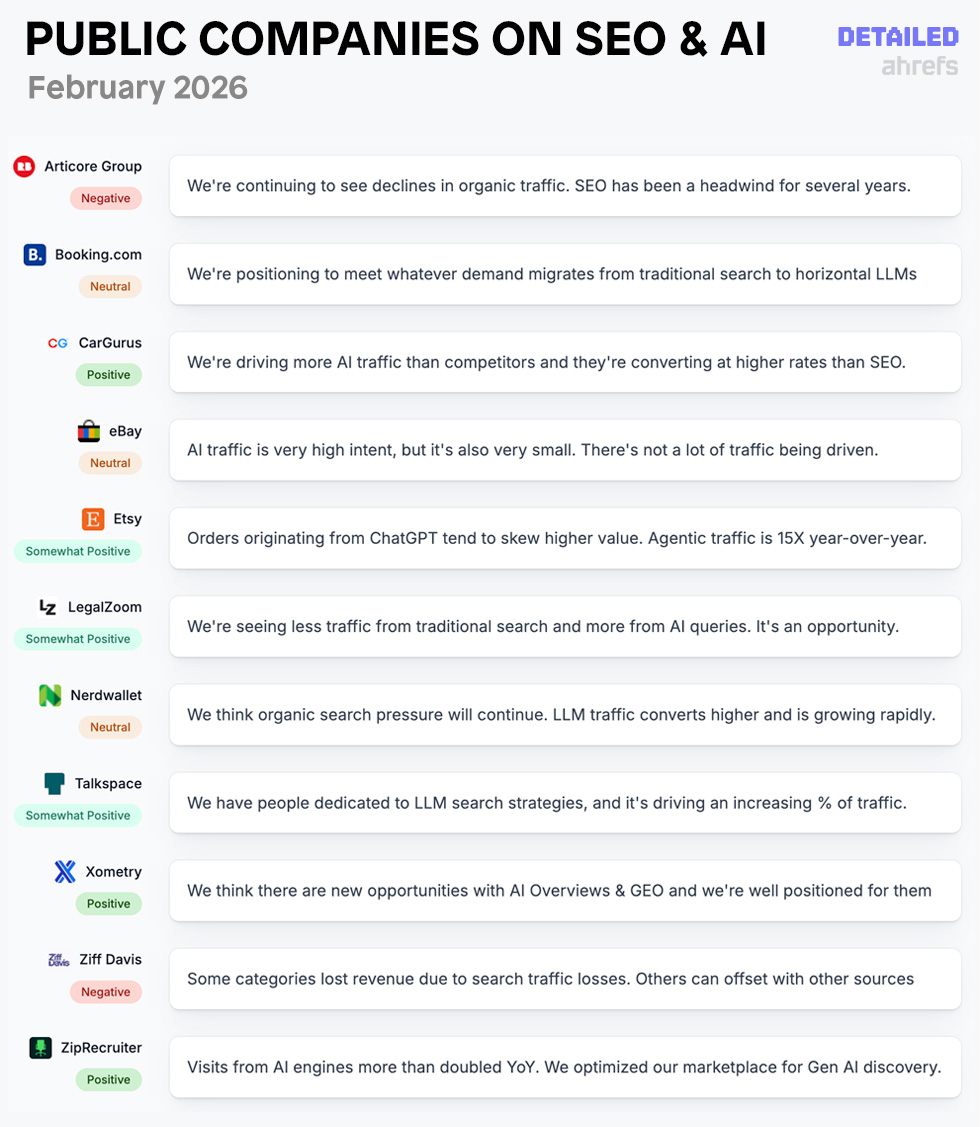
Here's what public companies have said about AI & SEO in the past few days.
It's nice to report on SEO wins, and that AI traffic continues to convert well.
Of course, AI and changing user habits have not been kind to a lot of companies that were reliant on search.
Traffic diversification is top of mind for many of them.
There also seems to be a lot of genuine excitement around AI as a whole, and not just from SaaS companies, but from eCommerce stores and marketplaces as well.
I think there are some much bigger marketing stories to tell there, so look out for some upcoming (free) reports on that topic.
I’m hoping to have the first one live in a couple of weeks.
As always, there's more to investor updates than I can share in these summaries, so please do your own research before making investment or marketing decisions.
Thanks for reading! 🤝
Big news: Ahrefs just added two new features to paid plans (at no extra cost).
Prompt tracking for AI visibility (!), and always-on site audits. 🥳
I had a *small* part to play in the former, but the latter was a surprise to me.
These new features are available for Lite plans and above.
For AI visibility, you get 150, 300, or 600 prompt "checks" to use however you like.
On the Standard plan that could be 75 prompts checked weekly on ChatGPT, 10 prompts daily, or 100 prompts monthly across three platforms.
You decide on the platforms and schedule.
Even with the recent opening of the API and the launch of Firehose, there are still some big announcements on the way.
I'll share them here as soon as they're ready.
P.S. I can't offer support here, but if you have any requests or feedback, I’ll do my best to curate replies and share them with the relevant teams.
Thank you!
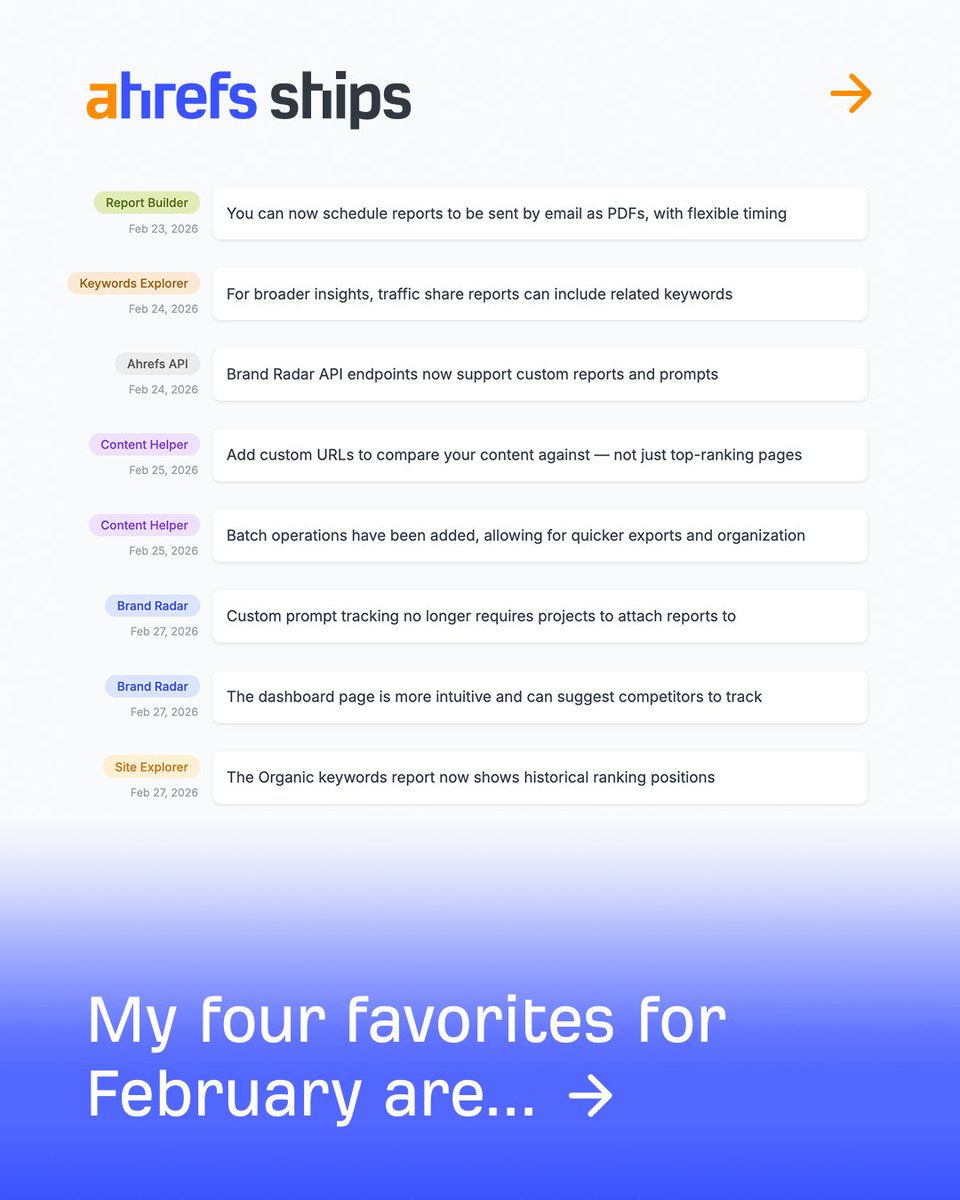
In the six months since joining Ahrefs, I've documented 130+ product updates.
Each month I like to share some of my favourites, so here's four from February....
(The carousel on LI has screenshots, but I've tried to attached some images here as well.)
#1. Brand Radar can now show whether you're mentioned *within the content* of the URLs AI cites.
You'll also see the 'Page Type' of each link, as we have it (currently tagging ~300M pages monthly).
#2. Competitive Analysis gets a new tab to play with: Paid keywords.
Uncover keyword opportunities across search advertising campaigns, including common paid terms, and any overlaps with organic rankings.
#3. Google Maps visibility is here.
Track your local search performance through key actions like calls, directions, and website clicks.
You can also compare data across locations.
#4. I pushed for this one: Tag the prompts you're using to monitor AI visibility.
It's a simple idea, but makes it so much easier to filter through different prompt clusters around intent, or queries covering specific products and services.
**
With these posts I'm hoping to make it easier for Ahrefs customers to see what we've been working on, so please let me know if these continue to be useful.
(And I'll be honest, it would be cool if they convince someone new to check out Ahrefs as well).
March has already been crazy with announcements of Firehose and API access for (almost) all paid plans, but we still have something very big to share… 😬
February was a record for new Ahrefs sign-ups self-attributed to AI. 🤖
Mentions of Claude grew the most, and are on track to double in March.
AI referrals only account for a small % of sign-ups — and we understandably get a lot of general answers ("social media") — but it's really nice to see the channel growing.
(If multiple platforms were mentioned in a response, we didn't count it, so the numbers are technically a bit higher).
As I've said before, I'm aware that self-attribution data isn't perfect. It’s affected by recency and recall bias, and it's not easy to account for every variation and typo.
It's not the only data source we look at, but it's fun to dive into.
(And especially interesting when people talk about specific YouTube channels, podcasts, blog posts, and so on, which convinced them to join.)
I report on so many other companies talking about how AI is impacting their marketing, so I think we should do a bit more on that front as well.
Hopefully it's interesting! 🤝
I'm biased, but I think companies are growing more optimistic about AI search.
Context is important (let's not scare investors), but it feels like a shift.
And I'm not just saying that because of these latest earnings calls.
Of course, I shouldn't make light of the fact that search traffic declines have been devastating for some, and AI referrals have a lot of ground to make up.
Certain businesses will have *much* more opportunity here than others.
But increasing conversion rates certainly help with some of the traffic loss.
AI Overviews and AI chat experiences have pushed many companies to diversify elsewhere (social, increased ad budgets, newsletters, etc.), but others genuinely seem to see them as an opportunity.
I have a lot more thoughts that I’ll cover in a longer post, but I wanted to make sure I shared this latest summary before the weekend.
Please keep in mind that they're simplified takes from much larger conversations, and there's always more to the story. I lean towards finding the positives, but never want to overhype anything.
I've been covering these updates for years now, and I still enjoy diving in as much as ever.
Thank you for reading them 🙌
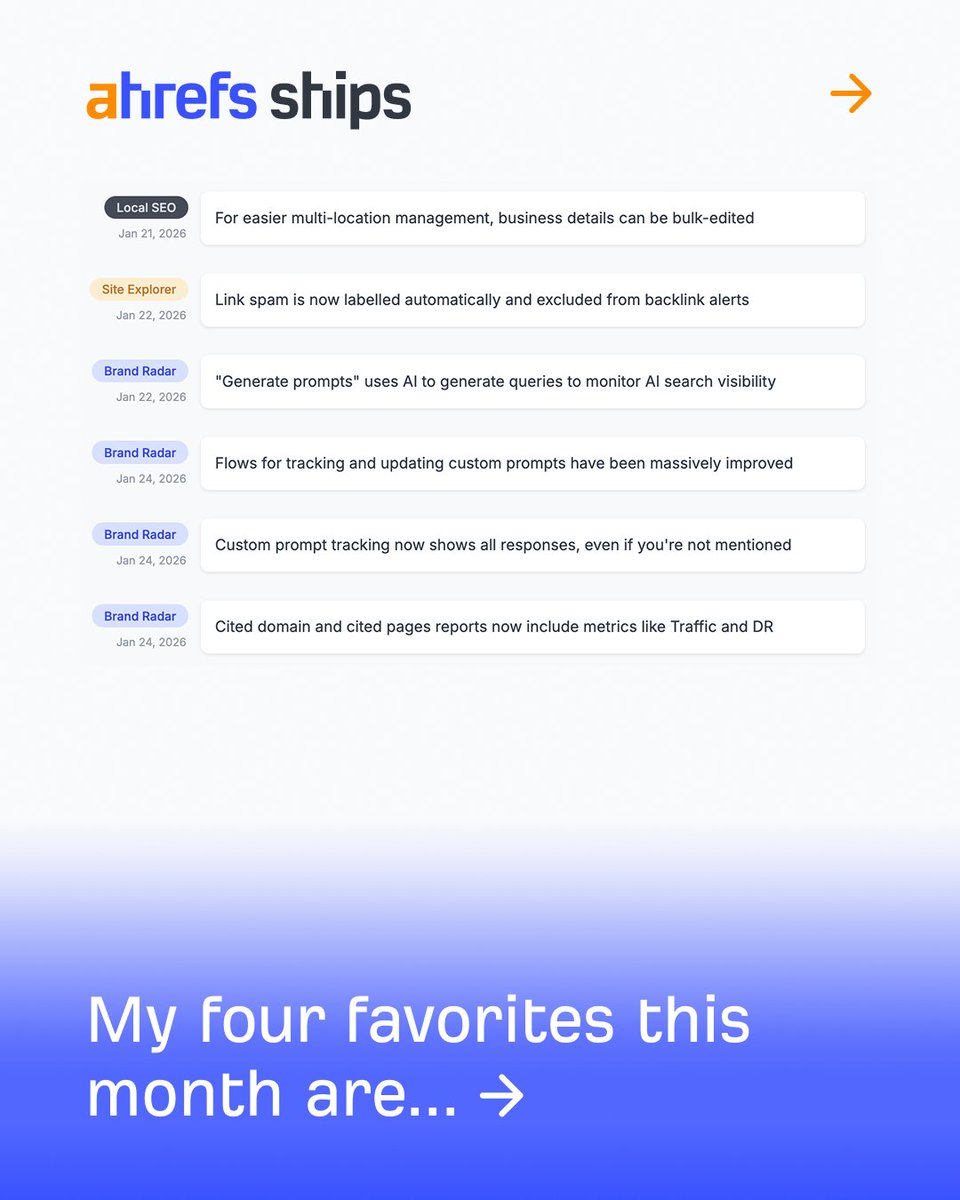
Since joining Ahrefs five months ago, I've documented 106 product updates.
Here are my favourite announcements from January…
(This looks a bit better on LinkedIn where there are additional images, so I've also included some commentary)
1. AI visibility reports now include traditional search metrics
Now, when you look up the top cited domains and pages for the prompts you care about, you'll see some familiar stats.
Site / page traffic, Domain Rating and URL Rating have been added first, with more on the way.
2. Historical ranking data for newly tracked keywords
If you add new keywords to Rank Tracker, you can import historical ranking data so your reporting no longer starts from scratch.
Optionally, you can also add years of ranking history to terms you're already monitoring.
3. The Social Media Manager tool has had some serious upgrades
There are almost too many to cover here, including the ability to leave the first comment on posts, improved performance charts and enabling multiple attachments per post.
It's currently free (including unlimited posts and channel connections) for all account levels.
4. Generate custom prompts to track your AI visibility
We take your brand, competitors and (optional) custom instructions to generate relevant prompts to monitor responses for.
You can still enter prompts manually, and use this new tool for inspiration on angles to tweak.
We'll soon ground prompt suggestions in keyword and website data to take this to the next level.
**
I bought my first Ahrefs subscription over 12 years ago, and it wasn't until I joined the company that I realized how often new updates go live.
That was the primary inspiration behind this new 'Ahrefs Ships' angle.
If seeing monthly product updates in this way is useful, please let me know and I'll keep these coming every month 🙌
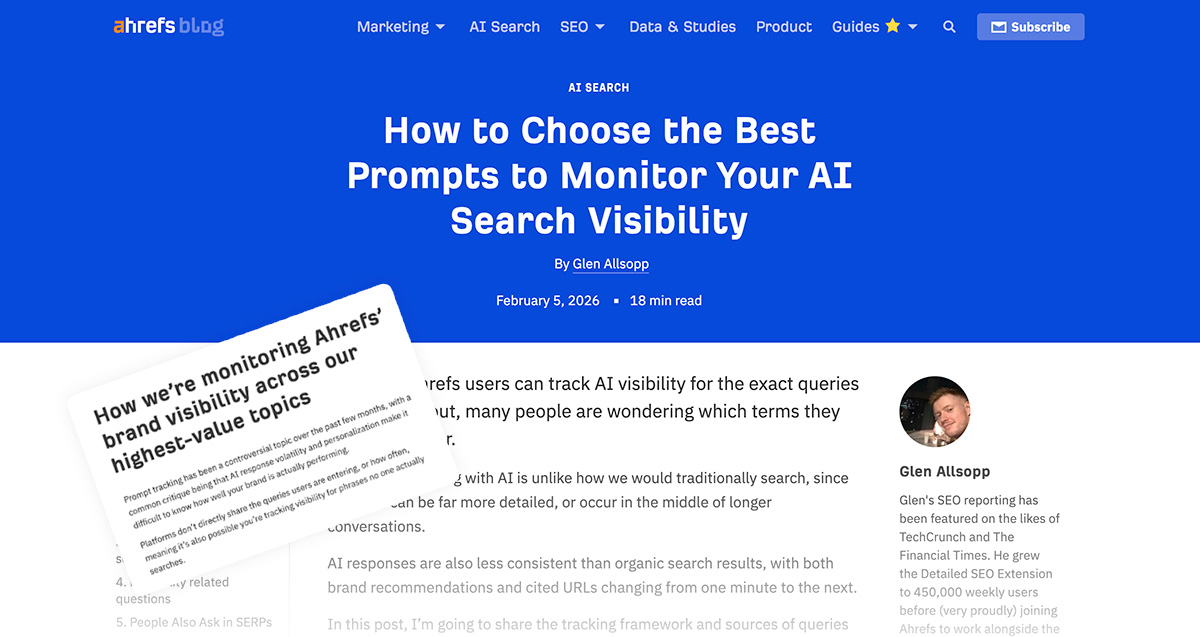
I'm back on the Ahrefs blog, sharing my thoughts on custom prompt tracking.
I like to think I've shared some practical ideas without overhyping the insights you can derive from it (or many prompts you should track).
This has understandably been a divisive topic in SEO over the past few months, which is something I generally avoid.
But, like I did with my listicles research, I spoke with people strongly for and against it, and combined that with my own experiences.
AI search responses are something I like to monitor myself, so thought I would share how I choose queries to track, and what I’m looking to get out of them.
I'm sure my thoughts will evolve here over time as interfaces change, data sources improve and models are updated, but here's where I'm at for now.
I hope you find it useful!
P.S. It's the latest post on the Ahrefs blog, and I'll also link to it in the comments below. Thank you! 🙏
I built a free tool to show how consistent AI responses are, live.
Asking the same question 500+ times, I recorded all commonalities.
Specifically, I looked at things like overall brand consistency, and how often brands appeared in the exact same order.
This project was entirely inspired by @randfish, whom I also credit on the page itself.
Rand encouraged people to share more data here, so I took that personally. 🙃
I've built countless AI response analysis tools over the past ~18 months, but loved the approach from his latest report.
I had a few more angles I wanted to look at, so I put them on a page that's being updated every hour.
This is the first version of the tool so forgive me if there are oddities or if I didn't explain anything properly.
I would love your suggestions for how to improve it going forward.
Link is in the comments below (and the graphic). No opt-in required etc. 🤝
I built a free keyword research tool via the Wikipedia API (updated for 2026).
If Wikipedia ranks for a term you care about, you can get an *idea* of how much traffic Google is sending their way.
Of course, there are lots of caveats to include here, like people finding those pages other than via Google, pages ranking for multiple terms, etc., but I've still had a lot of fun with this over the years.
Wikipedia appears to do a great job separating real users from bots, and I only share real user stats.
Technically, I'm using both the Wikimedia and Wikipedia APIs.
Unfortunately, my understanding is that the Wikimedia Analytics API will no longer be a thing in ~6 months, so I made some updates for 2026 while we can still play with it.
It's totally free, with no opt-in required.
Link is in the replies below (and the graphic).
If you have any feature suggestions please let me know. 🤝
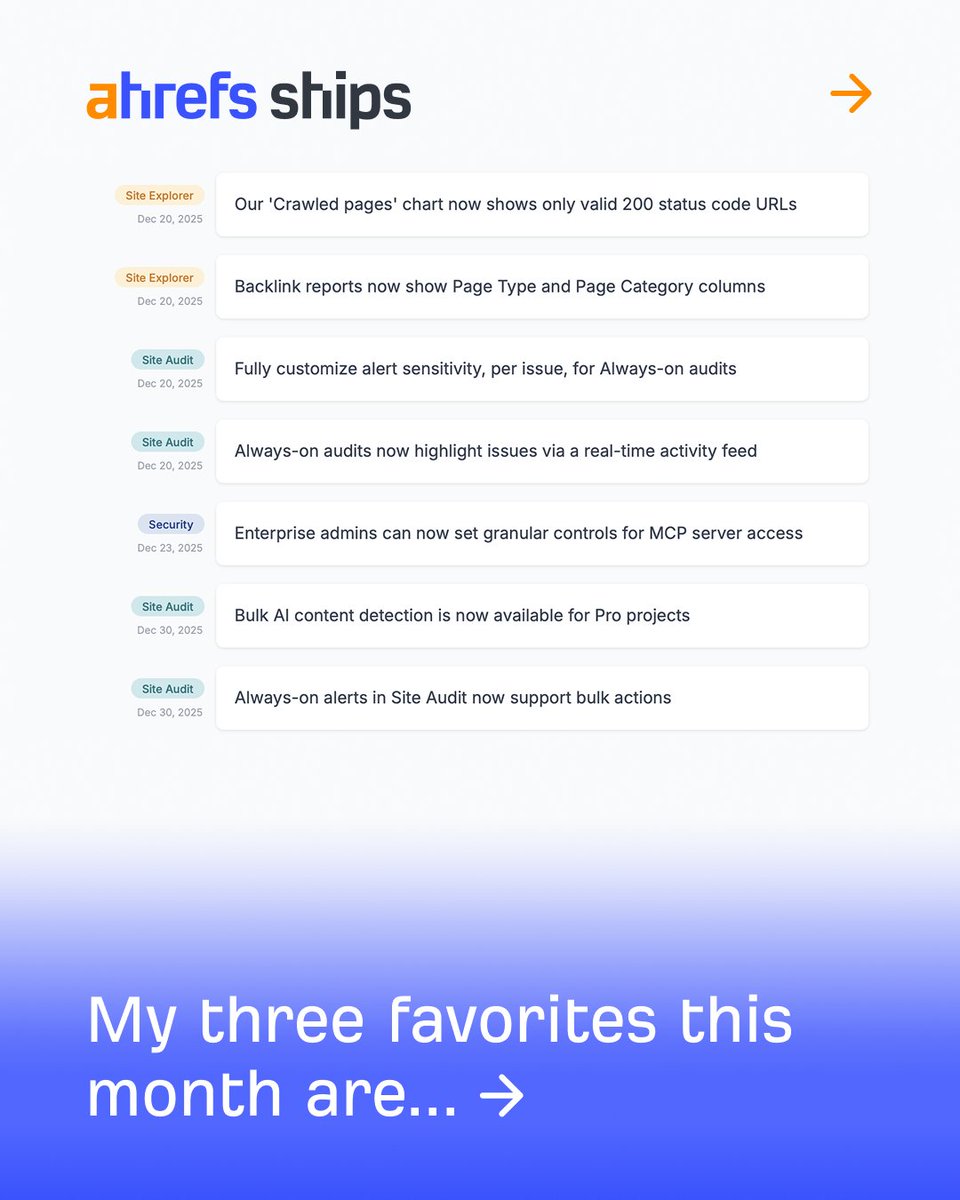
In the four months since joining Ahrefs, I've documented 83 product updates.
Here are three of my favourites from December.
Page #4 of the carousel (on LinkedIn) gives you a much better idea of what these features look like, but it's only fair that I write them out as well.
#1. Custom prompt tracking
Easily the most requested feature that I've seen.
While Brand Radar's dataset has been a huge success (it's Ahrefs' fastest-growing product), lots of people wanted to customize the queries we show responses for.
Choose the platforms, location & schedule you like, without needing a separate Brand Radar subscription.
We have some big plans here on the way, so stay tuned for those.
#2. Page and category types on backlink reports
Find the most niche-relevant links pointing to any site, and filter them across 100+ unique page types.
Page types also appear on any individual SERP overview.
We're currently classifying around 12M pages per hour.
#3. Keyword research goes global
Keywords Explorer now supports including (or excluding) the languages of your choice.
I'm "cheating" slightly in that English translations under each term were added in January, but I love that I can now see those as well.
**
I bought my first Ahrefs subscription over 12 years ago, and it wasn't until I joined the company that I realized how often new updates go live.
(I'm biased, of course, but I genuinely mean that).
You may have noticed I'm trying out a brand new style with this post. You've also probably guessed it was designed as a LI carousel so doesn't "work" as well here unfortunately.
If seeing monthly product updates in this way is useful, please let me know with a ‘Like’ or comment so I can convince Tim to let me do these every month 😬
Similarweb just released a report on the fastest-growing companies online.
Here's a list of some that stood out (and what I saw in Ahrefs).
It's my third year sharing these results, which look at average monthly unique visitors in 2025 vs 2024.
This year I took the top sites from the 🇺🇸 US, 🇬🇧 UK, and 🇦🇺 Australia and analyzed their organic search performance in Ahrefs.
166 sites (58%) grew search traffic year over year.
It's clear SEO is a big focus for a lot of them, but many have diversified traffic sources or prioritized growing with ads.
(Two are actually noindexed, including one in my graphic.)
The average search traffic increase was 67%. I didn't include Grok in that calculation, or it would have skewed the numbers too highly.
The average decrease was 29%.
Of course, neither Ahrefs nor Similarweb data will ever be perfect, but there's definitely a few I want to dive into further from a content & links perspective.
I have no affiliation with Similarweb and I don't do sponsored posts.
I just like sharing companies I find interesting. 🤝
I'll link to their full report in the replies.
Where did new users learn about Ahrefs in 2025?
Some insights from ~250K responses — a "small" subset of signups*
*I would love to build anything that gets 250K signups in a year, but the reality is most people share very specific sources, very broad sources (search, social, internet), or classics like "aslkdfjdasl;j" 😬
Google was the clear winner overall, which is also reflected in analytics data.
Reddit was the best channel for how many new users created a subscription over a free account.
Instagram was the "worst", but numbers are on the low end so don't read into that too much.
As a %, ChatGPT sent far more free account users than almost any other channel, but the overall numbers are significant.
There were more popular sources of new users, but I primarily wanted to see how specific channels stacked up against each other.
Total mentions of podcasts and blog posts (our own and others) would have been #4 and #5 on the chart.
Admittedly, this data source on its own isn't perfect:
- Self attribution can suffer from recency & recall bias
- Text fields can make it tough to account for every mention variation (e.g. Facebook, FB, Face book)
- Answers are often general — "social media" was more popular than Reddit
That said, it's nice to have other data points when a lot of traffic is misattributed, and nicer still when people mention specific blog posts, YouTube channels, groups, and events that inspired them to sign up.
I still have a lot of work to do on diving into those, but thought I would share what I've found so far. Hopefully it was interesting 🤝
P.S. I checked many more sources (Claude, Bing, etc.) but none were influential enough to make the chart.
The SEO ETF™ tracks companies generating revenue via search traffic*.
Here are the best and worst performing individual stocks for 2025…
📈 The biggest wins:
- Newegg (+540%)
- ThredUp (+359%)
- Opendoor (+276%)
- The Arena Group (+198%)
- Wayfair (+126%)
- Carvana (+107%)
- 1stDibs (+69%)
📉 The biggest losses:
- Torrid (-81%)
- TechTarget (-72%)
- Lulus (-69%)
- Bark (-67%)
- TravelZoo (-64%)
- Sprout Social (-63%)
- Rackspace (-56%)
$100,000 invested into the ETF at the start of 2025 would have returned $112,287 by December 31st (last week).
If you're new to these updates, the numbers are real, but this is just for fun and no such ETF exists.
*Some of the companies have very little reliance on Google, while others have had much more, such as Chegg.
I primarily use this data just to check in on some companies I don't follow too closely. It's a different view on the market, covering lots of digital-first brands.
(The SEO ETF was crushing it in August, which was interesting to dive into).
As always, nothing here is financial advice. Always do your own research before investing.
If there's any interest, I'll put a page on Detailed so you pick the stocks you want to chart yourself, with a little information about each. 🤝
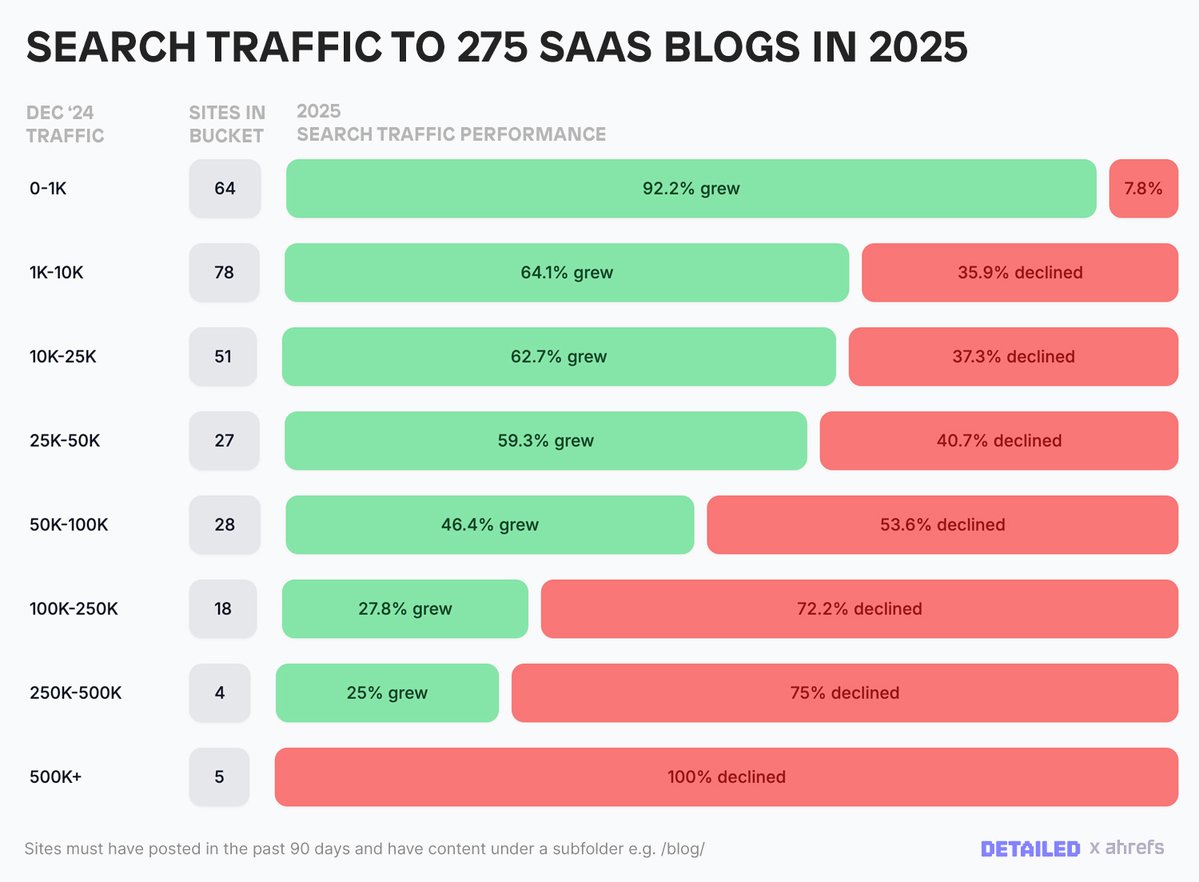
I looked at 275 SaaS blogs to see how their search traffic fared in 2025.
Surprisingly, 176 (64%) saw estimated visitor numbers increase.
I'm always trying to learn from sites that are performing well in Google, so I conducted this research to find more content-focused success stories.
It's really nice to see so many sites growing, though I should add a caveat.
Some blogs in lower traffic buckets that saw growth were either fairly new or the byproduct of redirects (blog URL changes, acquisitions, etc.).
Redirects were also in place for some that *lost* traffic, but it's definitely easier to grow when you weren't performing so well previously. This analysis isn't perfect, and is working with estimates.
Winners gained an average of 15,252 visitors, while "losers" saw an average loss of 69,270 visitors.
More than half of blogs previously getting 25K-50K visitors from search saw growth throughout the year.
A few blogs grew by over 200,000 monthly visitors. A couple also lost 1M+.
There's much more I could analyze (like publishing frequency & how many articles contributed to growth), but this is hopefully still an interesting overview.
Whether or not you're an Ahrefs user, I recommend performing this same analysis across your own industry (or similar site types) to identify who saw significant gains in 2025.
From there I would dive into things like the links they acquired, their top performing-pages, and so on.
Thanks to this research I realized one site in an industry I care about has acquired (and redirected) quite a few more sites than I knew about.
This is probably my last post here for 2025 so let me say a massive Thank You to everyone I've connected with this year.
Looking forward to sharing and learning a lot more in 2026.
Cheers!
Here's how many top-cited domains get *zero* traffic from Google.
A few notes from my research, and one question if you don't mind.
1. Ranking in Google doesn't define whether a website is valuable. That said, all but ~10 of these sites are highly questionable.
2. Copilot actually had more top sites in common with Perplexity than ChatGPT. Perplexity just does an arguably better job of surfacing higher-quality domains.
3. Only a third of the zero-G-traffic sites surfaced by ChatGPT & Copilot were the same.
4. It should be no surprise that Google's AI ventures reward sites performing well in traditional search. Still, I think it's cool to see that on a chart.
The question: I'm thinking about doing a deep dive here (without "outing" anyone) and would love to know if that's something you would read...
...or did I cover enough with a chart already? 😬
I have a few more notes I would like to expand upon.
The obvious explanation is that the sites ChatGPT & Copilot surface are performing well in Bing, but after looking at the domains (and Bing), I think there's a bit more to it.
Any thoughts would be appreciated.
P.S. It’s admittedly possible the zero traffic domains rank for something, but unlikely for anything notable.
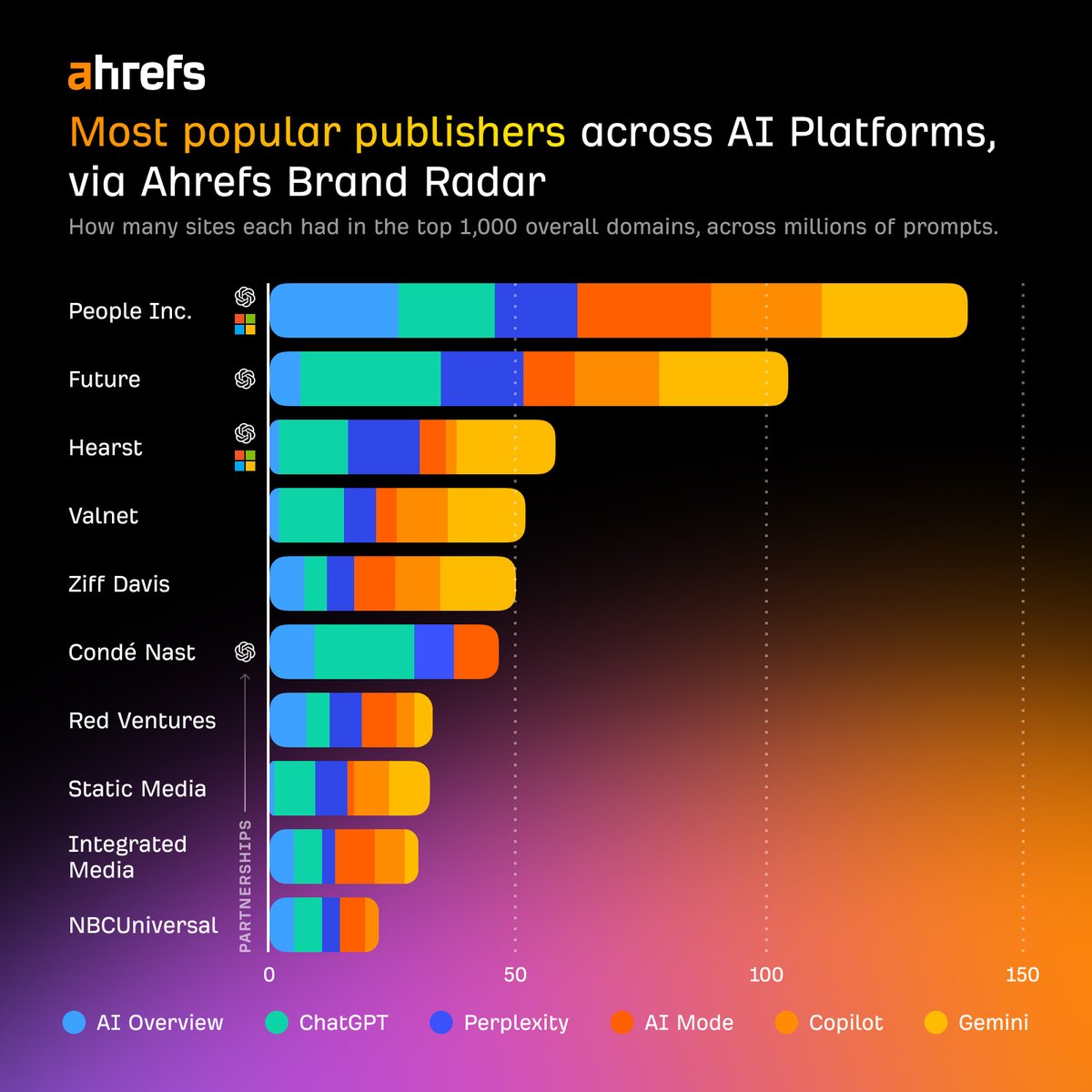
These are the publishers currently dominating AI search.
A few things stood out to me when putting this chart together.
1. Condé Nast performs much better in ChatGPT than other platforms.
(They didn't show up at all in Copilot or Gemini's top domains.)
On the surface it seems like striking a deal with OpenAI significantly helped, but perhaps not, as Valnet didn't seem to need one.
2. These ten publishers were most prominent in Gemini (123 of the top 1,000 domains), followed by ChatGPT (117 of the top 1,000 domains).
3. Ziff Davis' ChatGPT visibility is much lower than the brands they're surrounded by.
Then again, they're suing OpenAI, and also blocking their bots in different ways across various sites.
4. Some companies that just missed the cut include News Corp, Internet Brands, The Arena Group, and Axel Springer.
5. People Inc. (formerly Dotdash Meredith) is clearly the most prominent publisher overall.
I actually track more sites for some other brands, so it's not just about their scale.
**
If you've followed me for a while, you've probably seen me cover many of these companies before, sharing how they dominate Google's traditional search results.
Outside of any deals you can strike up and possible new advertising partnerships, you have to imagine there's significantly less value in dominating AI search.
Please let me know if this is interesting and I'll see if I can get the green light to make it a monthly update. 🙏
P.S. I added partnership icons to hopefully make the chart more insightful. That said, I should make it clear I don't know exactly what each of these entail outside of news reports covering them.
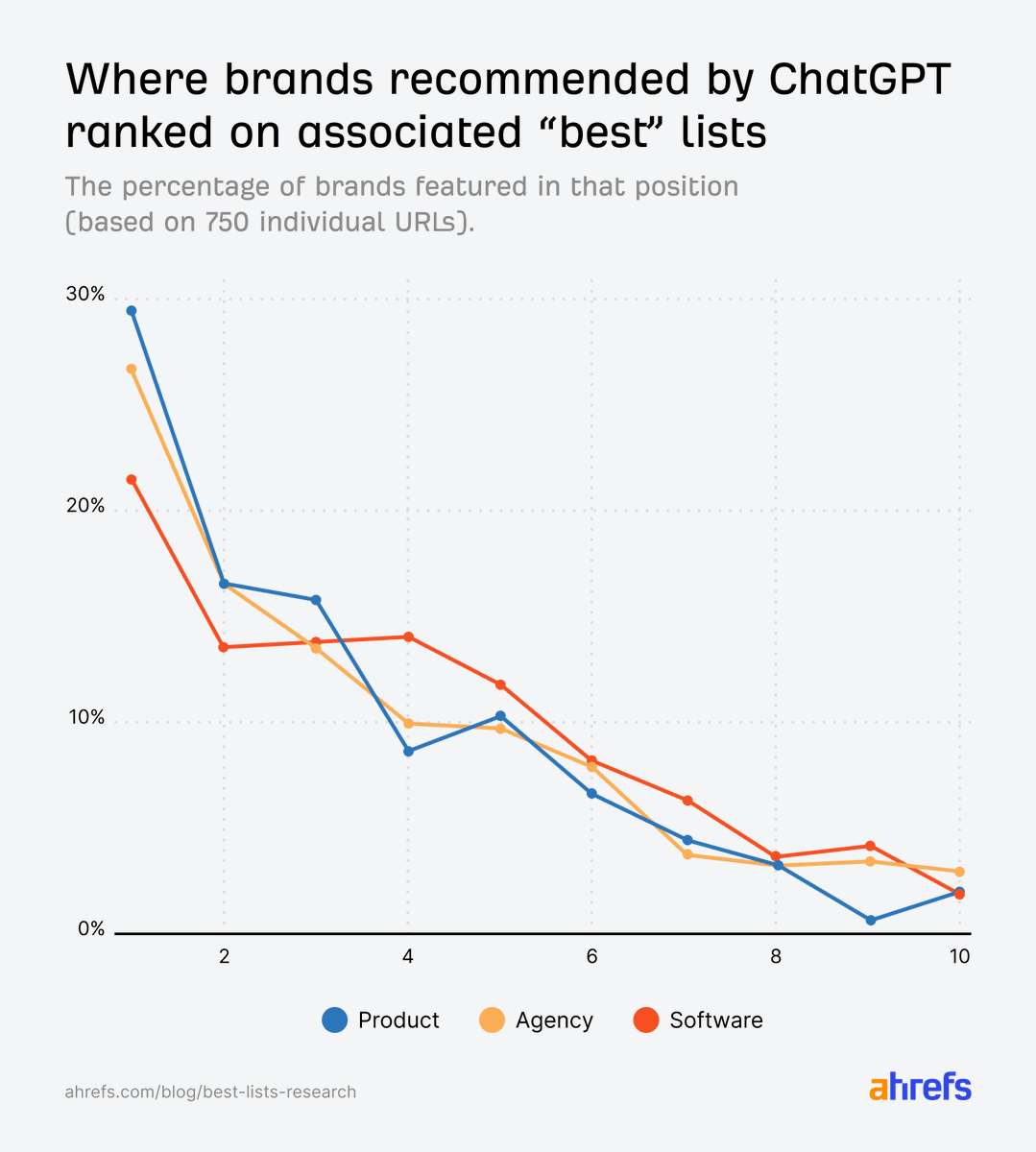
Can self-promotional "best" lists actually boost visibility in ChatGPT? 🥇
They let me back on the Ahrefs blog to try and find out, and share one change we're going to be making.
After dozens of hours categorizing brand rankings and page types, I finally have some of the answers I was looking for.
(And more questions I would love to tackle in v2 if there's enough interest).
There might be a link to check out in the comments.
Thank you! 🙏
It's time I shared one of my favourite keyword & link research tactics.
I genuinely do this every month. Skip to 2m 33s for the details 🤝
(I would love for you to watch the whole thing, but giving a timestamp is only fair).
If you've never seen the Ahrefs MCP server in action, I've also included some other use cases you'll hopefully find valuable.
Outside of private training I'm not usually one for sharing videos, so please let me know if you find this useful.
I'll happily do more :)
Thank you!