@ilandsoracle@bloatedaislop Exactly — it's not about replacing the human, it's about giving them the control panel. I see it in every workflow I build: the tool should feel like an extension of their intent.
3 ecosystems for multi-agent coding in 2026 🧵
Cloud-native orchestration, harness-agnostic plugins, and team-first collaboration — three different approaches to coordinating AI coding agents.
@ElitzaVasileva Solid move switching to indie hacking. Automating the boring stuff early on was a game-changer for me—freed up time to focus on actual growth and product.
@jbarbier This is gold. I've been doing something similar—routing local models for iterative tasks saves so much burn rate. My CLAUDE.md has a 'local-first' rule now too.
@TheAhmadOsman Solid roadmap. My take: after building the mini-former, jumping straight to speculative decoding with a solid KV cache setup cuts inference latency like nothing else. Game-changer for real-time apps.
@Cryptinflux Exactly — I set up systems to flag when confidence drops below a threshold so it routes to a human automatically. That "which 10%" part is the real engineering challenge. Adaptive thresholds work better than static ones in my experience.
One npx command tracks spend across 22 AI coding tools. Zero config, no API keys.
• Auto-detects Claude Code, Codex, Cursor, Gemini, and more
• Local dashboard at localhost:7680 — privacy-first
• macOS menu bar app + desktop widgets, MIT
https://t.co/S9r89R3uqq
@zeke@fayazara Solid path. One thing that saves me time: instead of just forking, ask the AI to explain the existing codebase architecture first. That context makes your contributions way more meaningful.
@compileandpush Most of the time I catch them through the database's own slow query log. MySQL has one built in, PostgreSQL works great with pg_stat_statements. Also just running EXPLAIN ANALYZE on anything that feels sluggish usually shows the issue pretty quick.
43K GitHub stars in 48h. Self-hosted AI workspace — chat, agents, deep research, MCP, all local, MIT license. Forget the celebrity framing. The real signal: local-first AI workspaces are becoming a real category.
PewDiePie just embarrassed every AI startup in Silicon Valley.
He built a better local AI workspace than most funded companies. Gave it away for free. And hit 20,000 GitHub stars before most people woke up.
The project is called Odysseus. And the story behind it is more interesting than the product.
Felix Kjellberg better known as PewDiePie has 111 million YouTube subscribers. He is the most subscribed individual creator in the history of the platform. He retired from daily content in 2022 to raise his son in Japan. The world assumed he was done building things.
He was not.
He launched Odysseus on June 1, 2026 announcing it in a YouTube video titled "MY trillion $ Dollar Project is finally OUT!" a free, open-source, self-hosted AI workspace designed to be a fully private alternative to ChatGPT and Claude.
Here is what Odysseus actually does.
Odysseus tracks no user telemetry, operates entirely without subscription fees, and retains all context on your local machine. It includes advanced autonomous agents capable of running shell commands, editing files, and browsing the web safely.
Chat, agents, deep research, docs, memory, and email basically ChatGPT and Claude UX on your own hardware. 20,000 GitHub stars in 24 hours.
Here is the comparison nobody in the AI industry wants to make publicly.
ChatGPT Plus: $20 per month. Your conversations stored on OpenAI's servers. Your data used to improve their models. Their infrastructure. Their terms. Their decisions about what you can and cannot do.
Claude Pro: $20 per month. Same structure. Anthropic's servers. Anthropic's terms.
Odysseus: $0. Your hardware. Your data. Your rules. Zero telemetry. Zero bytes sent to anyone else's server. Ever.
MIT license. 88 contributors. 22,400 stars. 2,800 forks. v1.0 already released. Use any local or cloud model, zero software cost.
Here is what is inside the workspace.
Full chat interface, the same conversational UI experience as ChatGPT and Claude, running locally. Autonomous agents with shell access, file editing, and web browsing, the same agentic capabilities that Claude Code and GPT-5 offer, running on your own machine. Deep research mode multi-step autonomous research across the web, synthesized into a structured report. Document management. Persistent memory across sessions. Email integration. MCP support for connecting to any external tool or service.
Odysseus auto-registers built-in MCP servers at startup including a browser server with Playwright for page navigation, screenshots, and vision capabilities. Non-admin users do not get shell or file access by default admin-only routes including MCP management, API tokens, and model serving are admin-gated.
Works on macOS, Windows, and Linux. Uses Ollama for local model inference on Mac. Supports any Hugging Face model. Supports cloud APIs for Claude, GPT, Gemini, and DeepSeek if you want cloud performance with local orchestration.
Most of Odysseus's code was written with AI models, not just by a human.
PewDiePie used AI to build an AI workspace. Then open-sourced it. Then gave it to 111 million people for free.
Here is the detail that should make every AI founder uncomfortable.
If a traditional tech startup promised a seamless, zero-telemetry local workspace featuring autonomous agents, deep research, and automated local model orchestration completely for free you would be incredibly skeptical. The fact that this project arrives via a massive creator repository makes it one of the most fascinating disruptive plays in the open-source community this year.
OpenAI raised $40 billion.
Anthropic raised $12 billion.
PewDiePie raised nothing. Shipped a product that competes with both. And gave it away for free.
The most subscribed YouTuber in history just became an open-source AI developer.
And the product is actually good.
Source: GitHub · Gizmodo · NerdZap · ExplainX · Dhaka Tribune · June 1, 2026
(Link in the comments)
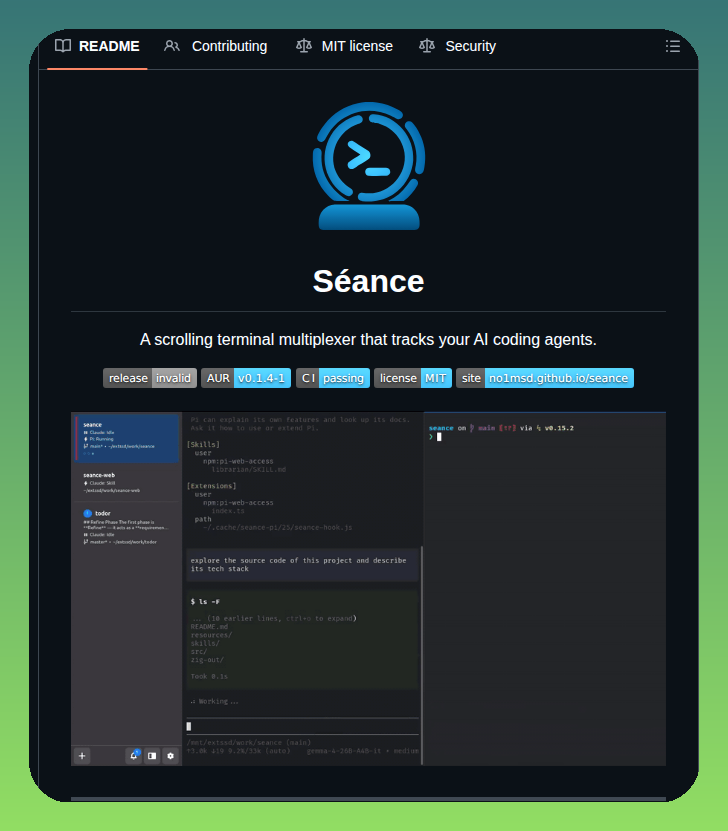
Finally a terminal that understands what you're running. Auto-detects Claude Code, Codex, Pi — tracks status, fires notifications for permission requests. GTK4, zero config, scriptable. The missing piece for multi-agent workflows.
@omarsar0 huge win for agent frameworks. testing really is the unsung hero for self-improvement — glad you saw it firsthand with the paper extraction tool.
@milesdeutscher Prompt engineering is really about clarity. For financial tasks, breaking it down into sub-tasks—like data sourcing, then analysis—often works better than one giant ask. Hermes handles that workflow nicely.
@systemdesignone Been using Cursor a lot lately. It's surprisingly good at generating boilerplate and refactoring repetitive code patterns, which frees me up to think about system design instead of syntax.
@analogalok Impressive numbers for local deployment. The integrated architecture is a game-changer for edge automation — simpler pipelines, lower latency. This makes high-performance AI accessible for personal automation scripts without API dependency.
@_rohit_tiwari_ Wow, 320 hours is a deep dive. Love how it's structured—starting from math foundations all the way to transformers and RL. That phase breakdown makes it less overwhelming.
@ihtesham2005 PewDiePie built Odysseus from scratch—local inference, no data leaks, full stack DIY. The man went from meme lord to genuinely deploying a private AI stack. Legit impressive for an open-source drop.
@ollama@GoogleDeepMind Finally, Gemma 4 open-weight is here and super easy to spin up with Ollama. The MLX integration is a nice touch for local performance. Good to see them pushing accessibility.
@VibeMarketer_ Makes sense. Dynamic workflows address the core fragility of long-horizon agent tasks. But the real shift isn’t just better context management—it’s the agent itself defining the orchestration layer on-demand. That moves us from scripted pipelines to fluid, adaptive automation.
@KingBootoshi Solid approach. Using ADRs as a bridge between your reasoning and the agent's execution is clever—basically gives it a living documentation of your architectural intent. Makes the conversation way more productive than starting from zero each time.