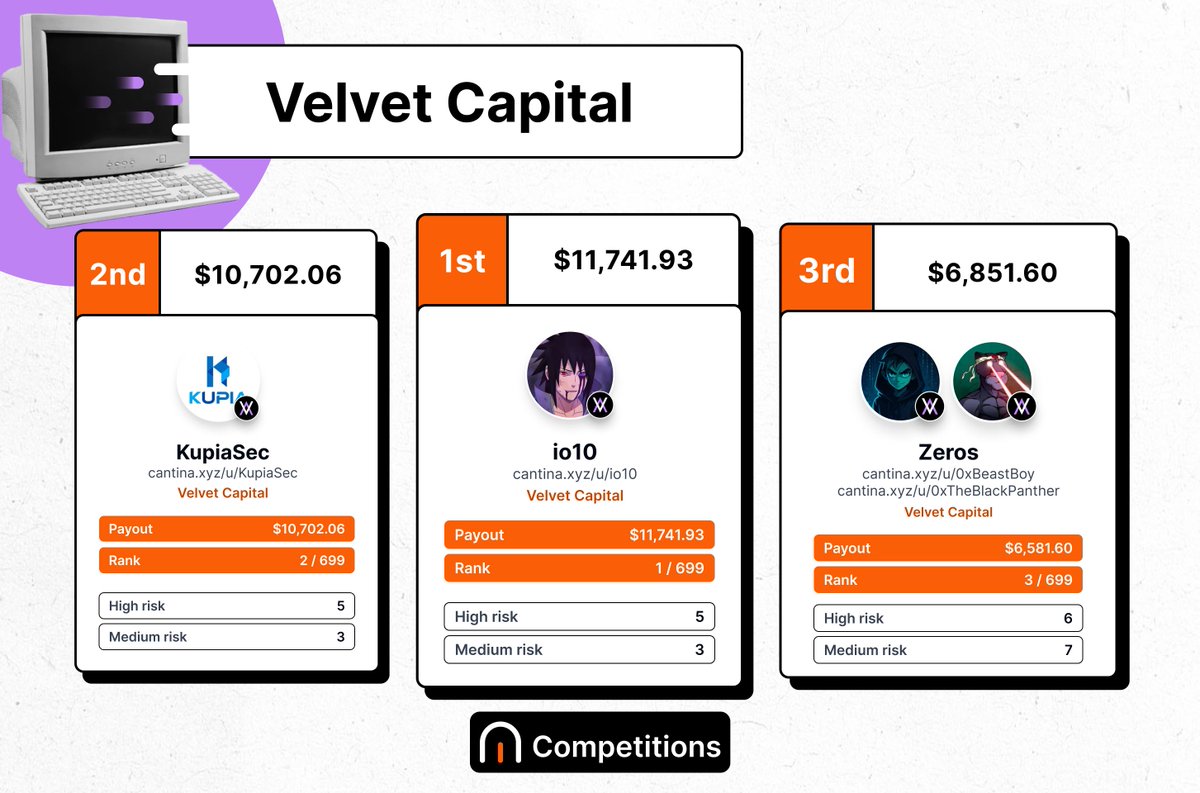
My 1st 🥇. Thank God for this win. Also huge thanks to the velvet team and @cantinaxyz for the opportunity. I’m really happy with this and this one in particular means a lot and signals I’m on the right track. Long live contests 💕
Another leaderboard locked in: Final results from the @Velvet_Capital competition are confirmed. 🪐
🥇 io10: $11,741.93
🥈 @KupiaSecurity: $10,702.06
🥉 Zeros (0xBeastBoy & @thepantherplus): $6,851.60
Thanks to all 699 participants that contributed. Full breakdown below.
I am currently in a similar scenario but I tend to limit my AI dependence to certain scenarios for example, when learning, I try to grasp every concept by myself first and go as deep as I can.
Once I truly feel I have exhausted my capacity on a certain problem, I try to structure my thoughts into detailed notes and dive deeper into those to spot any gaps.
Once this is done, I plug the input into an LLM to get a different view on my summary and potentially where my understanding may have been incorrect. Then I find where the gaps in my notes where and plug them and more importantly, understand why the gaps occurred in the first place. This is more time consuming but there is no substitute for being able to understand problems quickly and developing my own process. The quicker and more efficiently I can do this, the less dependence on AI is required as a from time to time, the LLM will hallucinate so I don’t tend to trust it completely either. I treat it as a more of an enhancement tool
@ammalgam What does oracle free even look like ? Unless you are referring to centralized oracles , I can’t see a way any system works without its internal oracles and some sort of backup oracles which is the argument for a more centralised one
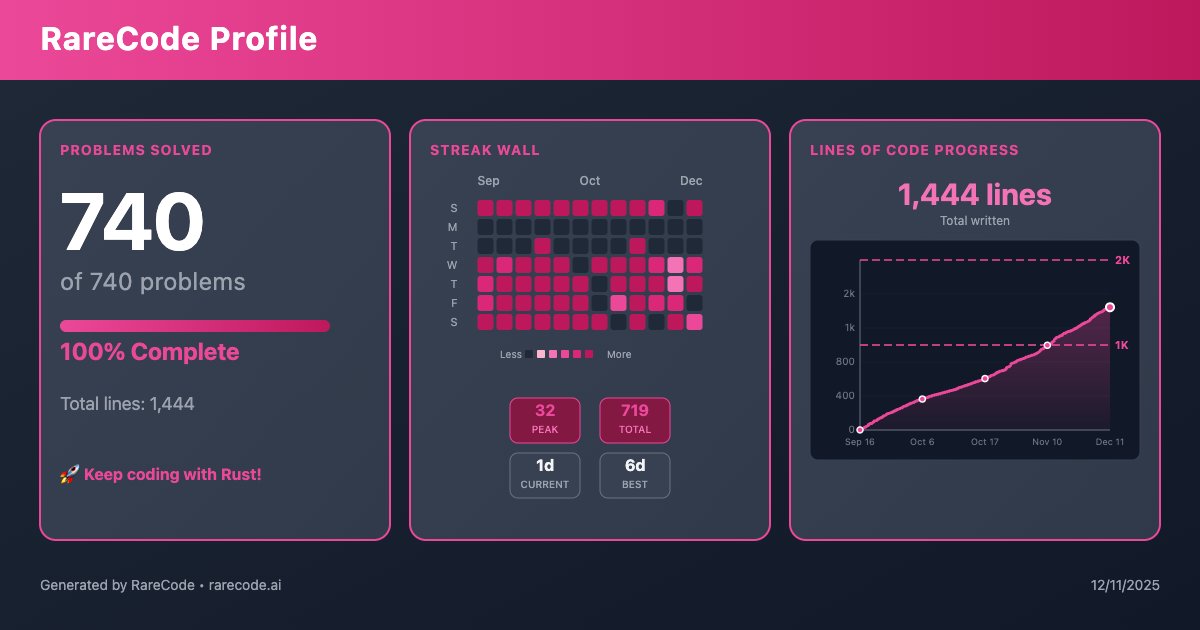
By far the smoothest programming language learning experience i have ever had. Looking forward to more lessons. I will definitely be renewing. Thank you @RareCodeAI@Jeyffre
@Jeyffre I’m using rare code as well to get rust proficient and it’s already helped me write a few scripts for some work I was doing. Can’t wait to finish it and start looking at implementations and trying to recreate. The more rust the better
Seeing news on this balancer hacks make me upset . All SR’s and white hats need to keep improving so shit like this becomes rarer.
I feel like the space has definitely evolved and is improving but it’s still not fast enough
Love being busy and learning new things but I do miss competing . Need to solidify some core learning and improve some skills which should free up some time soon ✨
I’m starting to enjoy learning different languages simultaneously. It really helps to connect the dots. The fundamentals are mostly similar besides a few nuances but there’s still a lot to learn and I’m looking forward to all of it !
EIP-5095: Principal / Yield Tokens
Most experienced SR's already know about principal/yield tokens but my first time coming across this took some time to get my head around so i decided to read the related EIP and i will be discussing main points to note from the EIP over the next few posts.
You can read more about ERC-5095 at: https://t.co/XQ7BHYPVp6
"The primary examples include yield tokenization platforms which strip future yield leaving a principal token behind, as well as fixed-rate money-markets which utilize principal tokens as a medium to lend/borrow."
Lets go over what 'stripping future yield' means:
When you deposit a yield-bearing asset (e.g. stETH), it naturally earns yield over time. Yield tokenization splits that asset into two separate tokens:
Principal Token – Represents the initial value of your deposit.
Yield Token – Represents the right to the future yield that will accumulate
This separation allows both parts to be traded or used independently.
Example in DeFi: Let’s say you deposit 1000 USDC into a fixed-rate lending protocol for 1 year at 5% APY.
Instead of holding the yield-bearing asset as a single token, the protocol mints:
1000 pUSDC → Principal Token (redeemable for 1000 USDC in 1 year) yUSDC → Yield Token (entitles the holder to the 5% yield over the year)
Now: You can sell the yield to someone else right now (e.g., yUSDC) Or sell the principal and hold the yield or use either in DeFi — e.g., to borrow/lend separately.
watch out for unbounded parameters (arrays) in functions with no access control. Worst case, DOS finding that is relatively easy to spot , best case (for whitehat lol), opens a rabbit hole that can lead to a deeper vulnerability