Now for a quick intro,
I'm Steve
🛠️ I'm Currently Building Projects with Javascript
I Tweet About:
→ Web Development
→ My Learning Journey
→ HTML & CSS & JavaScript
Introduce yourself👇, let's connect
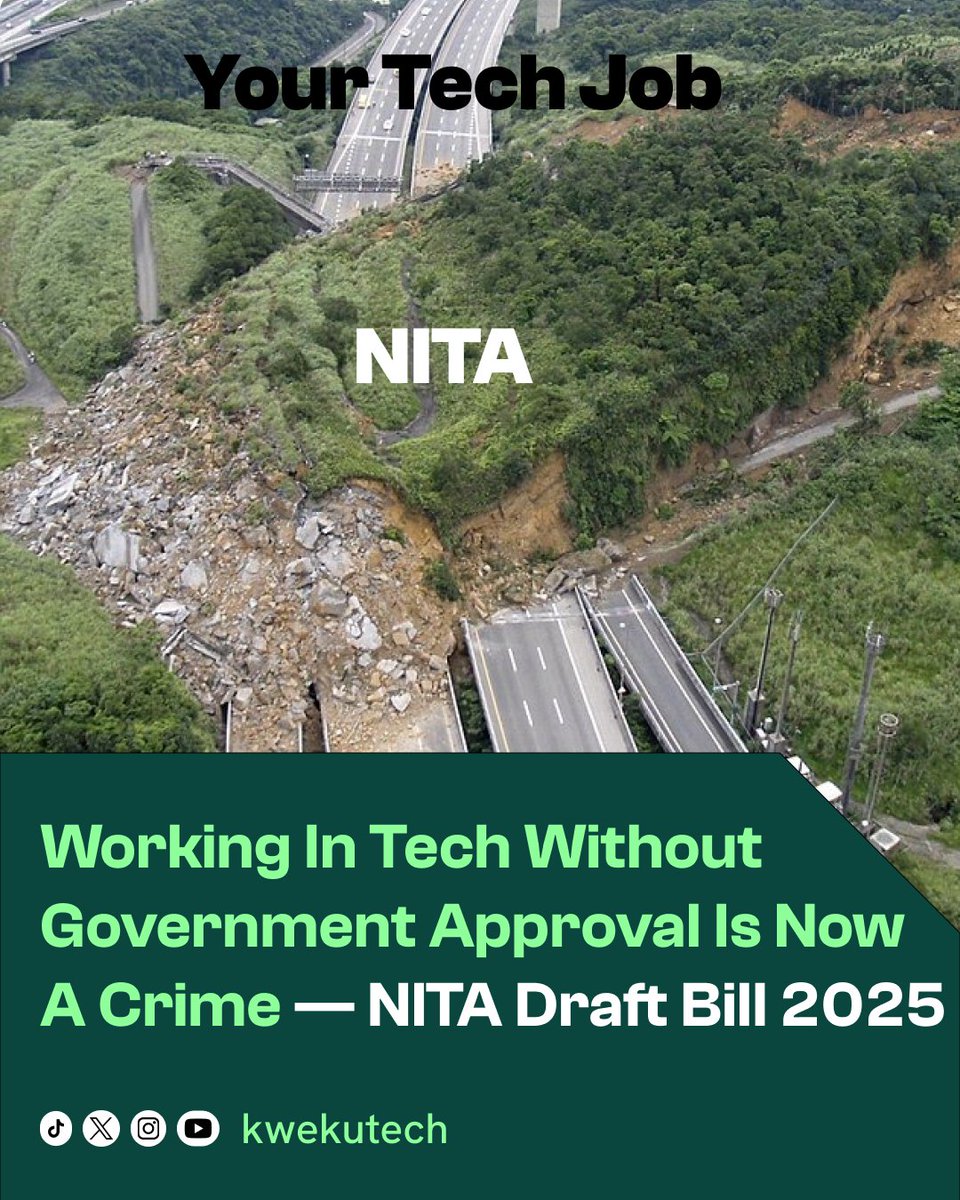
The NITA Bill 2025 mandates EVERY IT worker in Ghana licensed before they can work, even in private companies.
It also:
- taxes IT companies on revenue (not profit)
- jails unlicensed tech founders for up to 10 YEARS
- restricts IT licences to companies wholly owned by Ghanaians, potentially driving away foreign investment to other African countries like Rwanda & Kenya.
- The Bill does many other awful and archaic things
This may be the biggest anti-tech bill Ghana has seen in years.
#StopTheNITABill
I barely do this but I beg any Ghanaian to read the following write up by Chris-Vincent Agyapong. Bookmark, share etc cos wtf 😳
1/4
“Ghana's NITA Bill 2025: How a Government That Cannot Fix Potholes Wants to Certify Your Keyboard Strokes
There is a particular brand of Ghanaian governance that operates on a simple, well-rehearsed logic: identify the one sector in which ordinary young people, without connections, without family money, without a politician uncle are actually building something for themselves, and then erect a magnificent bureaucratic tollbooth right in the middle of it.
The National Information Technology Authority Bill, 2025 currently making its way through Ghana's legislative machinery with the quiet confidence of a document probably written by a majority of people who have never debugged a line of code in their lives is precisely that tollbooth. It is, in its 105 sections and accompanying Schedule, one of the most breathtaking exercises in regulatory overreach this country has produced in recent memory. And given our regulatory track record, that is genuinely saying something.
The ICT sector is the one industry where a boy from Ashaiman, or, like my friend from Pulima, Aliu Wahab, with a second-hand laptop and a YouTube tutorial, can compete with someone whose father went to Achimota. It is the one space where talent, not tribe; skill, not surname; output, not old-boy network, still carries meaningful weight. It is, bluntly, the only functioning meritocracy left in Ghana's economic life.
And our government, with the NITA Bill 2025 has decided that this is precisely the sector that requires the most elaborate regulatory architecture since the tale of Moses coming down from Sinai with the Ten Commandments.
The Absurdity of Section 46: Certifying Everyone, Everywhere, Always
Let us begin with what is, without competition, the most extraordinary provision in this bill. Section 46(1) states, in plain and unambiguous terms:
"A person shall not be appointed as an ICT professional in a public or private institution unless that person is certified by the Authority."
Read that again. Public or private.
This is not a provision that limits itself to government systems handling national security data. This is not a narrow carve-out for critical infrastructure. This is a provision that means the software developer at a startup in Osu, the data analyst at a logistics firm in Tema, the web designer freelancing from her bedroom in Kumasi, all of them, every single one must first obtain certification from a government authority before they can lawfully be employed.
Who dreamed this up? Under what theory of governance does it make sense for the government of Ghana which cannot consistently process a DVLA licence within six months, which spent years and hundreds of millions on a national identification system that still cannot talk to the health insurance database to position itself as the certifying gatekeeper for an entire profession across the entire economy?
And here is the delicious irony that the framers of this bill seem constitutionally incapable of perceiving: the government's own ICT record is the single most compelling argument against giving it certification authority over anyone. You do not hand the keys of the wine cellar to the person who has been drinking the wine.
Politicians: The One Profession That Needs Certification Most, and Gets It Least
Since we are on the subject of certification, let us pause to consider who in this country is not required to demonstrate any competence whatsoever before being handed consequential power over millions of lives.
Continued below
Thank you for this response.
However, we need to clarify that this does not address the claims being made.
Most of these questions are not anything we've heard said, possible that someone made them, but non of the overwhelming pushback concerns have been addressed.
Chief amongst them
1. Mandatory licensing of ICT business and professionals especially in the private sector.
2. 1% tax. Yes it's a tax on ICT business revenues.
3. Draconian punishments for breaches which include huge financial penalties and long terms.
We're happy to engage further if you're willing to join a space to discuss.
Dear @NITAGhana
The questions and answers provided in your response comes off a bit as a deflection of the main concerns.
Below are our concerns and would be very beneficial if answers can be provided. A twitter space won’t be a bad idea for digital natives 😊.
1️⃣ Article 46 states that no person shall be appointed as an Information and Communications Technology professional in a public or private institution unless certified by the Authority.
What specific national problem is this provision trying to solve that existing university degrees, industry certifications, and employer hiring standards have failed to solve?
2️⃣ Under Article 46, why should a private startup hiring a software engineer require state certification before employment?
Does NITA believe private companies are incapable of assessing technical competence on their own?
3️⃣ If a globally recognized engineer from companies like Google, Microsoft, or Amazon relocates to Ghana, would they legally be unable to work until certified by NITA?
4️⃣ Article 46 gives NITA power to determine the criteria and procedure for certification.
Why does the Bill not define the minimum criteria directly in the legislation itself, considering the broad powers being granted?
5️⃣ Can NITA point to any major digital economy such as Germany, United States, United Kingdom, Singapore etc. where all Information and Communications Technology professionals in both private and public sectors require mandatory government certification before employment?
6️⃣ The Bill appears to centralize approval authority within NITA.
How does NITA plan to avoid creating a bottleneck where innovation moves at the speed of regulatory approval rather than the speed of technology?
7️⃣ If a university student builds a small application, an artificial intelligence model, or an e-commerce website from their bedroom, at what point do they become subject to certification or regulatory approval under this Bill?
8️⃣ The Bill introduces penalties including fines and possible imprisonment for non-compliance.
Why was a punitive approach chosen for a sector historically driven by openness, experimentation, and low barriers to entry?
9️⃣. Does NITA see software engineering as equivalent to professions like medicine or law where licensing protects life and safety?
If so, which categories of Information and Communications Technology work does NITA consider dangerous enough to justify state licensing?
🔟 Could Article 46 unintentionally encourage companies to relocate talent, outsource development abroad, or avoid hiring locally certified professionals due to compliance uncertainty?
Has NITA conducted an economic impact assessment on innovation, startup growth, foreign investment, and youth employment?
we just crossed 1,000+ signatures.
to the accounts who picked this up and ran with it thank you. you didn't have to. you did anyway.
to everyone who signed and shared you are the reason this is happening.
@koboateng@kwekutech@TheDumbTechGuy
🔗 https://t.co/ntduCSrMRs
tech is the only professional field where a 19-year-old in kumasi can teach herself to code, build a product, find a client in berlin, and earn in dollars. no certificate from anyone.
that self-determination is not a gap in the system. it is the system. it is why ghana has a tech ecosystem at all.
when government certification becomes a prerequisite to work, two things happen:
brain drain accelerates.
meta just cut 8,000 jobs globally and moved 7,000 more into AI workflows. african developers are being positioned to absorb global opportunity right now. a licensing barrier at home does not raise standards. it raises the cost of staying.
self-employment dies at the root.
the freelancer, the solo founder, the developer building on weekends are not collateral damage. they are the pipeline. requiring certification before anyone can hire them attacks the entry point of the entire ecosystem.
@NITAGhana what problem is this actually solving?
We're trying to get airtime to discuss the approach NITA is trying to use to heavily regulate tech professionals.
As a short brief.
Tech is what it is because individuals can simply learn and become employable or even self employ themselves without any extra pain.
This is the second proposal since last year, this time NITA is proposing penalizing any private or public institution that hires tech folk who are not certified by them.
This completely goes against the ethos of the industry and will lead to a lot of problems.
See the attached graphic. https://t.co/O6FNw4dWPW