It’s sooo refreshing to see @RaviTeja_offl sir in #Irumudi! As authentic as ever!! 🤗🤗Looking forward and wishing all the very best to #ShivaNirvana and the entire team!!
నా ప్రాణం అడ్డుపెట్టైనా ..నా ఫ్యామిలీ కి ఏమి కాకుండా చూస్కుంటా 💥💥💥
#MiBTrailer out now!
▶️ https://t.co/4m4av3OXw6
MASS FAMILY ENTERTAINER WITH A FRESH TWIST 🔥
#MaaIntiBangaaram in cinemas worldwide June 19th, 2026.
Writing, storytelling and filmmaking is a LIFESTYLE we choose..just not a JOB!! Thought I knew this dude @sumank well enough as a friend/colleague but it’s not even 1% of what I could discover here! Loved this candid and insightful interaction with @amitvarma 👉https://t.co/E9PG0VgmLy
Many many happy returns of the day to my very dear @tarak9999 and what a way to celebrate this one!! 🙌 🙌 You and #PrashanthNeel and the entire #Dragon team hit the first ball out of the park!! 👏👏 Thanks for inviting me to be a small part of this journey!! 🤗🤗
The Trump phenomenon:
why did half of America believe a liar?
Many people keep asking the same question: how did Donald Trump come to power?
Why did such massive support go to a man widely seen as uneducated, irresponsible, and narcissistically self-obsessed?
Why did intelligence, competence, and experience suddenly carry so little political weight — and what does that say about democracy itself?
• Populism always sells simple answers.
Where experts talk about complexity, risks, and nuance, populists shout slogans. “Build the wall.” “Bring back greatness.” A slogan is always shorter than analysis — and therefore more effective for masses tired of thinking, or who never wanted to think deeply in the first place.
• Emotion defeats argument.
Trump, like every demagogue, spoke not to reason but to emotion. His rhetoric was built on anger, resentment, and fear. He created enemies, promised revenge, and avoided complicated explanations. Like many populists before him, he relied less on programs and more on outrage and emotionally charged narratives.
• Simplicity becomes the language of the “common people.”
Intellectuals almost always lose in mass politics. Complex language irritates people. Many feel uncomfortable when they do not understand something, but instead of admitting it, they blame the speaker. The person who speaks more simply is seen as “one of us.”
• Confidence is mistaken for competence.
Human nature has not changed. People still confuse decisiveness with wisdom and confidence with knowledge. Trump became a perfect example of the Dunning–Kruger effect: a man with limited understanding who presents himself as a genius. Yet this blind self-confidence is exactly what many voters perceive as strength.
• Populists surround themselves with weaker people.
Demagogues and authoritarian-minded leaders fear intelligent independent thinkers. That is why they often surround themselves with loyal but less competent figures. Trump’s first administration was partially restrained by institutional inertia and traditional Republicans. Later, many critics argued he increasingly preferred loyalists, conspiracy theorists, and ideological fanatics over experienced professionals.
• History keeps repeating itself.
A society searching for easy answers repeatedly opens the door to demagogues. Instead of embracing the difficult reality of democracy — compromise, institutions, responsibility — people choose the illusion of simplicity. They want a “strong leader” who supposedly “knows how” and will finally “tell the truth,” even if that truth is largely fiction.
• Knowledge itself becomes a disadvantage.
One of the paradoxes of modern politics is that intellect often appears weak. Thoughtfulness creates doubt, and doubt annoys people. The one who analyzes seems uncertain. The one who promises certainty sounds convincing. For many voters, appearance matters more than reality.
The lesson is simple and brutal: democracy without thoughtful voters is only a shell.
As long as large parts of society continue believing in easy answers to complex problems, the Trump phenomenon — or something very similar to it — will keep returning in different countries and under different faces.
And every time, it comes with the same promise:
“I alone can fix it.”
That is why democracy requires more than voting.
It requires thinking.
Without that, anyone with a slogan can become your master.
All these 30 qualities listed in “Hare PCLR psychopathy checklist” apply to one man and he’s sitting on top of the human power pyramid. A farmer in Punjab is worried about the anticipated Diesel scarcity that may kill his crop!! https://t.co/70KNQKAIYO via @YouTube
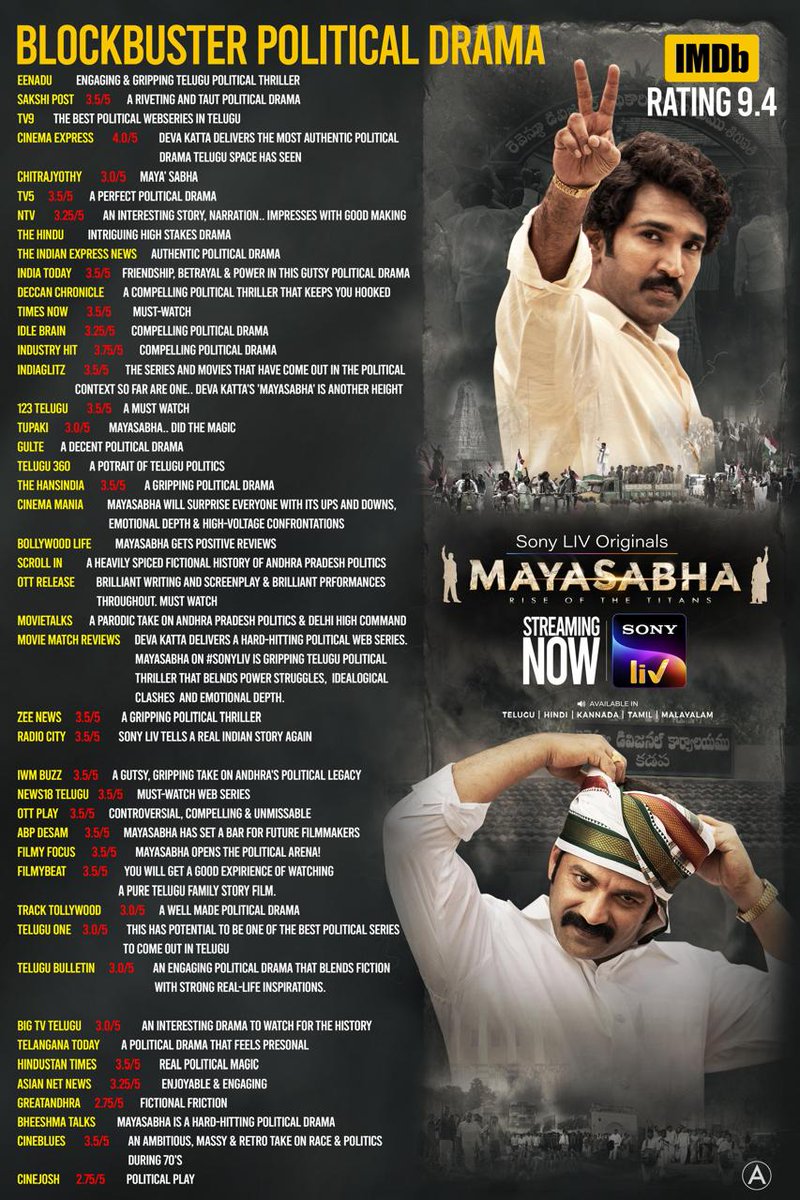
Dear @saugatam.. had an absolute blast working with you, Danish @raghuvamsip and Sandeep on #Mayasabha at #SonyLiv. In an ecosystem that often over-manages, you backed creators with trust, clarity, and a rare sense of creative freedom. As a showrunner and director, that kind of space is gold. You carry a huge share in its success with you.
You guys made the process feel less like “approval pipelines” and more like pure storytelling—which is how it should be.
Wishing you bigger adventures, bolder stories, and continued impact ahead.
Onward and upwards!🤗🤗