RAG has evolved far beyond its original form.
When people hear Retrieval-Augmented Generation (RAG), they often think of the classic setup: retrieve documents → feed into LLM → generate an answer.
But in practice, RAG has branched into many specialized patterns, each designed to solve different challenges around accuracy, latency, compliance, and context.
Here are some of the most important categories:
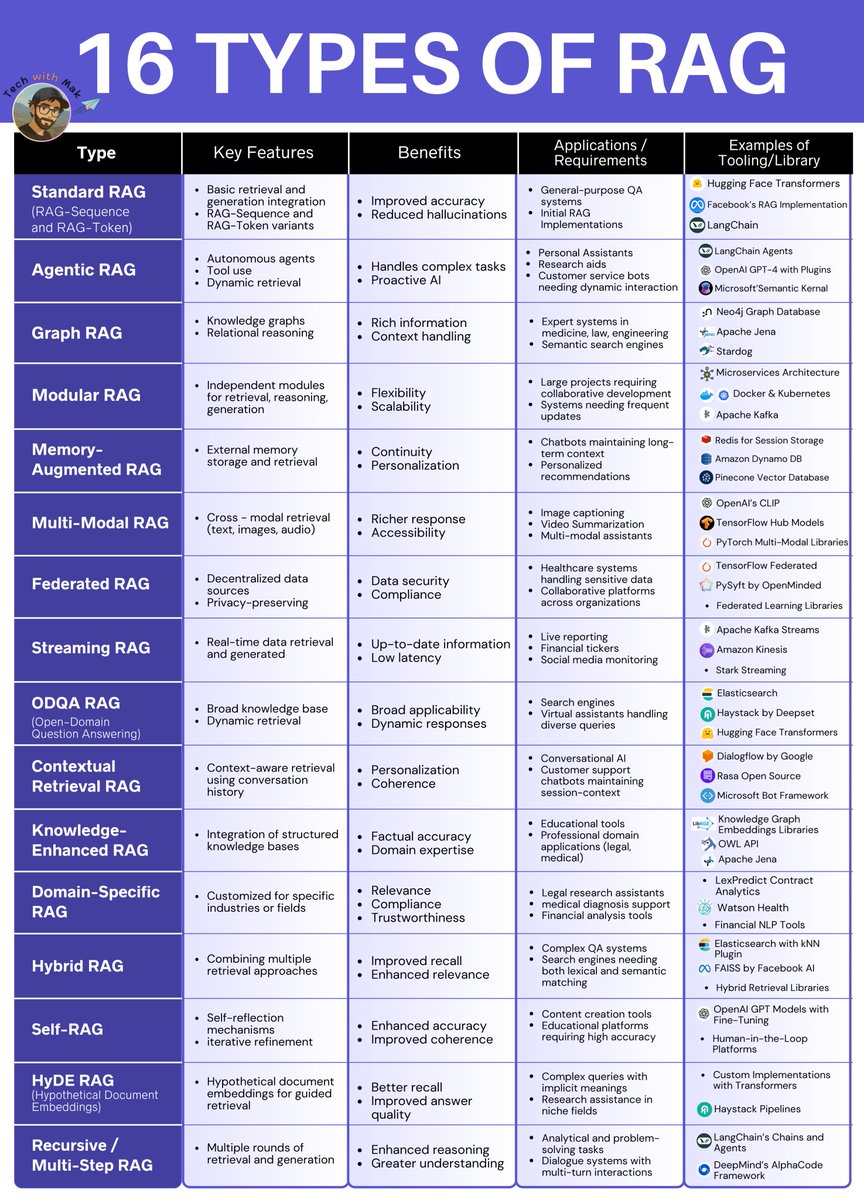
➤ Standard RAG - the original retrieval + generation (RAG-Sequence, RAG-Token).
➤ Graph RAG - connects LLMs with knowledge graphs for structured reasoning.
➤ Memory-Augmented RAG - external memory for long-term context.
➤ Multi-Modal RAG - retrieves across text, images, audio, video.
➤ Streaming RAG - real-time retrieval for live data (tickers, logs).
➤ ODQA RAG - open-domain QA, one of the earliest and most popular uses.
➤ Domain-Specific RAG - tailored retrieval for legal, healthcare, or finance.
➤ Hybrid RAG - combines dense + sparse retrieval for higher recall.
➤ Self-RAG - lets the model reflect and refine before final output (Meta AI, 2023).
➤ HyDE (Hypothetical Document Embeddings) - improves retrieval by first generating “mock” documents to embed.
➤ Recursive / Multi-Step RAG - multi-hop retrieval + reasoning chains.
Others like Agentic RAG, Modular RAG, Knowledge-Enhanced RAG, Contextual RAG are best thought of as system design patterns, not strict categories, but useful extensions for specific use cases.
The image below maps out 16 different types of RAG, their features, benefits, applications, and tooling examples.
Whether you’re building production-grade assistants, domain-specific copilots, or real-time monitoring systems, the right flavor of RAG can make all the difference.
R.I.P. basic prompting.
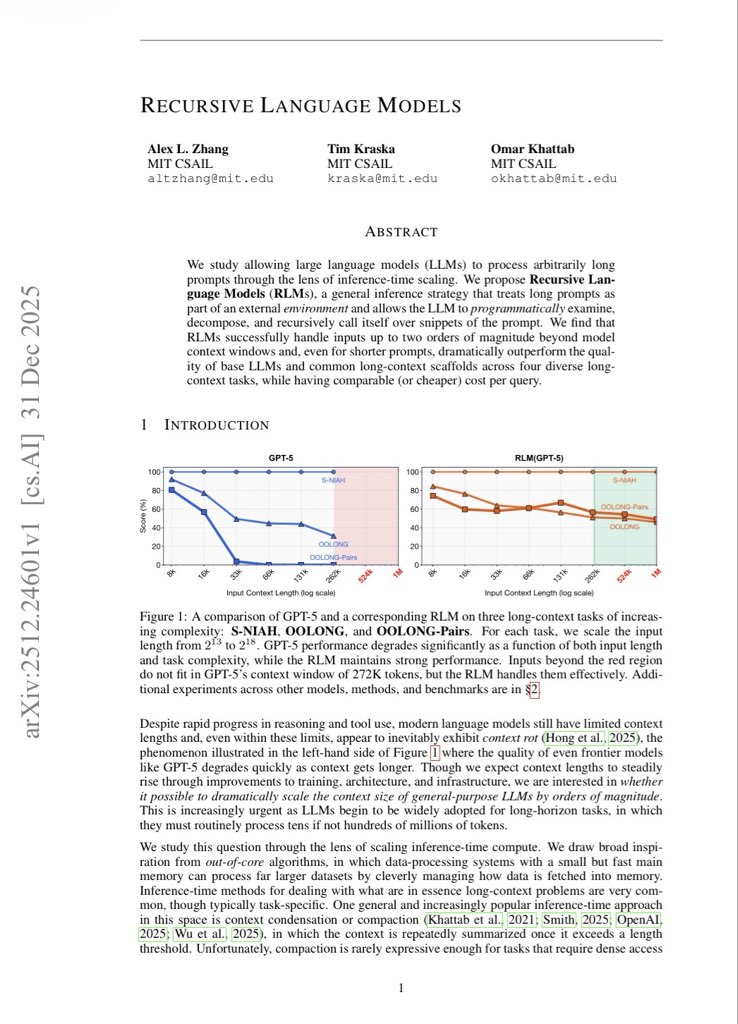
MIT just dropped a technique that makes ChatGPT reason like a team of experts instead of one overconfident intern.
It’s called “Recursive Meta-Cognition” and it outperforms standard prompts by 110%.
Here’s the prompt (and why this changes everything) 👇
LLM fine-tuning techniques I'd learn if I were to customize them:
Bookmark this.
1. LoRA
2. QLoRA
3. Prefix Tuning
4. Adapter Tuning
5. Instruction Tuning
6. P-Tuning
7. BitFit
8. Soft Prompts
9. RLHF
10. RLAIF
11. DPO (Direct Preference Optimization)
12. GRPO (Group Relative Policy Optimization)
13. RLAIF (RL with AI Feedback)
14. Multi-Task Fine-Tuning
15. Federated Fine-Tuning
My favourite is GRPO for building reasoning models. What about you?
I've shared my full tutorial on GRPO in the replies.
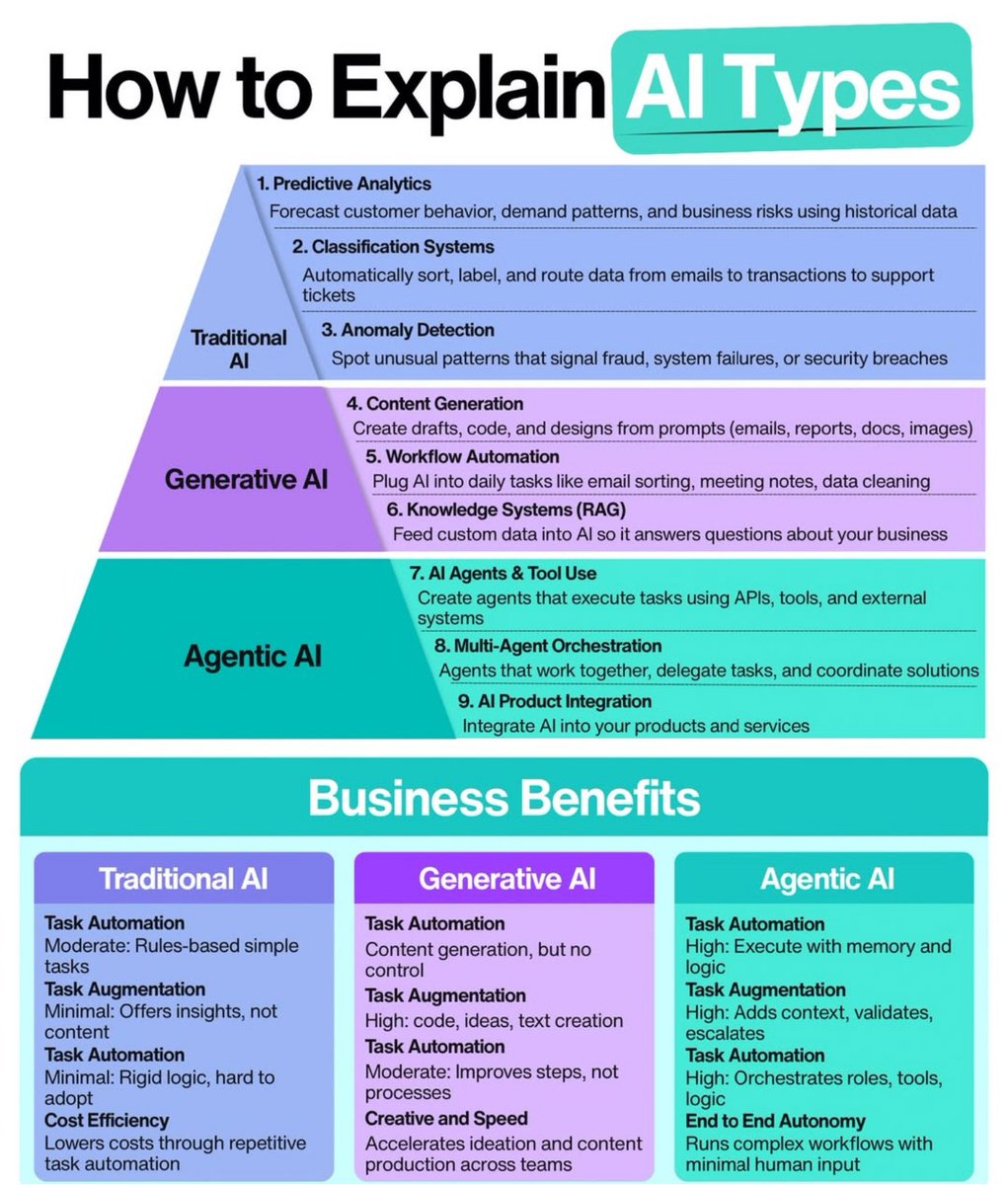
Not all Al is the same, and understanding the differences is becoming essential.
Traditional Al focuses on prediction, classification, and anomaly detection using historical data.
Generative Al creates content like text, code, images, and summaries from prompts. Agentic Al goes a step further by taking action, using tools, maintaining context, orchestrating workflows, and executing complex tasks with minimal human input.
As Al evolves from automation to autonomy, businesses gain speed, efficiency, and smarter decision-making. ai is no longer just about generating answers; it’s about getting real work done.
Achieved 3rd Position in the Cyber Security Awareness Week thematic quiz held on 25th-29th October at Manipal University Jaipur #cybersecurity https://t.co/sgbHLI6KVh
Meet innovators and technologists from leading open source and cloud native communities. Join us and experience how we are bringing technology closer to the human experience.
#googlecloudnext#googlecloud
Youtube Link: https://t.co/PbnVBEKbG0 https://t.co/Q5vvYzmsUs