Running slow??? Nothing wrong with that!!!!!
Slow CADENCE??? Let’s try to fix it so you can make your runs more effective and less stress on your body!!! 💪💪💪✨
Recently I've put on weight yet again.. Trying to balance out.. Here's to my last few runs.. 10K Bangalore Last week.. 5k today and few others while I am out travelling.. #Running#RunningOnX
This woman just made ultramarathon history in 56-hour, 250-mile run in Arizona.
Rachel Entrekin won the Cocodona 250 outright in a 56-hour, 250+mile effort, beating the entire men’s field, setting a new course record, and marking a landmark moment in ultrarunning history.
I’ve seen runners get weirdly proud of never taking a day off. Like the streak becomes the goal. Not the running itself. Just… keeping the chain alive no matter what.
Then you look at something like this and it doesn’t match that mindset at all. Two days a week keeps things going. Three is already solid. Four is where most people really start improving. After that, yeah you might get faster gains… but the risk climbs with it. That trade-off is real, whether people want to admit it or not.
I went through a phase where I tried to run almost every day. Thought that’s what “serious runners” do. Ended up with tight legs all the time, small aches that never fully went away, and runs that just felt flat. Nothing dramatic, just constant low-level fatigue. The kind that slowly drains your motivation without you noticing.
Some runners can handle 5–6 days, especially if they build into it properly. But a lot of people would get more out of just hitting 3–4 good runs and actually recovering. The goal isn’t to prove you can run every day. The goal is to keep showing up next month without something breaking
🚨HISTORY MADE!
Rachel Entrekin just won the Cocodona 250 outright — first woman ever to take the OVERALL title!
The 250-mile race from Phoenix to Flagstaff was an absolute beast, and she crushed it in 56:09:48, smashing the previous course record by over 2 hours.
13 minute mile pace for 56 hours!
She only slept 3 times the entire race (one 5-min nap + two 7-min naps) and still dropped the entire elite men's field. Absolute legend!
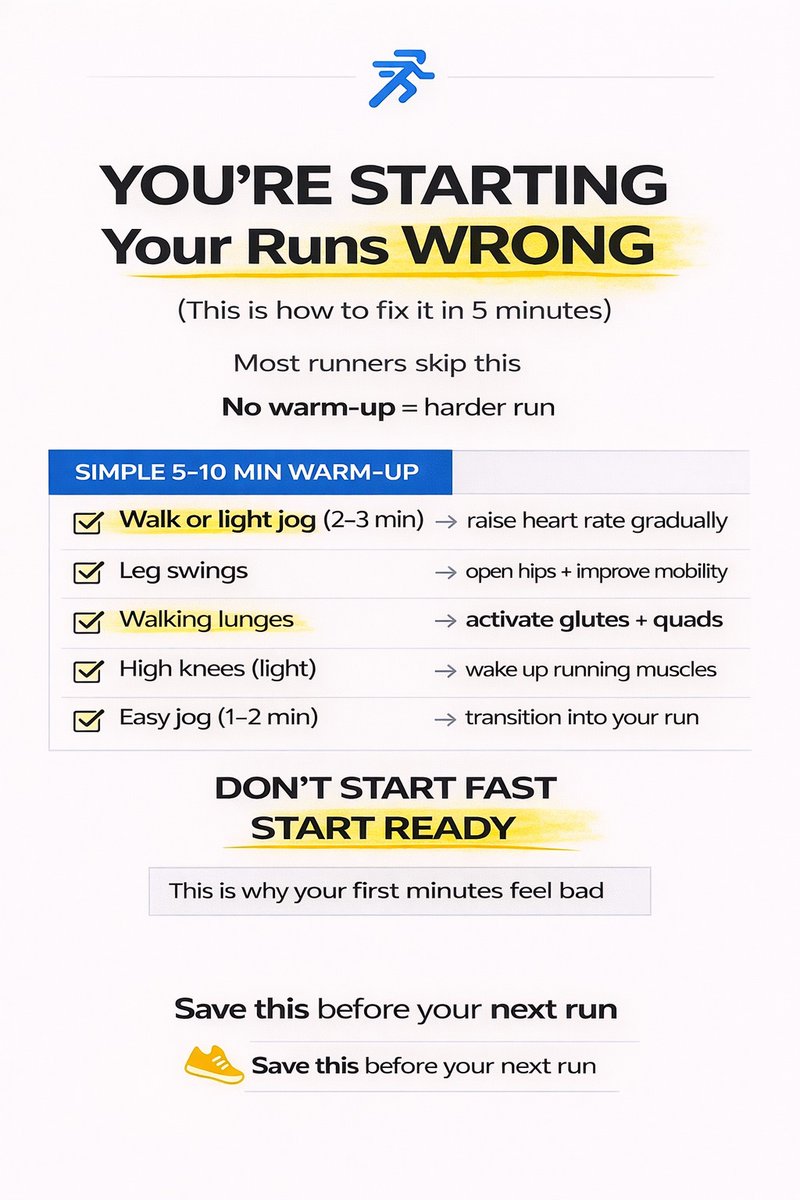
I used to just step outside and start running. No walk, no leg swings, nothing. Just hit start on the watch and go. And yeah… the first minutes always felt terrible.
Heavy legs, awkward stride, breathing all over the place. I thought that was just part of running. Turns out I was basically asking my body to go from zero to running without any warning.
That little warm-up in the image… it looks almost too simple to matter. But even just 2–3 minutes of walking or a light jog changes everything. Add a few lunges or leg swings and suddenly your body actually feels ready instead of shocked. The run doesn’t fight you as much.
“No warm-up = harder run” is exactly it. You don’t need anything fancy. Just enough to wake things up.
Some runners skip it and get away with it. Others feel it immediately. I was definitely in the second group… just didn’t realize it at the time
Most runners train way harder than they need to… and still feel behind.
Not because they’re lazy — but because they think more is always the answer. More days. More miles. More suffering. This is built from research and from years of watching runners burn themselves out chasing numbers that never matched their goal. You don’t need elite hours to race like a recreational runner. You need calm consistency, not chaos.
This is the part people hate hearing: training time is a budget. Spend it wrong and you’re broke fast. Spend it well and suddenly things click. Three focused runs can beat five sloppy ones. Long runs don’t need to be heroic. Weekly mileage doesn’t need to be impressive. It needs to be repeatable. Progress shows up when you stop panicking and start stacking weeks.
If you think this is “too little,” say it.
If you trained way more and still plateaued, prove your point in the comments. What race are you training for — and how many hours are you actually putting in right now?
There’s this quiet assumption that the marathon is the “next step.” Like once you’ve done a 5K, 10K, maybe a half… the only direction left is 26.2. Nobody really stops and looks at that bottom row in the image and asks if it actually fits their life right now.
Because that jump isn’t just distance. It’s 30–60+ miles a week, long runs that eat half your day, and recovery that can stretch into weeks. That 4–5+ hour finish time isn’t just race day… it’s a preview of how long you’ll be out there in training too. A lot of runners sign up for the race without really signing up for everything around it.
I’ve had runners thrive at the 10K or half marathon level. Strong, consistent, enjoying their training, not constantly tired. Then they push toward a marathon and everything starts to feel heavier. Not always in a dramatic way… just small things stacking up. Fatigue, missed runs, little niggles that don’t quite go away.
Some people are in a season where the marathon makes sense. Others aren’t, and that’s okay. Running doesn’t get more “real” just because the distance gets longer. Sometimes staying where you’re strong is actually the smarter move.
Andrew Huberman just laid out the cortisol math on late-day workouts. A heavy session in the afternoon or evening triples or quadruples your baseline for a few hours.
You can still fall asleep if you cool down properly. The next day is where the bill lands.
Cortisol is supposed to peak in the first hour after you wake up. That spike is called the cortisol awakening response, the CAR, and it sets the first domino of the entire day. Bright light in that window boosts it up to 50%. Sunlight or 10,000 lux indoor light. Hydration nudges it. A short walk nudges it. After about 90 minutes, the window starts to close.
Then the curve tapers. Cortisol falls through late morning, falls through afternoon, bottoms out at night, melatonin rises, you sleep. That is the rhythm the body evolved to follow.
A late evening lift collides with the wrong half of that curve. Cortisol triples, blunts the melatonin peak, holds your nervous system in sympathetic tone three to four hours after you walk out of the gym. You still sleep, but tomorrow morning's CAR pays for it.
Huberman's framing of burnout makes this concrete. Two patterns. The first is the morning exhaustion, afternoon caffeine, late-night wired loop. The second is the square wave cortisol profile where the curve never comes down. Both are versions of the same broken diurnal rhythm.
Chronic late-day cortisol or a flattened curve disrupts hippocampal function over time. Memory and recall suffer when the curve goes flat. Reversible with sleep normalization, but recovery takes weeks of clean mornings to compound.
The fix is mechanical. First three to six hours after waking are go time. Bright light, water, movement, caffeine if you want it. Last three hours before sleep are the inverse. Dim the lights, cool the room, ease the food and water, let the body settle.
The first hour after waking writes the rest of the day.
4 years ago, I couldn't run 1 mile without stopping.
Today, I've completed:
• Marathons
• Ironman 70.3s
• David Goggin's 4x4x48
If I had to start running again from 0, here's how I'd do it in 1/2 the time:
I remember overthinking my first marathon plan like crazy. Different workouts, exact paces, trying to get everything perfect. Ended up feeling more confused than prepared. Then you look at something like this and it almost feels too simple to work.
But that’s basically it… easy runs, one long run, and actual rest. That “easy is enough” part is the one people fight the most. They turn easy days into medium days, medium into hard, and suddenly every run feels like work. Then the long run becomes a survival test instead of something that builds you.
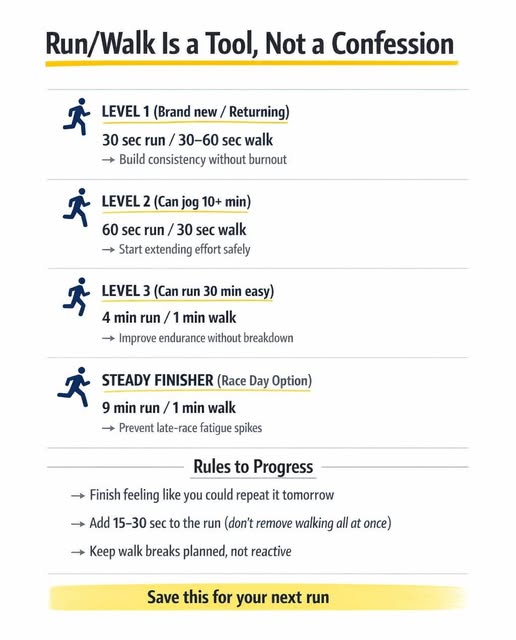
The long run once a week… that’s the real backbone here. Doesn’t need to be fast. Doesn’t need to look impressive. Just needs to happen consistently, getting a bit longer over time. And yeah, walking in those runs is completely fine, even if your ego doesn’t like it.
Some runners love adding more structure, more sessions, more detail. Others do better keeping it simple and repeating it week after week. But if you can actually stick to something like this without breaking down, you’re already doing it right
Most runners don’t want to run a marathon.
They want to say they ran a marathon.
And that’s where people get hurt. Or humbled. Or both.
Because 26.2 isn’t just “a longer half.”
It’s a different event. Different cost. Different consequences....
HOT TAKE:
Running a marathon doesn’t make you healthier than someone who runs 5K consistently.
If your goal is health… you probably don’t need anything beyond 5K.
Most of the real benefits—heart health, weight control, stress relief—are already there.
You don’t unlock some “extra health level” at 21K or 42K.
That’s where people get it twisted.
Long distances aren’t about health anymore… they’re about testing yourself.
Discipline. Ego. Curiosity. Limits.
And that’s fine.
But let’s stop pretending marathon training is the “healthier” choice.
Sometimes it’s just harder… not better.
I don’t think people really get how different elite marathoners are.
A sub-2 marathon is 4:34 pace… for the full 26.2 miles.
Most runners could train for years and still not hold that pace for a 10K, let alone a marathon.
At that level, it’s not just discipline anymore.
It’s talent, genetics, years of training, insane pain tolerance, perfect execution… and honestly, bodies that seem built for this in a way the rest of us just aren’t.
Different game entirely.
I heard today that marathon runners rarely have suicidal thoughts.
Because the frequent running sessions make the mindset positive, and life feels more amazing and motivating!
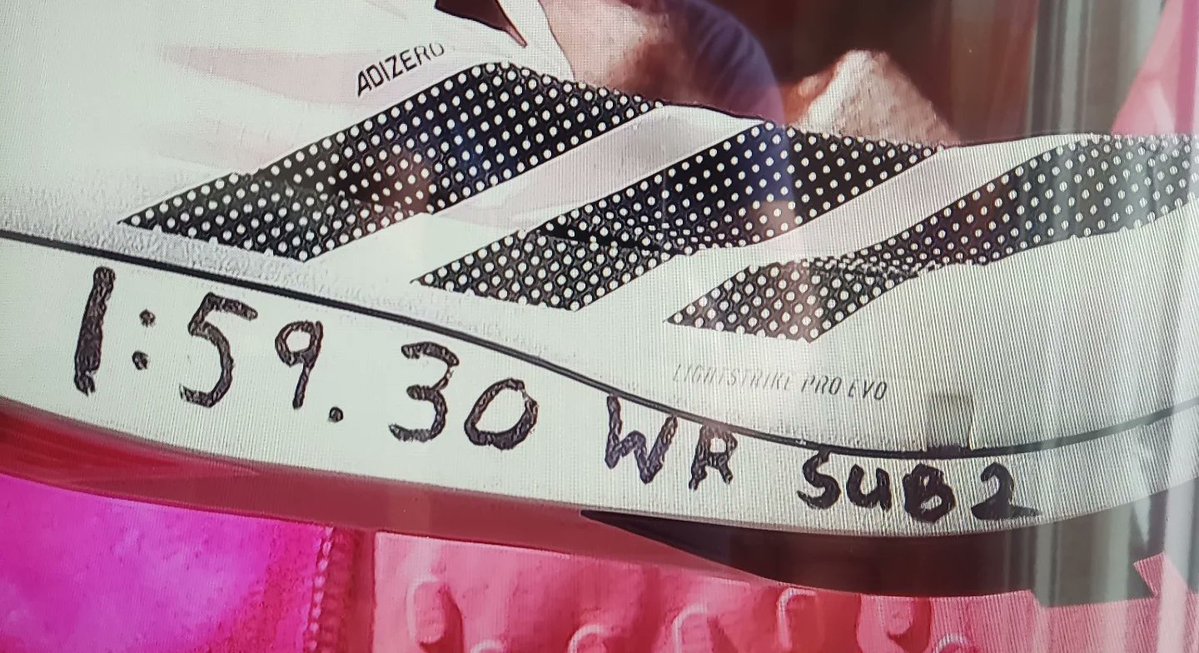
In a feat that redefines human ability, what was once considered impossible has been shattered at the London Marathon: a sub-2 hour marathon. Sabastian Sawe (Kenya) ran 42 km in 1H.59M.30S and Yomif Kejelcha (Ethiopia) finished in 1H.59M.41S.
Simply insane.
For decades, this was spoken of as a barrier the human body could not cross. Today, it has fallen.
A reminder that limits are often self-imposed. What seems impossible today becomes possible tomorrow.
That is the story of human progress.