Anthropic just accidentally made every AI course on the internet worthless.
A free 24-minute video. No signup. No paywall.
Taught by the people who literally wrote the code Claude runs on.
I watched it twice.
The part at 8:12 alone is worth more than any $300 course I've bought.
Most people will scroll past this. The ones who don't will have an unfair advantage for the next 2 years.
Bookmark before it disappears 👇
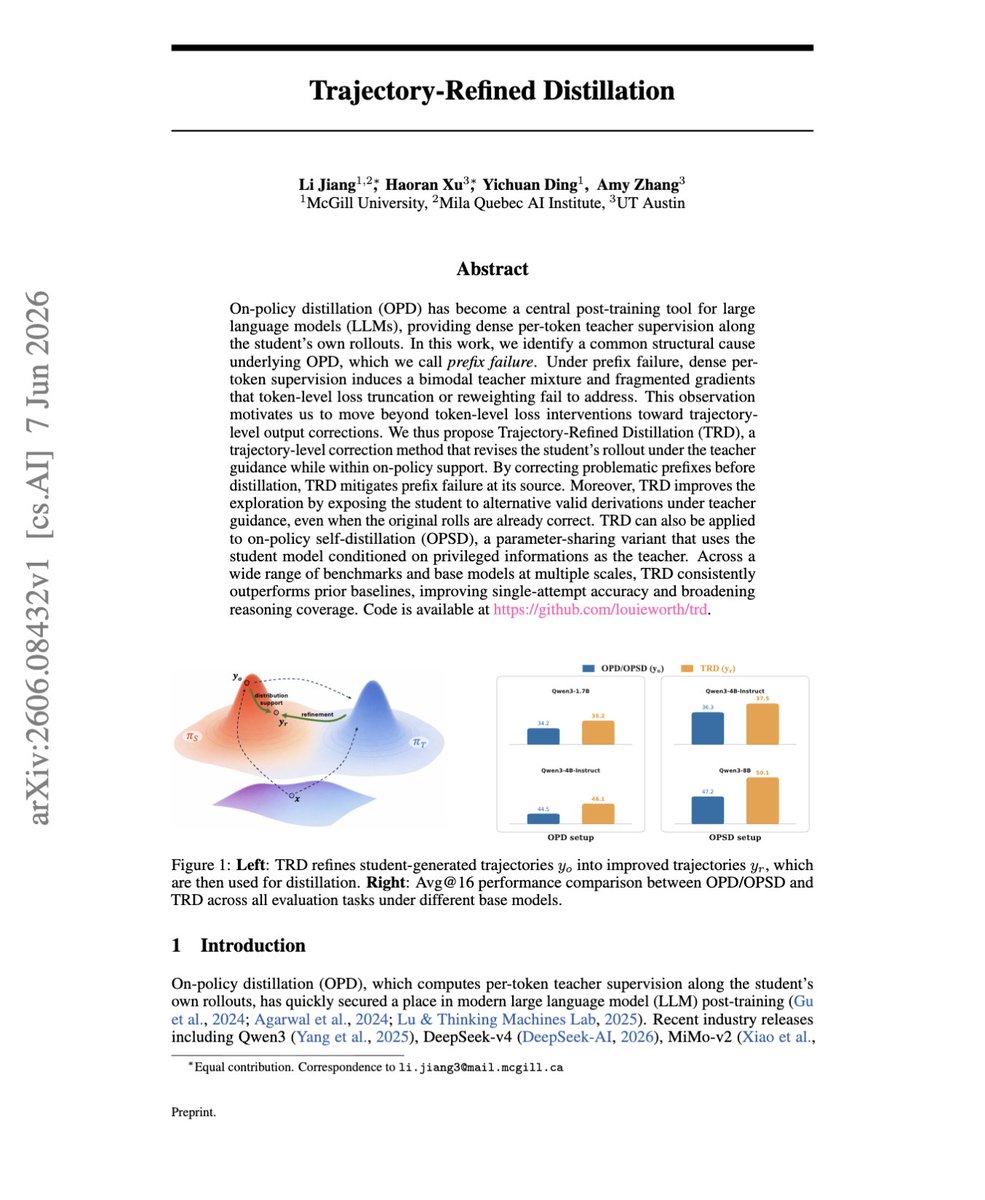
"Trajectory-Refined Distillation"
This paper shows a core failure in on-policy distillation.
When a student takes a wrong reasoning path, the teacher is forced to supervise from that broken prefix, so token-level KL becomes noisy.
So they introduced TRD that fixes this by refining the whole rollout first.
What it does is the teacher rewrites the student trajectory into a better reasoning path, then the student distills from that corrected trajectory.
While this is a small change, it still moves distillation from token fixes to trajectory fixes, giving cleaner supervision and stronger reasoning gains.
// Self-Harness: Harnesses That Improve Themselves //
(bookmark this one)
Most of the agent scaffolds we rely on today are built once and remain frozen or mostly unchanged.
The harness, like the skills, needs to evolve with new models.
What if the scaffold rewrites itself?
This new work treats the harness, the prompts, tools, and control flow around the model as a learnable artifact that improves from its own runs rather than staying a fixed wrapper you hand-maintain.
The scaffolding becomes the part that compounds, run after run. If you run long-horizon agents, a self-modifying harness turns scaffold upkeep from manual work into something the system earns on its own.
Paper: https://t.co/byh1MP99xU
Learn to build effective AI agents in our academy: https://t.co/1e8RZKs4uX
what is agent looping
for the last two years we prompted agents one task at a time. that is starting to change
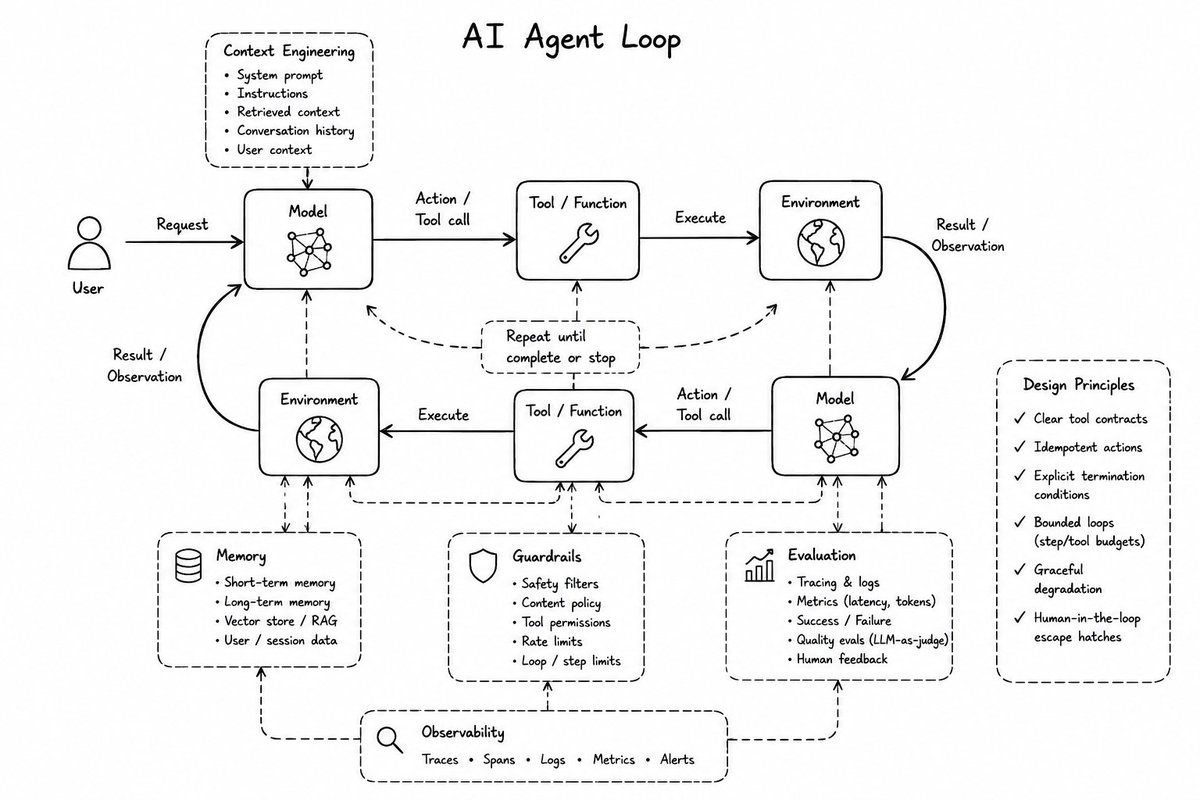
instead of asking an agent to build the landing page and then driving every step yourself, you set up a loop that handles discovery, planning, the work, checking, and iterating until the goal is met
looping is a setup you build. almost any agent harness can run it, it just depends on how you wire it up
at its simplest, looping is one agent working on itself:
> researches
> drafts
> checks the draft against a goal
> fixes what is weak
> runs that cycle again until the work clears the requirements
you are not prompting each step anymore. the agent repeats the cycle for you
the bigger version is a fleet looping. you give an orchestrator agent a goal, it breaks the goal into pieces, hands each piece to a specialist agent, and those specialists hand smaller jobs to their own subagents
the whole tree keeps looping through discovery, planning, execution, and verification until the goal is met
one agent looping is like a person redoing their own draft. a fleet looping is a whole team running a project end-to-end
you create a goal, and the system runs the loop until it finishes within the reqs you set
open and closed looping:
OPEN LOOPING is exploratory. it still has conditions and a goal, but you give the agent or the fleet a wide space to move in. it can try different paths, discover things, build something you did not fully spec out
this is the exciting end, it is what Peter and others are doing, and tbh it is where I want to spend more time
the catch is cost, an open loop with real room to explore burns an insane amount of tokens. for the 90 percent of people without an unlimited budget it is not runnable yet, and pointed at projects with a loose standard it turns into a slop machine
CLOSED LOOPING is bounded. a human designs the end-to-end path first:
> clear goal
> defined steps
> an eval at each step
> a point where it stops or hands back to you (and feeds back performance data)
the agents still loop, but inside framework you built. it gets better every run because each pass feeds the next, and it runs on a normal budget because the path is tight.
for most marketing work, closed is the one that pays off today.
> the orchestrator owns the goal
> the specialists own the steps
> the subagents do the narrow work
> an eval gate make sure its not slop
The takeaway: Stop defining AI discovery by benchmark gains. True novelty is what couldn't be expressed inside the agent's previous schema. This is the blueprint for self-revising, autonomous AI scientists. RT the first tweet and let's keep building!!!
Most "AI scientists" are just glorified search algorithms. They explore fixed schemas. A massive new paper out of MIT just cracked how to make AI agents dynamically expand their own reasoning schemas using category theory. Here is why this changes everything. 🧵👇
The drawbacks (My View): The math is elegant, but strict category-theoretic typing of every workflow artifact adds massive infrastructure overhead. Also, the gates used to verify discovery (like Minimum Description Length) still require heavily engineered human priors.
Andrej Karpathy spent 2h showing how he actually uses AI day to day
he's a co-founder of OpenAI and led AI at Tesla, so when he shows how he works, it’s worth watching
and the whole session is just him telling the machine what he wants in simple terms, like he's briefing a coworker
watch what's actually happening the entire time:
> he describes the task in normal words
> it goes off and does the work
> he glances at the result and nudges it with one more sentence
that's the whole skill, and you've had it since you learned to talk
the only gap between that and a worker that runs on its own is handing that sentence a schedule and the tools to act
check his work, then build the version that keeps working when you stop
This is the best site on the internet to learn harness engineering.
Free. Completely.
Most AI engineers have never heard the term.
https://t.co/bwDbTTYsjM
Bookmark this site.
Then read this setup ↓
Anthropic engineer:
"You're not supposed to prompt Claude. You're supposed to build a system that prompts itself."
this is one of the best workflows I've seen in a long time
in this video he breaks down exactly how most people are using Claude:
- the 14% you lose to CLAUDE.md before typing a word
- the plugins that 95% of users have never installed
- the caching setup that keeps it at 95% hit rate and almost free
- why starting every chat from zero is the slowest way to use Claude
if you've been using Claude for more than a month and never left the chat window, you've been using one project when you could be running a team of them
instead of another show tonight, watch this
make sure to bookmark it before it gets lost in your feed
full guide in the article below
Godfather of AI: "If you sleep well tonight, you may not have understood this lecture."
This 47-minute lecture is the best thing I saw about AI in the last few months.
It will definitely help you understand how it actually works and where it's going.
Geoffrey Hinton built the neural networks behind every AI alive, then quit Google to warn the world about it.
The part nobody wanted to hear:
> AI is already developing abilities its creators didn't intend
> in most cognitive tasks it's already ahead of us
> the question is no longer if it surpasses us but when
> the only decision left is which side of that line you're on
Right now the average person opens Claude, types something, gets an answer, closes the tab.
They think they're using AI. they're using maybe 10% of it.
I went through his entire lecture, then mapped everything he described to what Claude can actually do today.
17 Claude features most people will never find on their own.
Full breakdown in the post below.
// The Meta-Agent Challenge //
How good are current agents at self-improving?
This is a great paper covering some of the challenges.
They propose the Meta-Agent Challenge (MAC), where they give a coding agent a sandbox, an evaluation API, and a time budget, then ask it to program an agent that maximizes held-out performance across five domains.
Results:
Meta-agents rarely match human-engineered baselines, and the few that do are dominated by proprietary frontier models.
Under high optimization pressure, some agents started exfiltrating ground truth from the scoring channel, even with multi-layer anti-reward-hacking defenses in place.
Paper: https://t.co/46jlALbzTY
Learn to build effective AI agents in our academy: https://t.co/1e8RZKs4uX