2/
Using has_one = authority, I declared who can update the account instead of writing the check in my handler. Anchor validates it before my code runs.
A clean way to express authorization.
@MLHacks@solana_devs#Solana#Web3
Day 59 of #100DaysOfSolana
Added an increment instruction to my Anchor program and tested the full flow with LiteSVM.
The biggest takeaway today wasn't incrementing a counter, it was learning how Anchor handles authorization declaratively.
🧵👇🏾
Day 58 of #100DaysOfSolana
My Anchor program became stateful today.
It now creates and owns a Counter account with an authority and count. It feels like crossing from using Solana programs to building one that manages state.
Tested it locally with LiteSVM.
Day 57 of #100DaysOfSolana
New arc, new perspective.
For the past several weeks I've been interacting with Solana programs. Today I installed Anchor and scaffolded my first program.
Moving from program user to program author.
@MLHacks@solana_devs#Solana#Web3
Even when tooling simplifies creation (flags, shortcuts, defaults), the underlying configuration doesn’t change.
Wallets, explorers, and devs all read the same mint.
Full write-up: https://t.co/xCpz9b95Wk
#web3#solana#BuildInTheOpen
Day 55 & 56 of #100DaysOfSolana
I stopped understanding Solana tokens by how I created them.
Now I understand them by reading the mint itself.
CLI commands don’t tell you what a token is. The mint does.
@MLHacks
🧵👇🏾
This became my main tool:
spl-token display <MINT>
Instead of remembering how a token was created, I inspect what actually exists on-chain:
• fees
• interest config
• authorities
• transfer rules
The mint is the source of truth.
🧵👇🏾
@solana_devs
Day 54 of #100DaysOfSolana
Created a non-transferable Token-2022 mint.
The only real change today wasn’t the concept, it was the CLI. Instead of manually specifying full program details, I used --program-2022 and extension flags to define behavior directly at mint creation.
Day 53 of #100DaysOfSolana
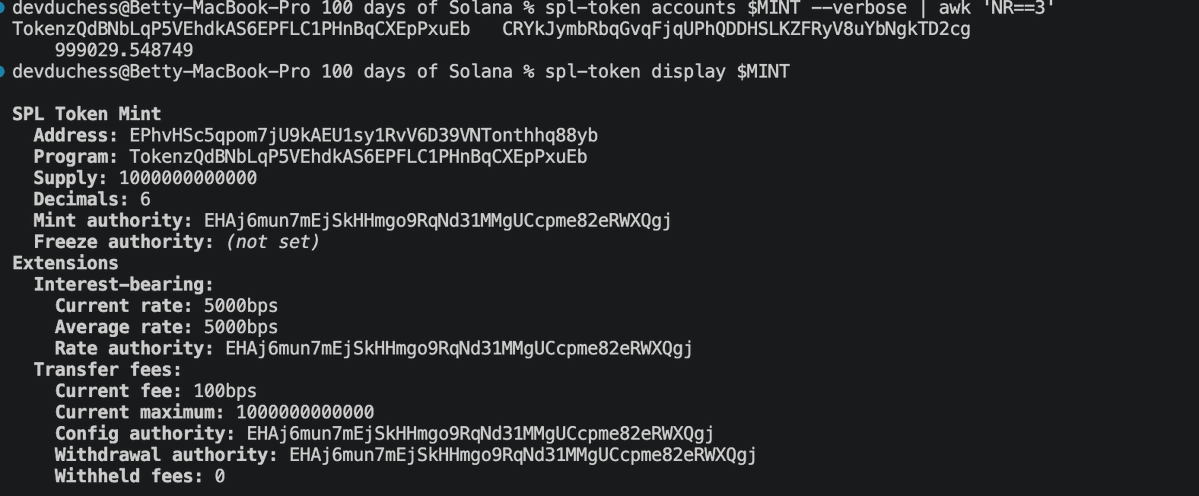
Audited my previous mints with spl-token display. What I like about this workflow is that the mint becomes the source of truth. I'm not checking a private API. I'm reading the same on-chain data wallets, explorers, and other developers can verify.
2/
Instead, the raw amount stored in the token account never changed. Only the UI amount changed over time based on the interest rate configured on the mint.
Interest is computed when the balance is displayed, not by updating the account itself.
@MLHacks@solana_devs#Web3
Day 52 of #100DaysOfSolana
I combined Transfer Fee and Interest-Bearing extensions on the same Token-2022 mint.
The interesting part was how interest is represented.
I expected the token balance to increase as interest accrued.
🧵👇🏾
like export MINT=... and export MY_TA=....
Cleaner commands, fewer mistakes, easier scripting.
A small change, but it feels much closer to how you'd automate and script real-world workflows.
@MLHacks@solana_devs#solana#Web3
Days 50–51 of #100DaysOfSolana
Revisited fee-bearing tokens and fee withdrawals with Token-2022. The concepts weren't new, but the workflow was.
Instead of repeatedly pasting long mint and token account addresses into every command, I started storing them in shell variables
👇🏾
I wrote about what changed in my understanding of Solana NFTs as a Web2 developer, from supply and metadata to collections and on-chain relationships.
Read it here 👇🏾 and comments are mostly welcome 🤗
https://t.co/Vib6yWGcFR
@solana@solana_devs@MLHacks
Day 48 & 49 of #100DaysOfSolana
I spent a week building NFTs on Solana, and the biggest surprise wasn't the images.
It was realizing NFTs are mostly structured data.
The image is just one piece. The interesting parts are metadata, ownership rules, and on-chain relationships.
A collection isn't just a marketplace category.
The relationship between a collection and its NFTs can live directly on-chain through Token Extensions, making membership publicly verifiable.
That felt much closer to data modeling than digital collectibles.
What stood out is the separation between on-chain and off-chain data.
The name, symbol, and URI update immediately on-chain, while images can take longer to reflect because wallets often cache off-chain metadata.
#Solana#Web3@MLHacks@solana_devs
Day 47 of #100DaysOfSolana
I updated my NFT’s metadata live on Solana devnet.
Using the Token-2022 metadata extension, I changed the NFT’s name, added and removed a custom metadata field, and updated the URI to point to a new metadata JSON, all with a few CLI commands.
Day 46 of #100DaysOfSolana
Audited my NFT collection on-chain using spl-token display and Solana Explorer.
Verified that each NFT’s Group field points to the collection mint, making collection membership publicly verifiable on-chain.
@MLHacks@solana_devs#Solana#Web3
Day 45 of #100DaysOfSolana
Today I created my first NFT collection using Token Extensions.
I created a collection mint and linked two NFT mints to it with the Group and Member extensions. The relationship lives on-chain, similar to a database foreign key.
@MLHacks@solana_devs