Presenting "Hornbills of India"- the 9 magnificent Hornbill species that inhabit the hill and mountain forests across India.🌳
Hornbills are enduring symbols of loyalty- faithful to their partners and, in a broader sense, to the future of the forests they help sustain.🌼
Out of the mouths of babes ....it's time some of the older talking heads sit down and take a deep breath instead of trying to play manipulative games with minors. They have done what we should have done ....and let's be grateful for that @sidhant_sarthak
We were both invited by Rahul Gandhi, and to the parliament, together. Nisarga couldn't go because even though he was in Delhi for it, he was sick.
I represented both of us at both the places however. That is because you can not forget Nisarga's efforts to the cause.
We both have a different perspective of things, including palantir and surveillance, but presenting a comparison in a way that presumes a lot of things is dishonest.
The work we both did was different. The cause was roughly the same, it is not a good idea to divide people when they are standing for the same cause.
“We are told, with varying degrees of sociological certainty, that the Congress remains a “family firm” and that Rahul Gandhi lacks the “gravitas” and “curriculum vitae” required to unseat a formidable electoral machine.
This assessment, while satisfying to the purist, is not merely harsh: it is analytically flawed. It reduces the existential struggle for the soul of the Republic to a critique of the personal failings of a single individual, unwittingly validating the very playbook designed by Narendra Modi and Amit Shah.”
Five rejoinders: What Ramachandra Guha gets wrong about Rahul Gandhi https://t.co/RDHlUQ0tUk via @scroll_in
By God. It's bracing to read an official Congress takedown of our discoursewala-in-chief, in delectable prose at that. Read it, people. I hope it straightens out the other 'pompous, predictable and politically undercooked' opinion-makers-at-large as well.
Meet Vedant Shrivastava, Nisarga Adhikary, and Sarthak Sidhant ,they exposed CBSE in every possible way :
17 years old Vedant Shrivastava :
> Applied for the CBSE re-evaluation process
> Got a different Physics answer sheet
> Posted it on X
> Got labelled "Pakistani" by the BJP IT cell
> Brought CBSE to its knees and proved them wrong
19 years old Nisarga Adhikary :
> Bro hacked the CBSE website
> Reported the vulnerability to them
> But they didn't take any action
> Then bro posted it on X
> Showed everyone that it could be hacked
18 years old Sarthak Sidhant :
> Bro exposed a CBSE tender
> Took it to X
> Wrote a detailed thread
> Explained how the CBSE OSM tender conditions allegedly favoured COEMPT
> And today came on the media
> Exposed them with facts
These three boys are doing what whole media failed to do, all of them took x to expose CBSE .
"Modi’s (who likes to present himself not just as a national leader, but as a national father-figure) call for austerity was plainly directed at India’s elite. Many think of themselves as middle-class. They are a patriotic bunch. They support Mr Modi. They are fed up. What do these people get for their money? Not health or education. Not decent public transport. Not even clean air. Elites are not fools. They understand that their votes make no difference. But their taxes do. And they are no longer in any mood to suffer for the country."
Vishwaguru Without Civic Sense?
Many Indians genuinely believe the world looks at us with admiration and awe. We are constantly told that India is becoming a “Vishwaguru.” A moral and cultural guide to humanity. But step outside India and observe carefully. The reality is often very different.
Across airports, hotels, beaches, public transport systems and tourist destinations worldwide, Indians are increasingly developing a reputation that should worry us deeply. Too many Indians travel abroad carrying entitlement instead of civic sense.
Anyone who has travelled extensively has seen it. Families speaking loudly inside silent trains in Japan. People cutting queues at airports in Europe. Tourists touching protected monuments despite repeated warnings. Groups blasting music on peaceful beaches in Thailand and Bali. Passengers aggressively arguing with airline staff over baggage rules that everyone else quietly follows. Some even proudly try “Indian tricks” abroad, sneaking extra people into hotel rooms, hiding food in restricted places, or treating every rule as a system to outsmart rather than respect.
In India, this behaviour is often romanticised as smartness or “jugaad.” Abroad, it is seen for what it actually is, dishonesty, disorder and lack of civic culture.
Not all Indians behave this way, of course. But enough do for the stereotype to now exist globally.
A few years ago, a viral incident from Bali showed an Indian family caught stuffing hotel accessories into their luggage. Hair dryers, decorative items and bathroom fittings. The defence was immediate, offering to pay once caught, as though money could erase the behaviour itself. The incident became social media comedy. But the deeper issue was the mindset. The belief that rules apply to others, not to us.
And unfortunately, this mindset travels with us everywhere.
We speak emotionally about India’s ancient civilisation. But civilisation is not measured by old scriptures alone. It is measured by how citizens behave in public spaces. Do we keep our surroundings clean? Do we respect silence where silence is expected? Do we follow rules without supervision? Do we think about the comfort of strangers?
Slowly, the consequences appear. More scrutiny at immigration. More stereotypes. More silent distancing. More frustration from hosts who no longer see Indian tourists as easy guests.
The uncomfortable truth is this. No country becomes respected because its citizens loudly declare themselves superior. Real respect is earned quietly. Japanese football fans clean stadiums after matches. Singaporeans follow rules even when there is no policeman in sight. Many European societies function smoothly because people treat public spaces with dignity and think collectively, not selfishly.
Meanwhile, many Indians increasingly mistake loud nationalism for global admiration. It is not the same thing.
If India genuinely wants respect on the world stage, we need less chest thumping and more introspection. Less obsession with “Vishwaguru” and more focus on civic sense, humility, honesty and discipline.
Because the world is judging us by how we behave when nobody is watching
Not sure what is more disappointing, the fact that our school principals have no spine or the fact that they can't even read a 2 mins script out convincingly. We are so cooked, no courage, no integrity, no accountability.
Environmental activist Erin Brockovich has launched a new online tool to help communities monitor and respond to the rapid expansion of AI data centers across the United States.
The Brockovich AI Data Center Reporting website allows residents to report and map operational facilities, projects under construction, and rumored developments. Since its launch, the map has already received over 2,700 submissions, with Texas emerging as the current hotspot.
One of the most controversial projects is a massive 3-gigawatt data center planned by MSB Global in Sulfur Springs, Texas. The 1,600-acre development has sparked strong local opposition and multiple lawsuits due to its enormous environmental impact.
The initiative shines a light on growing public concern over the massive resource demands of AI infrastructure. A single large data center can consume up to 5 million gallons of water per day, roughly the same amount used by a town of 50,000 people, while their enormous electricity needs are driving up energy costs for regular households.
If you’ve seen or heard about a data center project in your area, you can help by submitting information to the map.
Seed industry and the agriculture establishment has been the double engine destroying seed diversity ...and now that civil society, farmer collectives have conserved seed they want to get hold of that to make money off it ...
(2/7) There’s a sweet irony in FSII’s recent call for preserving India’s agrobiodiversity! They highlight “seed diversity and resilient crop genetics” as crucial for food security and farmer resilience. But historically, industries have exploited, not conserved, this diversity.
One of the most horrific scenes in human history has been revealed.
A video shows people trying to rescue an injured person and carry him to the hospital; Israel bombed them all and killed them with a missile.
A video the world must never forget.
Finnish scientists trucked in real forest dirt and grass and laid it over the gravel at four daycare yards. They let the kids dig around in it for a month. The blood tests came back with changes the researchers hadn’t expected to see so fast or so clear.
The study ran at ten daycares in two Finnish cities with 75 kids aged three to five. Four of the yards got the forest treatment: about a tennis court worth of soil and grass laid over the gravel, plus planters and peat blocks the kids could dig and climb on. Three others stuck with their normal gravel yards. The last three were daycares where the kids were already visiting real forests every day.
After one month, the variety of bacteria living on the kids’ skin shot up, and the kind that helps train the skin’s immune defenses jumped the most. Their gut bacteria started to look like the gut bacteria of the forest-visiting kids. Their blood showed more of the immune cells whose job is to keep the body from freaking out at harmless stuff like pollen and peanuts, and overall inflammation dropped. The kids on the plain gravel yards showed none of this.
Childhood asthma in the US doubled between 1980 and 1995. Food allergies in kids jumped 50 percent between 1997 and 2011, then jumped another 50 percent between 2007 and 2021. And peanut allergies in one-year-olds tripled between 2001 and 2017.
The Finnish researchers think one of the reasons is simple: kids today don’t get dirty enough. 37 percent of American preschoolers now spend an hour or less outside on a normal weekday. Their immune systems are getting trained in environments stripped of the bacteria humans have always lived around.
Aki Sinkkonen, who led the study, put it in plain words: “It would be best if children could play in puddles and everyone could dig organic soil.” The Finnish government is now helping pay for daycares across the country to make the same changes.
बूंद बूंद के पानी के लिए तरसता पूरा इंदौर आज सड़कों पर आ गया है इंदौर के 40 साल के इतिहास में कांग्रेस ने इतना जोरदार आंदोलन नहीं किया है जो लोग पूछते थे कांग्रेस कहा है वो सड़कों पर आकर देखे आज गांधी नेहरू की कांग्रेस फिर जिंदा हो गई है #indore
IMPORTANT: Gurmeet Ram Rahim Singh (Dera Sacha Sauda chief) granted parole once again, this time for 30 days. It’s the 16th time he has been out on parole since his conviction in August 2017.
He is serving a 20-year sentence for rape. Meanwhile likes of Umar Khaled have stayed in jail for almost 6 years without even a trial commencing. Yeh hai JUSTICE system: Wonder what our Lordships would pontificate on next! 🙏
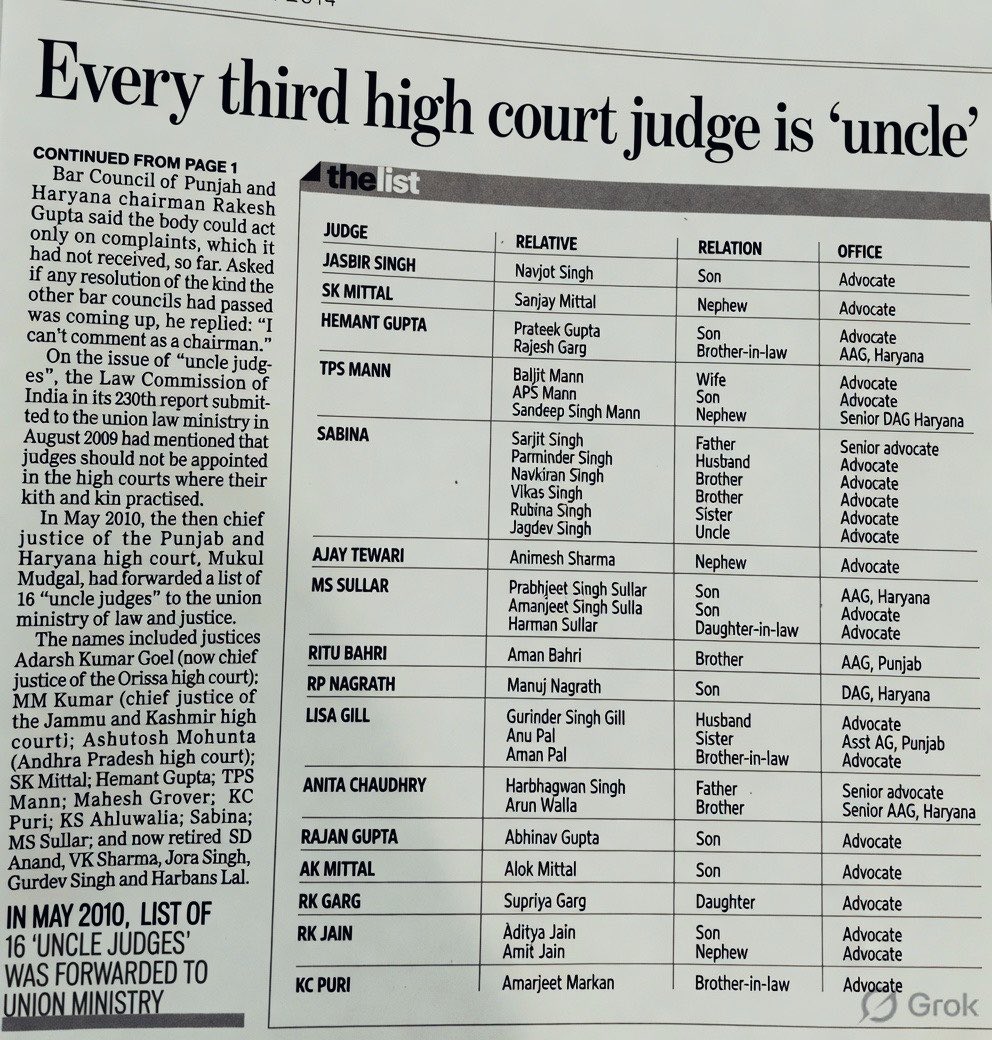
INDIA’S JUDICIARY: Every 3rd High Court Judge is an “Uncle”
This 2010 exposé on Punjab & Haryana High Court is damning proof of deep-rooted nepotism and shameless family favoritism.
Sons, nephews, wives, brothers, sisters & in-laws — all practicing as advocates in the SAME court where their relative sits as a Judge.
A list of 16 such “Uncle Judges” was officially forwarded to the Union Law Ministry.
Just look at this table. Clear, blatant conflict of interest. How the can justice be delivered fairly when family members argue cases before their own “Uncle”?
The Law Commission and Bar Council flagged this years ago. Nothing changed.
This uncle culture has destroyed public faith in the judiciary. Merit is dead. Nepotism rules.
We need ruthless reforms NOW:
- Ban close relatives from practicing in the same court
- Mandatory public declaration of family links
- Strict penalties for violations
Enough is enough. The temple of justice has become a family business.