As this video demonstrates, Trumpist foreign policy rightly understood is neither anti-globalist nor isolationist, but rather a “hemispherically focused reactionary counter-globalism.”
The Monroe Doctrine has shaped U.S. foreign policy for over two centuries. 🇺🇸
American dominance in the Western Hemisphere will never be questioned again.
Trump son-in-law Jared Kushner paid $120 million for a swath of coastal Albania to build a resort.
Problem is the seller is an Albanian gangster (based in Miami, of course), and the land belongs to a bunch of villagers. @WSJ uncovers this wild story: https://t.co/ZP4BrDsKTV
The simplest possible fact is this: China has broken a number of theoretical economic taboos, shown that they are wrong, and economics will have--whether it likes it or not-- to adjust to that & revise what it currently holds and teaches.
You cannot treat the most successful economic growth in the history of the world as an exception to the generally valid rules of economics.
How many cases a year are there of this? “A practice whereby some foreign billionaires allegedly pay surrogates to have their children on U.S. soil, then return them to China without ever setting foot in the United States themselves.” https://t.co/2F3fpV0iZx
Why does “standard economics have a problem incorporating this model” (China)?
Here’s the real answer you don’t hear: Because standard economics is benchmarked on fairy tales of Western development: clean, good institutions lead to wealth
And China keeps reminding us of the real Western history
BREAKING: A source close to Iranian officials says Tehran has documented a pattern of oil market manipulation tied to Axios reports and Trump administration insiders, including evidence of a $9 billion insider trading operation linked to Jared Kushner and Steve Witkoff.
Some of the documented timeline from the $9 billion insider profit:
Between April and May 2026, a series of suspiciously timed trades in oil futures markets preceded major Iran war announcements—each tied to reporting by Axios.
On March 23, approximately $500–580 million in shorts were placed 15 minutes before Trump announced he was postponing strikes on Iran. Oil dropped.
On April 7, roughly $950–960 million in shorts were placed hours before Trump announced a two-week ceasefire with Iran. Oil fell around 15 percent.
On April 17, around $760 million in shorts were placed 20 minutes before Iran's foreign minister announced the reopening of the Strait of Hormuz. Oil dropped.
On April 21, approximately $430 million in shorts were placed 15 minutes before Trump extended the ceasefire. Oil dropped again.
On May 6, nearly $920 million to $1.7 billion in crude oil shorts were placed approximately 70 minutes before an Axios scoop claimed the U.S. and Iran were near a "14-point agreement." Oil dropped 12 percent. Traders made an estimated $125 million. Iran called the report "the Americans' wish list."
Previously, a senior Iranian official told investigative outlet Drop Site News that Tehran privately warned JD Vance during Switzerland talks that Jared Kushner and Steve Witkoff were "abusing" negotiations—"more interested in exploiting insider knowledge to profit in financial markets than reaching a deal."
The Trump Administration has some serious explaining to do because there’s a ton of money missing and ZERO explanation for where it went.
It has collected an estimated $13 billion from Venezuelan oil sales.
Take a wild guess on how much of that is currently accounted for.
The answer is $300 million. That’s roughly 2.3 PERCENT.
And even that information came from the Venezuelan government, not the Trump Administration.
So where is the rest of the money?
https://t.co/OPx5hrZMrI
DEA analysts have found Trump's boat strikes on alleged drug trafficking boats have failed to affect the supply or price of cocaine in the United States, but instead have led traffickers to diversify. Deviant innovation: https://t.co/U7jBgeKJW1
"The targeted killings — and the highly choreographed positioning of the remains — were clearly a warning from organized crime, which, despite official denials, constitutes a kind of parallel government in many areas of Mexico" https://t.co/1XISfNJFAo
First known US case: American charged for using a “duress” password
Samuel Tunick, an Atlanta resident, is being prosecuted for allegedly giving border agents a passcode that wiped his phone.
The feature comes from GrapheneOS, a privacy-focused Android OS. Entering the duress code triggers a full factory reset.
This is believed to be the first time federal prosecutors have brought such charges.
The incident happened in January 2025 at Atlanta airport. Agents demanded access to his phone without a warrant, saying he hadn’t yet officially entered the US. When they entered the code, the phone wiped itself.
Tunick has pleaded not guilty. His lawyers argue the seizure was unlawful and that agents were investigating his activism against “Cop City.”
The case raises big questions about digital rights at the US border.
What do you think?
Article: https://t.co/tV806yWtyW
#Privacy #GrapheneOS #DigitalRights
Sébastien Jean and Jean-Pierre Landau: "In terms of welfare, European consumers should welcome cheap electric vehicles, batteries, and solar panels that are subsidized directly or indirectly by Chinese workers and taxpayers. But Europeans instead see them as a threat, which is rational from a dynamic perspective. Cheap imports may raise purchasing power today, but they can destroy the industrial base on which tomorrow’s income depends. The transfer is generous in the present, but costly in the future."
Jean and Landau are right, and they represent a real shift in the way the world understands trade, away from the complacent (some would even say condescending) neglect still favored by mainstream economists, to a deeper grasp of how trade imbalances allow countries that exert greater control over their external accounts to export their industrial policies (in reverse) to those of their trade partners with more open external accounts.
In a world in which some economies exert substantial control over their external accounts, in other words, while other countries don't, if the former decide to implement aggressive industrial policies, not only are they restructuring their own domestic economies, but they are also restructuring the domestic economies of the latter in a such a way as to accommodate their own economic needs.
Jean and Landau add: "A useful complement to this strategy is capital controls. Controls on outflows keep domestic savings at home, while restricting inflows prevents the economy from rebalancing from tradable to non-tradable sectors—the opposite of what the strategy aims to achieve. Capital inflows strengthen the currency, weaken exports, and support consumption. They accelerate domestic absorption before scale and learning are secured, thus impeding the pursuit of comparative advantage."
I agree, and this suggests that rather than encourage capital inflows, economies that want to strengthen their manufacturing and productive sectors and to benefit workers by raising productivity and wages should consider capital controls as a far more effective tool than tariffs. Unfettered financial inflows largely benefit the large banks and owners of movable capital at the expense of manufacturers and workers. They also force the economy to shift out of producing tradable goods (including manufacturing) and into non-tradable goods (real estate and services).
https://t.co/zaECptPGI7
Chinese models will dominate the world. US AI might survive behind a protective wall. Americans will end up paying a lot more for their AI, just like they do for meds, EVs, solar panels and drones.
"Flight records released by DOJ show that.... this shadow network spanned Europe, recruiting dozens, potentially more than a hundred women, who were transported to his properties in France, the UK, the US and the US Virgin Islands." https://t.co/3RK8xkw9VE
climate change comes for us all... even the plutocratic insurgency
"French authorities have ordered the evacuation of the entirety of the Cap Ferret peninsula on the south-west coast, with hundreds of people escaping by boat."
https://t.co/sZ845ybwUz
OpenAI said the ‘agent’ escaped a testing environment, gained internet access, stole login credentials and hacked into the start-up Hugging Face by itself — one of the first public examples of a cyber attack by an AI system acting outside human control. https://t.co/w3HGQ7zXoF
Putin
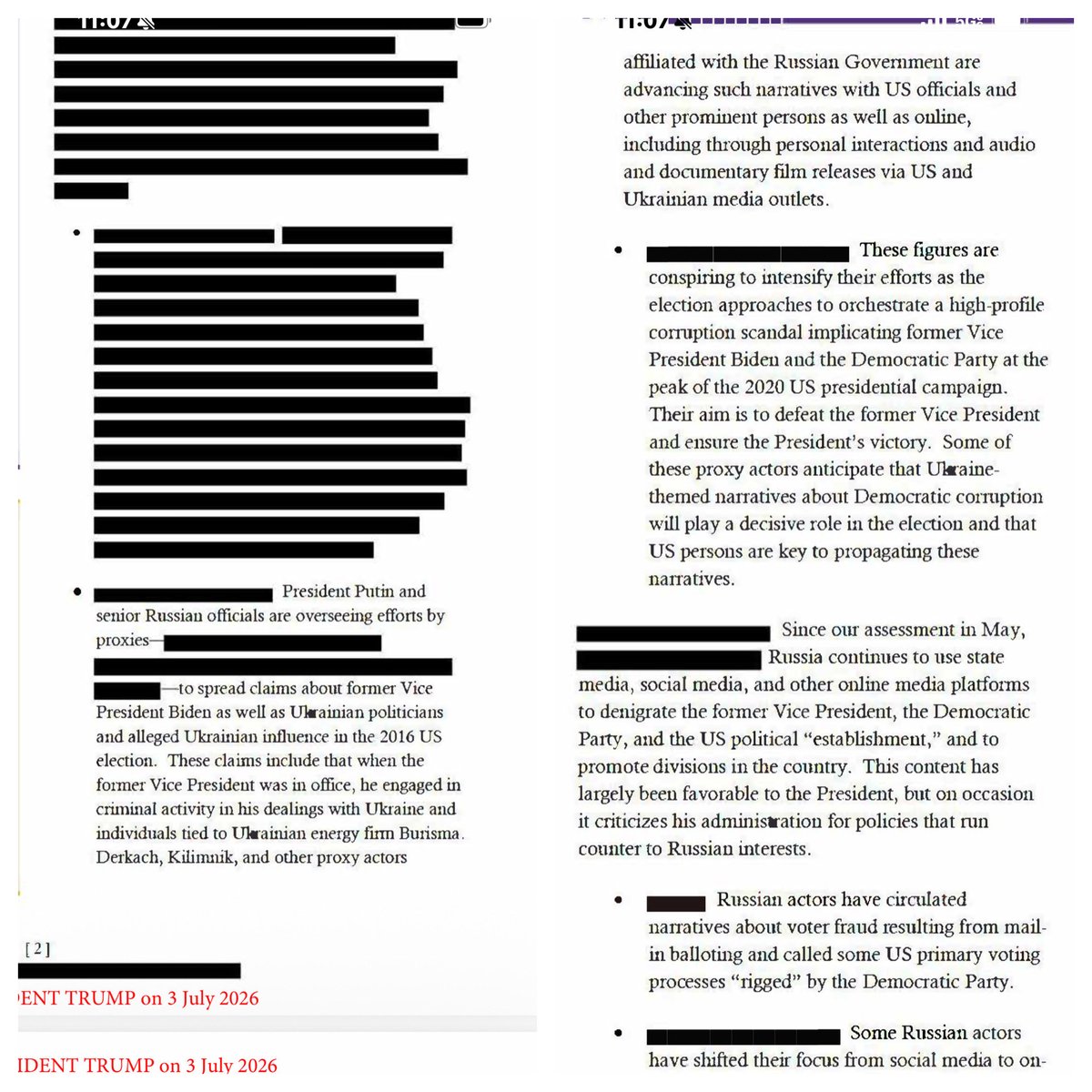
Last night Donald Trump released a declassified document that says his own intelligence community identified Putin as personally running an operation to defeat my father in 2020, built around a fake Burisma corruption scandal centered around me and executed through prominent Americans.
Trump tasked his personal lawyer, Rudy Giuliani, to fly to Kyiv and meet a known Russian agent.
The Americans who ran, laundered, and legitimized the operation:
Donald Trump. Rudy Giuliani. John Solomon. Joe DiGenova. Victoria Toensing. Lev Parnas. Igor Fruman. Chanel Rion. Sean Hannity. Steve Bannon. Miranda Devine. Ken Vogel. Ron Johnson. Chuck Grassley. James Comer. Jim Jordan.
To name a few.
An operation formally sanctioned by Trump's own Treasury Department on September 10, 2020, and expanded to include more named actors on January 11, 2021.
Oh, and don't forget the Russian-linked FBI informant Alexander Smirnov, who later pleaded guilty to making the entire Burisma bribery story up.
The record exists and we have all the receipts, and more.
Russian code is inside the White House app, which is now mandated on all government phones. The company behind the code is growing. Its founders bank at sanctioned Russian banks. And its accountant has a criminal history. My investigation:
Bessent says all the gold the U.S. Treasury has is worth “over a trillion dollars”; for perspective, that much gold at current prices would be about a 23 foot cube.