“…vocabulary-rich children arrive at school with a hidden cognitive advantage ... They have heard “ridiculous” and “extraordinary” and “investigation” at the dinner table, in bedtime stories, in the overheard conversations of articulate adults. Their minds have been silently sketching the spellings of hundreds of words they have never read..
“Children from language-poor environments arrive without those skeletons…
“It is a gap in prediction. And it compounds: the child who reads more easily reads more, hears more words in the context of text, forms more skeletons, and reads still more easily. The child who struggles reads less, encounters fewer new words, forms fewer skeletons, and falls further behind.”
That one neuron connects to about 7,000 others. Your brain has 86 billion of them. Do the math and you get somewhere around 100 trillion connections inside your head. More connections than stars in 1,500 galaxies.
And each connection point is way more complicated than anyone expected. A Stanford lab found that every single connection contains about 1,000 tiny switches that can store memories and process information at the same time. So your brain is running roughly 100 quadrillion switches right now, while you read this sentence.
The wild part is the power bill. Your brain runs on 20 watts. That’s less energy than the light in your fridge. The world’s fastest supercomputer needs 20 million watts to do the same amount of raw calculation. A million times more power for the same output.
We’re still nowhere close to understanding how any of this works. In October 2024, a team of hundreds of scientists finished mapping every single connection in a fruit fly’s brain. Took six years and heavy AI help. That fly brain had 140,000 neurons. Yours has 86 billion. Google and Harvard also mapped a piece of human brain last year, a speck smaller than a grain of rice. That speck alone contained 150 million connections and took 1,400 terabytes to store. The lead scientist said mapping a full human brain at that detail would produce as much data as the entire world generates in a year.
A tiny worm had its 302 brain cells mapped back in 1986. Almost 40 years later, scientists still can’t fully explain how that worm’s brain keeps it alive. Your brain has 86 billion of those cells, each one wired to thousands of others, each wire packed with a thousand switches, all of it humming along on less power than a lightbulb.
Let's check in on Gerald's water consumption.
Gerald woke up this morning and did the following:
6am - drank from his trough. Approximately 30 litres. In British beef cattle, this is 100% of Gerald's actual blue water use for the day.
6:15am - it rained on him. This has been counted in the statistics as Gerald consuming water. Gerald did not decide it would rain. Gerald did not apply for the rainfall. Gerald has not been asked whether he endorses the accounting methodology.
8am - Gerald ate grass. The grass required rainfall to grow. This rainfall has also been attributed to Gerald. The rain fell on the field in 1742 as well, when there was no spreadsheet.
10am - Gerald produced manure. The manure will go into the soil. The soil will grow more grass. The grass will need more rain. The rain will fall regardless of Gerald's continued employment on this farm.
Gerald's daily blue water use: about 30 litres. The same as a moderately long shower.
The headline figure: 15,000 litres per kilogram.
The gap between those two numbers is rain.
Gerald is not a drought. Gerald is what happens when you point rain at a field and give it a biological purpose.
This is, broadly, what farming is.
Here is a fact so perfectly constructed it seems like something a polemicist invented, except it is simply true and sitting in every etymology dictionary on the shelf.
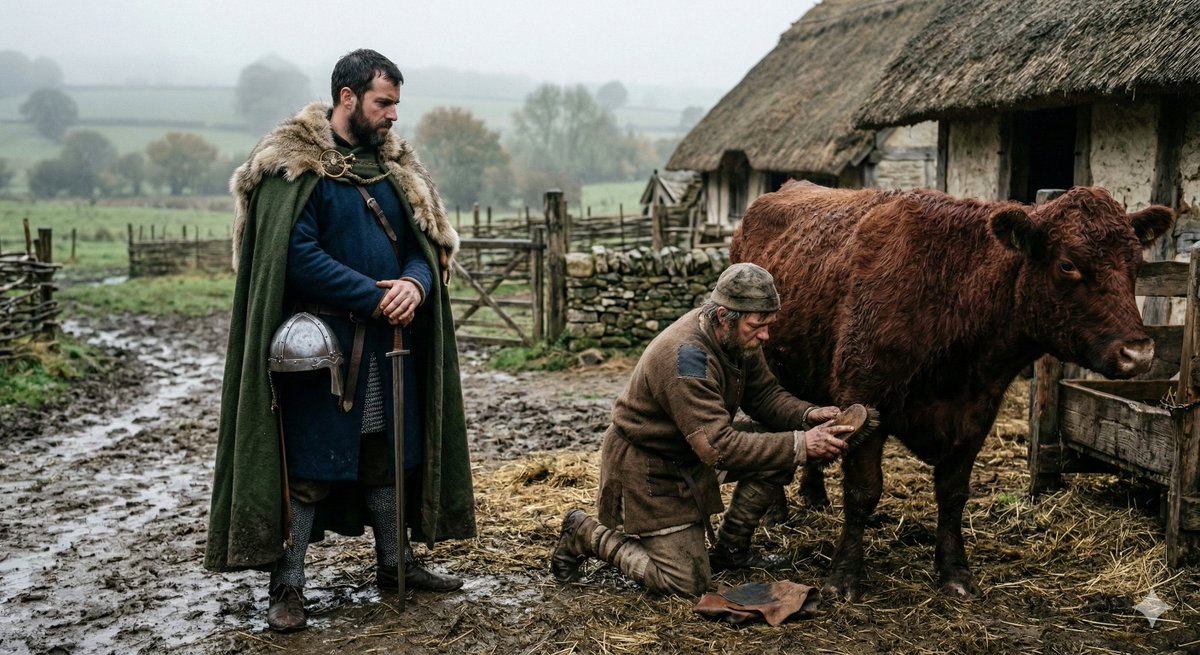
The Anglo-Saxon peasant kept a cow. He raised it, fed it, moved it to pasture, treated its ailments, watched it give birth, and if things went badly in winter made the decision about whether the family could afford to keep it. He called it a cu. It was his animal, his responsibility, his labour.
He did not eat it.
The Norman lord ate it. And he called it beef. From the Old French boeuf.
The Anglo-Saxon kept a pig. He called it a picga. The Norman ate it and called it pork, from porc.
The Anglo-Saxon kept sheep, which he called scep. The Norman ate them and called the meat mutton, from mouton.
The Anglo-Saxon watched deer move through the forest that had just been legally declared the king's personal property under the Forest Laws. He called them deor. The Norman hunted them and called the meat venison, from venaison.
The animal in the field has an Anglo-Saxon name because an Anglo-Saxon was looking after it.
The meat on the table has a French name because a Norman was eating it.
This division is sitting in plain sight in the English language and has been sitting there for nine hundred and fifty years, which is roughly the amount of time it has taken for anyone to notice that it tells you something important.
Walter Scott noticed it in 1819. He put it in Ivanhoe. The swineherd Gurth says to the jester Wamba: the swine is Saxon when he is kept and Norman when he becomes pork. The observation got filed as a colourful literary detail rather than as the class analysis of the food system that it actually is.
The language is the record. The record has been in every dictionary the whole time.
The Anglo-Saxon raised the food.
The Norman ate the food.
The English language has been commemorating this arrangement ever since.
I genuinely cannot believe this isn't in the national curriculum.
What utter garbage.
@Nanaakua1 is English and British
There is no room in any serious political party for ethnically based nationalism.
Yes the rate of demographic change is of huge concern
Yes mass migration combined with multiculturalism is undermining our national identity
Yes progressive discrimination is a disaster.
But Nana is English and British.
Ethno-nationalism is inherently un-British. It would lead our wonderful country into a very dark alley.
@jan_murray Ultrasounds require all sorts of timed prep: 4 hour fasts, full bladders, clamped catheters etc. 'Squeezing in' an extra patient to these lists is hard, estimating their waiting time is harder. We don't like to throw out guesses bc when it's wrong people kick off even worse 🤷♀️
Them: If you really wanted to eat like your ancestors and truly be a carnivore, you would hunt instead of buying beef and eggs.
Me: If you really wanted to "save the planet" by eating clean plant-based or vegan, you would grow all your own fruits, vegetables, rice, soy, wheat, corn, beans, nuts, and seeds instead of importing them from all over the world grown on big corporate monocropping farms that spray toxic pesticides and ruin the soil, water, and air.
The working class fought for decades for higher wages to afford meat.
"A chicken in every pot" was a promise of prosperity.
Now that meat is affordable, they tell you it's unhealthy and you should eat grains and beans instead.
They convinced you to voluntarily return to poverty rations.