The most expensive modernization project is the one that ships nothing for 18 months and then breaks on cutover day.
We see it all the time. A business runs on an aging https://t.co/0iAMyDsCBL app that still works. Someone proposes a full rewrite. The estimate doubles. The timeline triples. Tribal knowledge gets lost. Edge cases the old system handled silently start showing up as bugs in production.
There's a better path: modernize incrementally. Refresh the UI without touching the backend. Migrate to modern .NET piece by piece. Clean up the data access layer where it actually hurts. Each step delivers value. The business keeps running. Risk stays bounded.
That's what we do at devInstance. Assess, roadmap, execute, no flipping a switch on day one.
If your team is staring down a 'we have to rewrite this' conversation, talk to us first.
https://t.co/qfWXIAkQyL
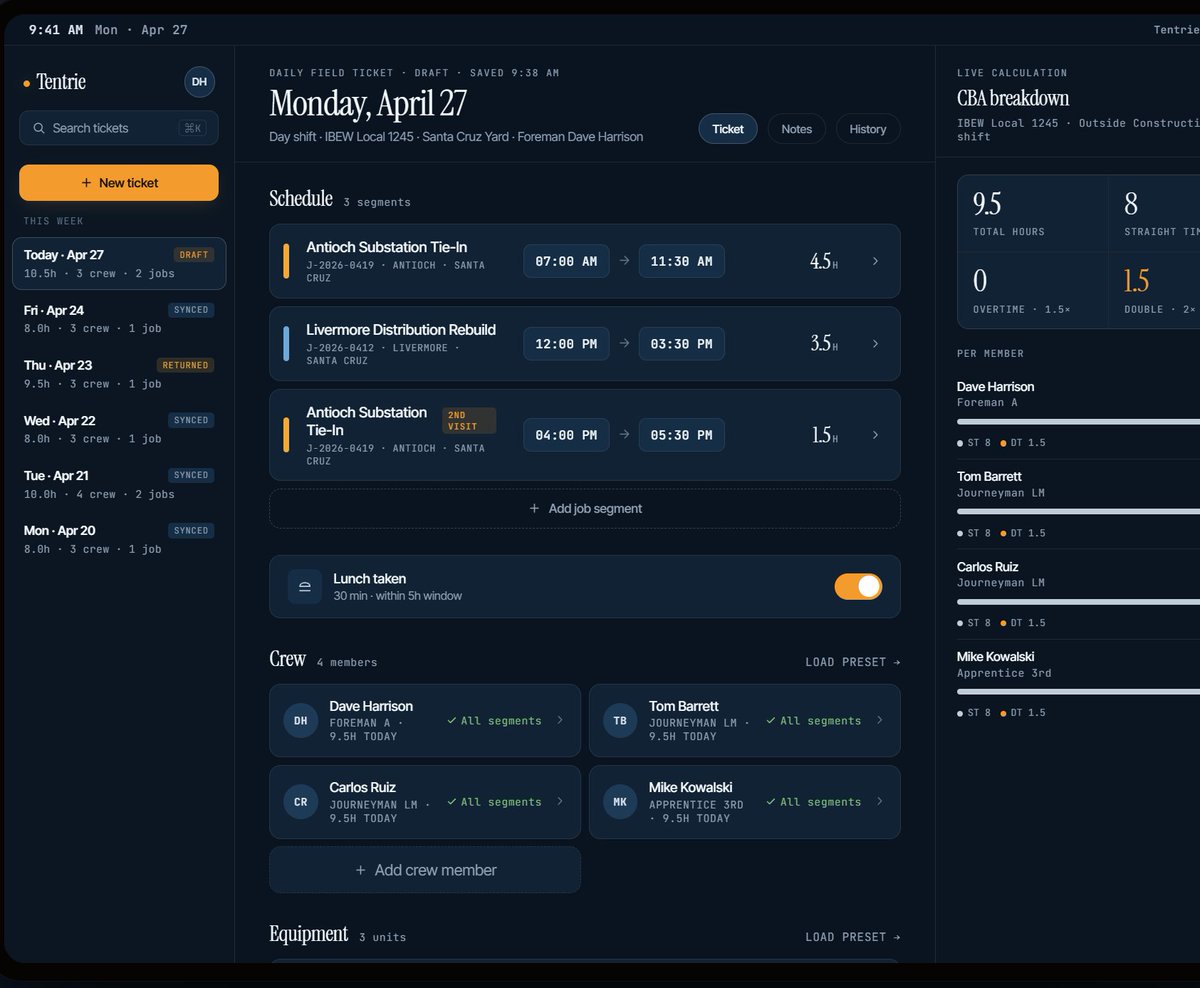
Over $200B of western US energy infrastructure is breaking ground through 2030. The contractors building it are still classifying CBA hours by hand on Friday afternoons.
Tentrie automates the classification at point of entry, on the daily field ticket.
https://t.co/OKnjT4c40p
4 AM trouble call. Crew rolls before sunrise. By end of day the ticket has shift differential, double time, subsistence, and a meal penalty. All four classified before it leaves the field.
That's what Tentrie does. For #IBEW/#NECA outside line contractors.
https://t.co/OKnjT4c40p
No payroll system classifies CBA hours at point of entry. Not Foundation. Not Sage. Not Viewpoint.
That's why we built Tentrie — a daily field ticket system where the CBA rules fire before the ticket ever leaves the field.
IBEW/NECA outside line contractors → https://t.co/xLbbgCRVHl
Your foremen are doing payroll math in the field. Your office staff is re-classifying hours from handwritten tickets.
We built Tentrie — CBA hour classification that fires automatically on every daily field ticket.
Built for IBEW/NECA signatory contractors.
https://t.co/xLbbgCRVHl
Should your SMB go all-in on AI? Not recklessly, but yes.
The models are ready. The tooling is still shifting. That's not a reason to wait. It's a reason to be strategic.
Start with pain points, not shiny tools. Keep humans in the loop. Iterate fast.
https://t.co/h9yxemY17i
#AI #SmallBusiness #SMB #DigitalTransformation #AIAdoption #BusinessStrategy #CustomSoftware
"We need to modernize. The market expects results in weeks, not months."
Everyone in the room nods. The meeting ends. Then it lands on the technology team, and things quietly fall apart.
Not because the team is slow. Because "modernize" means two completely different things depending on who is saying it, and most organizations never stop to sort out the difference.
And no, throwing AI at a 20-year-old system is not a shortcut. It is a recipe for expensive confusion.
We wrote about where this conversation goes wrong and what to do about it.
https://t.co/lHbhLyVmrz
Nobody's impressed by AI chatbots anymore. But when your 5-person shop can handle support tickets at 2am without burning out your team? That's the real flex. Let AI take the routine stuff. Keep humans for the hard conversations. #SMB#AIforBusiness#CustomerSupport#SmallBizTech
AI won't modernize a 20-year-old codebase on its own. The companies getting real results aren't using better tools. They're doing the prep work first — then letting AI do what it's actually good at. New post: https://t.co/y1sHlEeZoG
#AI adoption among small businesses jumped from 36% in 2023 to 57% in 2025. This is a 58% increase in two years. The average small business worker now saves 5.6 hours per week using AI, with managers saving more than 7 hours. Roughly two-thirds of organizations report saving between $500 and $2,000 per month through AI solutions. #SMB #Automation
Read more: https://t.co/pX28vf2ljr
Most SMB software problems aren't technology problems.
They're process problems hiding inside spreadsheets, email threads, and tools that were never meant to talk to each other.
When companies come to us, the story is usually the same. The business grew, but the internal systems didn't. So now everything runs on a patchwork of workarounds.
You know the signs:
- 5 to 10 spreadsheets to run a single process
- Manual data entry between systems that should talk to each other
- No real visibility into what's actually happening
- Reports that take hours to pull together
- SaaS tools that are 80% of what you need, forever
At some point the workarounds cost more than fixing the actual problem.
That's when it makes sense to build something that fits the business instead of bending the business to fit the software. Not another generic SaaS subscription. Not an enterprise platform with a two-year implementation. Just internal software built around how you actually operate.
If your team is spending more time managing the tools than doing the work, that's usually the sign.
Learn more: https://t.co/gHWuNRp1gs
#customsoftware #smb #erp #businesssystems #processautomation
Unpopular opinion: SaaS isn't dying. It's evolving. And most of the "SaaS is dead" takes are dangerously oversimplified.
The companies rushing to replace every SaaS subscription with a vibe-coded tool are building tomorrow's technical debt today. Nearly half of AI-generated code ships with security flaws. Context windows close, architectural knowledge vanishes, and maintenance becomes a nightmare.
I wrote an article about what actually changed in 2025, what the data says, and what SMB owners should actually do about it.
https://t.co/q8n50b1zXq
#SaaS #AI #SMB #SoftwareDevelopment #DigitalTransformation #VibeCoding
Bad ERP UX isn't just annoying - it's expensive.
Hidden costs pile up in workarounds, errors, and lost productivity. AI can help fix it without a full replacement.
Please read our blog about it: 👉 https://t.co/JH3imhHno2 #ERP#UX#UserExperience#DigitalTransformation #LegacyModernization #BusinessSoftware #SMB #CustomSoftware
I keep hearing two extremes from SMB owners:
1. "We need to go all-in on AI right now or we'll be left behind."
2. "It's all hype. We'll wait until the dust settles."
Both are wrong.
The first camp overspends on tools that become obsolete in 12 months. The second camp watches competitors compound small efficiency gains month after month until the gap is too wide to close.
The truth is more nuanced. The LLM models themselves are mature and delivering real value today. But the tooling around them, the integrations, workflows, and AI development platforms, is still evolving fast. What's state of the art today might need a rework next year.
So how should an SMB approach this? Start with pain points, not shiny tools. Run small experiments. Keep humans in the loop. And build with enough flexibility to adapt.
I put together a practical guide covering all of this:
https://t.co/Ds3HNw7X5s
#AI #SMB #DigitalTransformation #SmallBusiness #AIAdoption #BusinessStrategy #TechLeadership
Most #SMB owners say: "I don’t care how it’s built. I just need it working."
That mindset can cost you tens of thousands later. Software architecture determines whether your system survives growth or collapses under it.
I wrote a practical guide for business owners on how to protect themselves when building custom software.
Read here: https://t.co/Bmlk3nwEqW #softwarearchitecture #customsoftware #erp #businessgrowth
Custom Software Development. What does it mean? The term is so vague it probably should not be allowed.
Yet many of us still use it, including me, because I haven’t found a better, widely understood way to describe what we do.
Sure, I could say “Business Process Automation” or “Enterprise Software Development”... It sounds fancier, but does it actually add clarity?.. Not really.
I wrote an article about custom software development and what it means, at least what it means for my company.
It’s written for SMB owners who are weighing a decision between using SaaS or building their own solution.
The article explains the basics, where standard software works well, where it breaks down, and how to think about ROI before going custom
👉 https://t.co/bGGBgLY5KD
#CustomSoftware #SoftwareDevelopment #ERP #SMB
Why legacy systems persist longer than expected
Many legacy systems did not originate as long-term platforms.
Over time, these systems become deeply embedded in daily operations.
They accumulate business rules, approvals, reports, and edge cases that are rarely documented but critical to how the organization functions.
This is why full rewrites often fail.
The challenge is not the technology itself, but the operational knowledge encoded in the system.
A successful modernization approach focuses on risk reduction:
- Incremental replacement of independent modules
- Parallel operation of legacy and modern systems
- Gradual transition to modern .NET architectures
Legacy systems remain in place not because organizations resist change, but because these systems continue to run the business.
#LegacySystems
#SoftwareModernization
#DigitalTransformation
#DotNet
#EnterpriseSoftware
#CustomSoftware
If your ERP needs Excel exports, you don’t really have an ERP.
Companies buy an ERP, but real decisions still happen in spreadsheets.
Why?
Because the system:
- Can’t answer real operational questions
- Doesn’t match how the business actually works
- Lacks approvals, summaries, or edge-case logic
So data gets exported to Excel.
Filtered.
Emailed.
Discussed outside the system.
At that point, the ERP is just storage.
This doesn’t always mean “replace the ERP”.
Often the right move is custom extensions or purpose-built tools that close the gaps instead of fighting the core system.
Excel is fine.
But if it’s your decision engine, something upstream is missing.
👉https://t.co/HIveV8ohQ3